
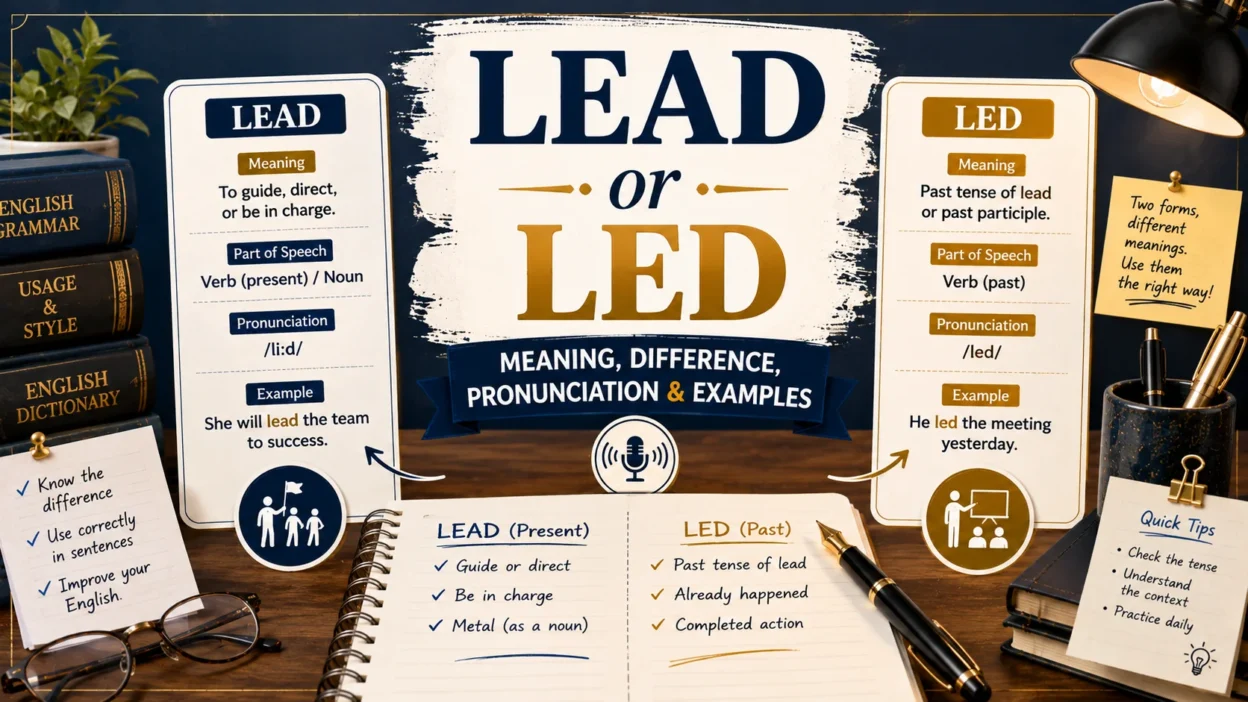
Lead or led is a common English word choice that can confuse even confident writers. The two words look similar, but they do not have the same grammatical role. Lead can be the present form of the verb meaning to guide or direct, while led is the past tense and past participle of that verb.
There is another reason this pair can be tricky: lead has two different pronunciations. When it means to guide or direct, it sounds like leed. When it refers to the metal, it sounds like led. The word led, however, is always pronounced like red or bed.
Understanding these differences will help you choose the right word in essays, emails, workplace writing, and everyday English.
Quick Answer
Use lead when you mean guide, direct, or be in charge in the present or future. Use led when that action happened in the past. For example, She will lead the team tomorrow, but She led the team yesterday. Lead can also mean the metal, which is pronounced like led.
Lead or Led: At a Glance
| Word | Meaning | Pronunciation | Example |
|---|---|---|---|
| Lead | Guide or direct | leed | She will lead the team. |
| Led | Past form of lead | led | She led the team yesterday. |
| Lead | A type of metal | led | The paint contained lead. |
The simplest rule is:
Lead = present or base form
Led = past form
However, remember that lead can also be a noun referring to the metal.
What Does Lead Mean?
Lead has several meanings, but one of its most common uses is as a verb meaning to guide, direct, manage, or take someone somewhere.
Lead as a Verb
When lead means guide or direct, it is pronounced like leed.
Examples:
- She will lead the meeting.
- He knows how to lead a team.
- The guide will lead us through the museum.
- Good managers lead by example.
- This road will lead you to the city center.
In these examples, lead describes an action of guiding or directing.
Lead for Being Ahead
Lead can also mean to be ahead in a race, competition, or situation.
Examples:
- Our team leads by three points.
- She leads the race.
- The company leads the market.
- He currently leads the competition.
Here, the word describes being in front or having an advantage.
Lead as a Noun
Lead can also function as a noun.
Examples:
- Our team has a five-point lead.
- She took the lead in the final lap.
- He played the lead role in the movie.
- The company has a strong lead over its competitors.
Depending on the sentence, lead can refer to an advantage, the main position, or a principal role.
What Does Led Mean?
Led is the past tense and past participle of lead when lead means to guide, direct, or manage.
Examples:
- She led the team last year.
- He led us through the forest.
- The manager led the meeting yesterday.
- They led the project successfully.
- Her example led many people to change their minds.
If the action happened in the past, led is the correct form.
Compare:
- Present: She leads the team.
- Past: She led the team.
Lead or Led: What’s the Difference?
The main difference is verb tense.
Lead is the base or present form of the verb.
Led is the past tense and past participle.
Compare:
- I lead the group every Monday.
- I led the group last Monday.
The first sentence describes a current or regular activity. The second describes something that happened in the past.
Another example:
- She will lead the discussion tomorrow.
- She led the discussion yesterday.
The future action uses lead, while the completed past action uses led.
Simple Formula
Present or base form → lead
Past form → led
Examples:
- We lead the project.
- We will lead the project.
- We led the project last year.
- We have led the project successfully.
Lead or Led Pronunciation
Pronunciation is one of the biggest reasons these words cause confusion.
Lead Meaning Guide
When lead means to guide or direct, it is pronounced like leed.
Examples:
- lead a team
- lead a meeting
- lead the way
- lead a project
It rhymes approximately with words such as need and feed.
Lead Meaning Metal
When lead refers to the metal, it is pronounced like led.
Examples:
- lead pipes
- lead paint
- lead exposure
- lead content
So the spelling stays the same, but the pronunciation changes according to meaning.
Led Pronunciation
Led is pronounced like bed, red, and fed.
Examples:
- She led the team.
- He led the way.
- They led the discussion.
The pronunciation of led does not change.
Lead or Led Examples
Seeing the words in similar sentences makes the distinction easier.
Example 1
She will lead the meeting tomorrow.
The meeting has not happened yet, so lead is correct.
She led the meeting yesterday.
The meeting already happened, so led is correct.
Example 2
The guide will lead us to the museum.
This describes a future action.
The guide led us to the museum.
This describes a completed action.
Example 3
He hopes to lead the company one day.
The action is expected or intended to happen in the future.
He led the company for ten years.
The leadership happened in the past.
When to Use Lead
Use lead when you are talking about the base form, present action, future action, or an action following certain auxiliary verbs.
Present Tense
- I lead the team.
- She leads the department.
- They lead the discussion.
Future Tense
- He will lead the project.
- She will lead the group tomorrow.
- We are going to lead the training session.
After To
Use lead after to when forming an infinitive.
- She wants to lead the team.
- He hopes to lead the project.
- They plan to lead the discussion.
After Modal Verbs
Use the base form lead after modal verbs.
- She can lead the team.
- He should lead the meeting.
- They might lead the project.
- We must lead by example.
When to Use Led
Use led when the action of guiding, directing, or managing happened in the past.
Examples:
- She led the company for five years.
- He led the team to victory.
- They led us through the mountains.
- The teacher led the discussion.
- His actions led to a major change.
You also use led with has, have, and had when forming perfect tenses.
Examples:
- She has led the team successfully.
- He had led several projects before becoming a manager.
- They have led the organization for years.
The past participle remains led in these constructions.
Common Mistakes With Lead and Led
Mistake 1: Using Lead for a Past Action
Incorrect:
She lead the team last year.
Correct:
She led the team last year.
The action happened in the past, so led is required.
Mistake 2: Using Led for a Present Action
Incorrect:
She led the team every Monday.
If you mean this is her current regular responsibility, use:
She leads the team every Monday.
Mistake 3: Writing Lead Instead of Led After Have
Incorrect:
They have lead the project successfully.
Correct:
They have led the project successfully.
After have or has, use the past participle led.
Mistake 4: Confusing the Verb With the Metal
These sentences use the same spelling but different meanings:
- The captain will lead the team.
- The old pipes contain lead.
In the first sentence, lead means guide and is pronounced leed.
In the second, lead refers to the metal and is pronounced led.
Lead vs Led in Different Tenses
Understanding the verb forms makes the difference much easier.
| Tense or Form | Example |
|---|---|
| Base form | I lead the team. |
| Present | She leads the team. |
| Past | She led the team. |
| Infinitive | She wants to lead the team. |
| Present perfect | She has led the team. |
| Past perfect | She had led the team. |
| Future | She will lead the team. |
| Present participle | She is leading the team. |
Notice that led is specifically the past and past-participle form, while lead is the base form.
Lead or Led in Real-World English
In Workplace Writing
Use lead for a current or future responsibility:
- Maria will lead the marketing project.
- James leads the sales department.
Use led when describing previous work:
- Maria led the marketing project last year.
- James led the department before becoming director.
In Academic Writing
Examples:
- The researcher leads the study.
- The previous researcher led the study.
- The evidence may lead to a different conclusion.
- The findings led to further research.
In Everyday Conversation
Examples:
- Can you lead the way?
- Who led you there?
- This road will lead to the station.
- Her advice led me to a better decision.
Lead, Led, and Leading
It is also useful to understand the related forms of the verb.
Lead is the base form.
Leads is the third-person singular present form.
Led is the past tense and past participle.
Leading is the present participle.
Examples:
- I lead the team.
- She leads the team.
- She led the team last year.
- She is leading the team today.
This pattern can help prevent tense-related mistakes.
Easy Way to Remember Lead or Led
Use this simple rule:
Lead = now or later
Led = already happened
Think of a timeline:
Today: She leads the team.
Yesterday: She led the team.
Tomorrow: She will lead the team.
Another useful reminder is that led is the only past-tense spelling of the verb lead.
Do not write lead when you mean the past form of the verb.
Is Lead a Homophone?
Lead is unusual because its pronunciation changes depending on its meaning.
When it means to guide or direct, it sounds like leed.
When it means the metal, it sounds like led.
The word led, meaning the past tense of lead, is pronounced like red.
This makes lead a heteronym rather than simply a word with one fixed pronunciation.
Frequently Asked Questions
Is it lead or led in the past tense?
The correct past tense of lead is led.
For example:
She led the team last year.
Is it lead or led in the present tense?
Use lead for the base form and leads with he, she, or it.
Examples:
I lead the team.
She leads the team.
Is led the past tense of lead?
Yes. Led is both the past tense and past participle of lead when lead means to guide, direct, or manage.
How do you pronounce lead?
It depends on the meaning. Lead meaning guide is pronounced like leed. Lead meaning the metal is pronounced like led.
How do you pronounce led?
Led is pronounced like bed, red, or fed.
Is lead a noun or a verb?
It can be both. As a verb, lead can mean guide or direct. As a noun, it can refer to an advantage, a leading position, a principal role, or the metal, depending on context.
Which is correct: lead by example or led by example?
Use lead by example for the base or present form and led by example when describing a past action.
Examples:
Good managers lead by example.
She led by example throughout her career.
Why is lead pronounced differently from led?
The word lead has two different meanings with different historical origins, so its spelling is shared even though the pronunciations differ. The verb lead is pronounced like leed, while the metal lead is pronounced like led.
Final Takeaway
The difference between lead and led is mainly about verb tense. Use lead as the base or present form when someone guides, directs, or manages something. Use led when that action happened in the past.
The pronunciation creates another layer of confusion. Lead meaning guide is pronounced leed, while lead meaning the metal is pronounced led. The word led, as the past form of the verb, is always pronounced led.
A simple way to remember the verb forms is: lead now, led before. Once you connect the spelling with the tense and meaning, this commonly confused pair becomes much easier to use correctly.

Miles Ellington enjoys exploring the subtle differences that can completely change how a word or phrase is understood. At Differology, he turns confusing language questions into straightforward explanations, covering word comparisons, vocabulary, grammar, usage, and everyday English.
With a practical and reader-focused approach, Miles uses real-world examples and clear comparisons to help readers choose the right word, understand its meaning, and communicate more precisely.