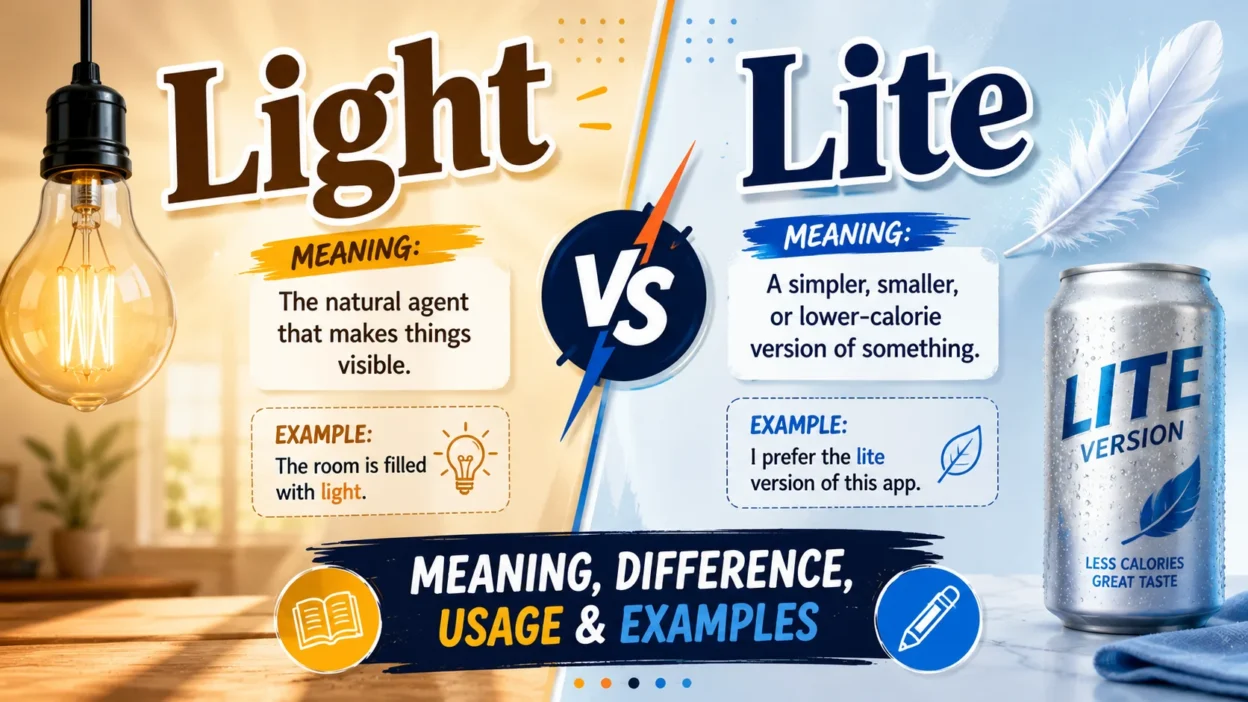
Light vs lite is a common English word-choice question because the two words are closely related but are not normally used in the same situations. Light is the standard English word with many meanings, including brightness, low weight, a pale color, and something that is not heavy or intense. Lite is a shortened spelling mainly used in names, branding, advertising, and informal product descriptions.
For example, we normally write light meal, light jacket, and light weight when using standard English. However, you may see lite in phrases such as lite beer, lite version, or a product marketed as lite.
The key is not simply to treat lite as a spelling variation of light. In modern English, lite has a much narrower purpose and often gives a word a commercial, simplified, or informal feel.
Light vs Lite: The Quick Difference
Light is the standard and much more widely used English word.
Lite is a nonstandard or informal spelling commonly used in advertising, product names, menus, and branding to suggest something reduced, simplified, or lower in calories or features.
Compare:
- This bag is light.
- This is a lite version of the software.
- I ordered a light meal.
- The menu offers lite options.
The first and third examples use standard English. The second and fourth use lite as a marketing-style spelling.
What Does Light Mean?
Light has many meanings and can function as a noun, verb, adjective, and adverb.
Light as a Noun
As a noun, light can mean something that makes it possible to see.
Examples:
- Turn on the light.
- The room was filled with natural light.
- A bright light appeared in the distance.
- The street lights came on at sunset.
Light as an Adjective
Light can describe something that is not heavy.
Examples:
- This bag is very light.
- I need a light jacket.
- The box is surprisingly light.
- She carried a light backpack.
Light can also describe something that is not strong, severe, or intense.
Examples:
- We had a light rain.
- He ate a light lunch.
- The exercise was light.
- She has a light workload today.
Light as a Verb
As a verb, light can mean to make something start burning or to illuminate something.
Examples:
- Please light the candle.
- He lit the fire.
- The lamp lights the room.
Its past forms can be lit or lighted, depending on the context.
What Does Lite Mean?
Lite is a simplified spelling of light that is mainly used in commercial, informal, or branded contexts.
It often suggests that something has:
- Fewer calories
- Less fat or sugar
- Fewer features
- A simpler design
- A reduced intensity
- A lighter version of a product
Examples:
- The restaurant offers a lite menu.
- Try the lite version of the app.
- The company released a lite edition.
- This product is marketed as a lite option.
Unlike light, lite is not the normal spelling to use throughout standard formal English.
Light vs Lite: Main Differences
| Light | Lite |
|---|---|
| Standard English spelling | Alternative/informal spelling |
| Used in everyday English | Mostly used in branding and marketing |
| Has many meanings | Usually suggests a reduced or simplified version |
| Can be a noun, verb, adjective, or adverb | Mostly appears as a modifier |
| Appropriate in formal writing | Usually less suitable for formal writing |
| Example: light meal | Example: lite menu |
| Example: light bag | Example: lite version |
When to Use Light
Use light when you are writing standard English and mean something related to weight, brightness, color, intensity, food, or another established meaning.
1. Light for Weight
- This suitcase is light.
- The material is extremely light.
- I prefer light shoes for traveling.
2. Light for Food
- I had a light breakfast.
- We ordered a light dinner.
- She prefers light snacks.
3. Light for Color
- She wore a light blue dress.
- The walls are painted light gray.
- He chose a light shade of green.
4. Light for Intensity
- We had light rain.
- The traffic was light this morning.
- The exercise was fairly light.
In all these cases, light is the normal spelling.
When to Use Lite
Use lite when the spelling is deliberately being used to communicate a reduced, simplified, or marketed version.
Lite in Food and Drinks
You may see lite on product packaging or menus.
Examples:
- lite beer
- lite dressing
- lite mayonnaise
- lite snacks
In these contexts, lite often communicates a marketing claim or product category rather than ordinary descriptive English.
Lite in Technology
Technology companies sometimes use lite to describe a version of software with fewer features or lower resource requirements.
Examples:
- lite version
- lite app
- lite edition
- lite mode
For example:
The company released a lite version of its application.
Here, lite suggests that the product is a reduced or simplified version.
Light vs Lite in Food
Food is one of the areas where people commonly see lite.
Compare:
Light meal
This is standard English and means a meal that is not heavy or substantial.
Lite meal
This may appear on a menu as a marketing label suggesting a reduced-calorie or modified option.
Similarly:
- light beer is standard descriptive English.
- Lite beer may appear as a product or brand-style name.
The important point is that lite often appears because a company intentionally chooses that spelling.
Light vs Lite in Technology
The technology industry frequently uses lite to label simplified products.
Examples:
- Lite app
- Lite browser
- Lite version
- Lite edition
- Lite mode
In this context, lite commonly suggests fewer features, smaller size, or lower resource requirements.
For example:
The Lite version uses less storage.
Here, the capitalized spelling may be part of the product’s official name.
In formal writing, however, do not automatically replace light with lite. Use the spelling that belongs to the actual product or brand.
Light vs Lite Examples
Example 1
Correct: I packed a light bag for the trip.
Here, light means not heavy.
Example 2
Correct: The company launched a lite version of its software.
Here, lite suggests a simplified version.
Example 3
Correct: We had a light lunch.
This means the lunch was not heavy or substantial.
Example 4
Correct: The restaurant introduced a lite menu.
Here, lite is being used as a marketing-style label.
Example 5
Correct: She chose a light blue shirt.
You would not normally write lite blue in standard English.
Light vs Lite for Formal Writing
In formal writing, light is usually the safer choice.
For example:
- The company introduced a lightweight product.
- The report recommends a light meal before exercise.
- The room receives plenty of natural light.
- The fabric is light and breathable.
Use lite only when it is part of a proper name, brand, product title, or deliberate marketing language.
For example:
The company launched its Lite Edition.
If that is the official product name, retaining Lite is appropriate.
Light vs Lite in Branding
Brands often use lite because it feels shorter, modern, casual, or commercially appealing.
You may encounter names such as:
- Lite Edition
- Lite Plan
- Lite Mode
- Lite App
- Lite Package
The spelling can communicate that the product has been reduced or simplified.
This is one reason lite continues to appear even though light is the standard spelling.
Is Lite a Correct Word?
Yes, lite is a recognized English spelling, but its use is restricted compared with light.
It is most commonly found in:
- Product names
- Brand names
- Advertising
- Packaging
- Menus
- Informal descriptions
- Technology products
It should not automatically replace light in ordinary writing.
For example:
Standard:
She carried a light bag.
Not:
She carried a lite bag.
However:
Download the Lite version.
can be correct if Lite is part of the product’s name.
Is Lite Just a Shorter Spelling of Light?
Historically and functionally, lite is associated with a simplified spelling of light, but modern usage gives it a specialized role.
In ordinary English, light remains the standard spelling.
Lite often signals that the word is being used in a commercial, informal, or product-specific way.
So the two words are related, but they are not interchangeable in every sentence.
Common Mistakes With Light and Lite
Mistake 1: Using Lite in Standard Writing
Incorrect:
I bought a lite jacket.
Better:
I bought a light jacket.
If you mean that the jacket is not heavy, use light.
Mistake 2: Using Lite for Colors
Incorrect:
She wore a lite pink dress.
Correct:
She wore a light pink dress.
For colors, light is the standard spelling.
Mistake 3: Using Lite for General Weight
Incorrect:
This box is very lite.
Correct:
This box is very light.
Use light when referring to physical weight.
Mistake 4: Assuming Lite Is Always More Casual
Lite is not simply a casual replacement for light. It usually has a particular commercial or branding purpose.
Light vs Lite Memory Trick
A simple way to remember the difference is:
Light = standard English
Lite = marketing, branding, or reduced version
Think:
Light is the normal word.
Lite is the special spelling.
If you are unsure which one to use in ordinary writing, light is usually the correct choice.
Light vs Lite: More Examples
| Sentence | Correct Word | Why |
|---|---|---|
| This bag is very ___ | light | Refers to weight |
| I want a ___ lunch | light | Refers to a less heavy meal |
| She wore ___ blue | light | Refers to color |
| The rain was ___ | light | Refers to intensity |
| Turn on the ___ | light | Refers to illumination |
| Download the ___ version | lite | Reduced product version |
| Try our ___ menu | lite | Marketing-style label |
| The product is called ___ Edition | Lite | Official product name |
| This jacket is ___ | light | Refers to weight |
| The app has a ___ mode | lite | Simplified mode |
Related Words: Lightweight and Lightened
It is also useful to distinguish light from related forms.
Lightweight
Lightweight means having relatively little weight.
Example:
The laptop is lightweight and easy to carry.
Lightened
Lightened means made lighter or less intense.
Examples:
The designer lightened the color.
The mood was lightened by the joke.
These words should not be replaced with lite simply because they relate to something being lighter.
Frequently Asked Questions
What is the main difference between light and lite?
Light is the standard English word with many meanings. Lite is mainly used in branding, advertising, product names, menus, and informal descriptions to suggest something reduced or simplified.
Is lite a correct spelling?
Yes, lite is an established spelling, but it has a much narrower use than light. It is commonly used for products, brands, and marketing language.
Should I write light or lite?
Use light in normal English. Use lite when it is part of a product name, brand, menu label, or deliberate marketing term.
Is it light beer or lite beer?
Both spellings can appear, but light beer is standard descriptive English, while Lite is commonly used in product and brand names.
Is it light version or lite version?
Light version is standard English when you are simply describing something as lighter. Lite version is common when a company intentionally labels a simplified or reduced product that way.
Is light or lite correct for color?
Use light.
For example:
She wore a light blue dress.
Is light or lite correct for weight?
Use light.
For example:
This suitcase is very light.
Is lite more informal than light?
Not exactly. Lite is mainly associated with branding, advertising, product descriptions, and simplified versions. It is not simply an informal spelling that can replace light everywhere.
Final Thoughts
The difference between light vs lite is mainly about standard usage and context. Light is the normal English word and can describe brightness, weight, color, intensity, food, and many other ideas. Lite is a specialized spelling most often used in advertising, branding, menus, and product names to suggest something reduced, simplified, or modified.
A useful rule is simple: use light in normal English and lite when the spelling is deliberately part of a product, brand, or marketing term.
For example, write light jacket, light meal, and light blue. But if a company calls its simplified software the Lite Edition, keep the official spelling. Knowing this distinction will help you choose the right form without treating lite as a universal replacement for light.

Miles Ellington enjoys exploring the subtle differences that can completely change how a word or phrase is understood. At Differology, he turns confusing language questions into straightforward explanations, covering word comparisons, vocabulary, grammar, usage, and everyday English.
With a practical and reader-focused approach, Miles uses real-world examples and clear comparisons to help readers choose the right word, understand its meaning, and communicate more precisely.