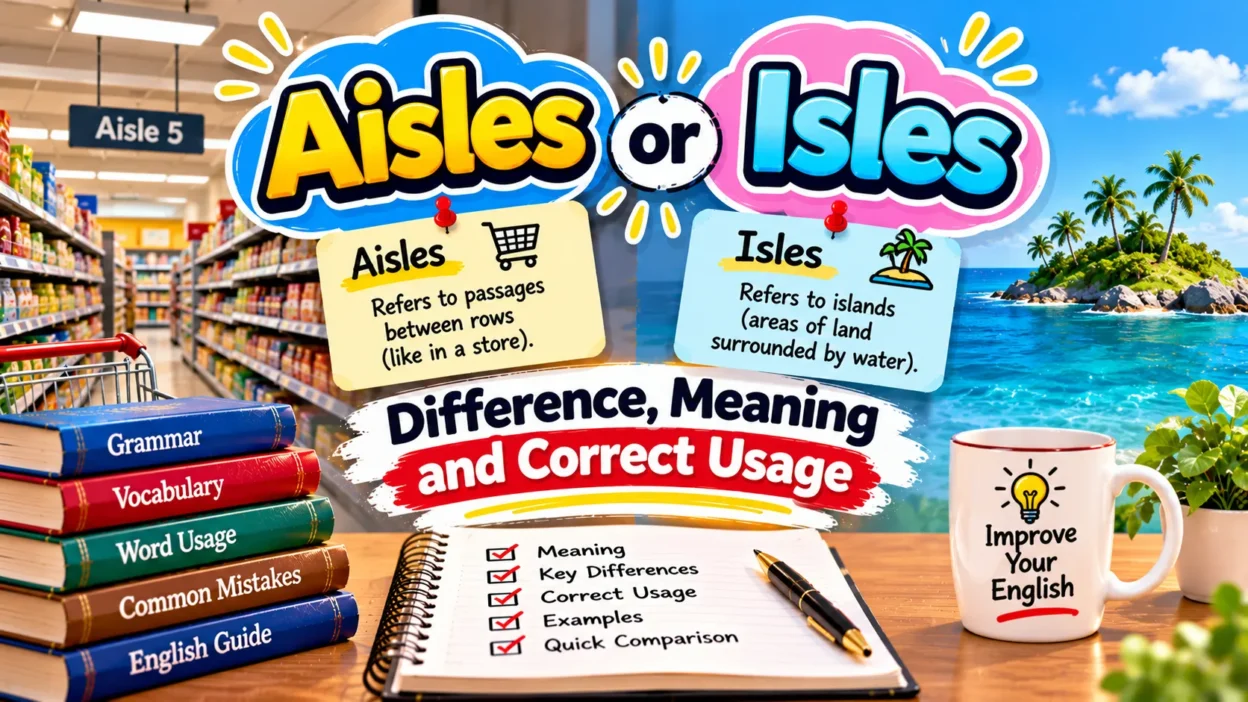
Choosing between aisles and isles can be surprisingly difficult, even for confident English writers. Both words are pronounced identically, yet they describe entirely different things. One refers to the passages people walk through in buildings, while the other refers to islands surrounded by water.
This distinction matters in everyday communication, academic writing, professional content, and creative storytelling. A single spelling mistake can change the meaning of a sentence, making it confusing or inaccurate. Understanding how these words function will help you use them naturally and recognize them in different contexts.
The key is to remember that aisles are walkways, whereas isles are islands. Their pronunciation may be the same, but their meanings, spelling patterns, and typical uses are not.
Aisles vs. Isles: The Essential Difference
Although these words sound alike, they belong to different semantic contexts. Aisles describes spaces designed for movement between rows, while isles describes geographical landforms surrounded by water.
| Feature | Aisles | Isles |
|---|---|---|
| Singular form | Aisle | Isle |
| Meaning | Passages or walkways | Islands |
| Pronunciation | /aɪlz/ | /aɪlz/ |
| Common contexts | Shops, aircraft, churches, theaters | Geography, travel writing, literature |
| Example | The shoppers walked through the aisles. | The sailors approached the distant isles. |
The surrounding words usually provide enough information to identify the intended meaning. References to shopping, seating, or movement generally indicate aisles. References to oceans, coastlines, or isolated landmasses point toward isles.
Understanding this distinction is more useful than relying on pronunciation alone because spoken English does not reveal which spelling the speaker intends.
Aisles: Meaning, Origins, and Practical Usage
An aisle is a passage that allows people to move between rows of seats, shelves, pews, or other objects. The plural form, aisles, refers to more than one such passage.
Aisles are common in buildings designed for shopping, transportation, entertainment, education, and public gatherings. Their primary purpose is to provide access and movement while keeping separate rows or sections organized.
The word also appears in several established expressions, including aisle seat, center aisle, and walk down the aisle. These expressions retain the basic idea of a passage but may develop additional meanings through common usage.
Where You Commonly Encounter Aisles
Retail stores and supermarkets
In supermarkets, aisles separate shelves containing different categories of products. Shoppers move through these passages to locate groceries, household supplies, personal care products, and other necessities.
Example: “The store reorganized its aisles to make popular products easier to find.”
Airplanes and public transportation
An airplane aisle separates seating sections and provides access to passenger seats. Similar arrangements appear in coaches, trains, and other transportation settings.
Example: “Please keep the aisle clear while passengers are boarding.”
Churches, theaters, and event venues
Aisles provide routes through rows of seats or pews, helping attendees reach their places without unnecessarily disturbing others.
Example: “The guests stood beside the aisle as the wedding ceremony began.”
Libraries and educational buildings
Libraries use aisles to create access between bookshelves, while classrooms and lecture halls may have aisles between seating sections.
Example: “The librarian placed the new collection along the main aisle.”
These examples illustrate a consistent pattern: whenever a sentence describes a passage between rows or sections, aisle or aisles is generally the appropriate choice.
Expressions That Give Aisle a Broader Meaning
The word aisle also appears in expressions whose meanings are not limited to physical walkways.
- Walk down the aisle: Commonly means to get married or participate in a wedding ceremony.
- Aisle seat: A seat beside a passage, often preferred by people who want easier access.
- Across the aisle: In politics, refers to cooperation between people from different political parties.
- Right down your aisle: A less common variation of the expression “right up your alley,” meaning something particularly suited to someone’s interests or abilities.
For example, “The two lawmakers reached an agreement across the aisle” uses aisle figuratively rather than describing a physical passage.
Recognizing these expressions helps writers avoid mistakes when the word appears in familiar phrases rather than straightforward descriptions.
Isles: Meaning, Origins, and Literary Significance
An isle is an island, and isles is its plural form. An island is an area of land completely surrounded by water and smaller than a continent under conventional geographical definitions.
Unlike aisle, which is widely used in practical, everyday contexts, isle often has a literary, poetic, historical, or descriptive quality. Writers may choose it to evoke remote destinations, natural beauty, exploration, or a sense of timelessness.
For example, “The travelers discovered a chain of peaceful isles beyond the reef” communicates the presence of islands while creating a more evocative tone than the straightforward phrase “a chain of islands.”
The word is not restricted to poetry, however. It also appears in geographical names, traditional expressions, tourism materials, and historical descriptions.
How Isles Appears in Different Contexts
Geography and travel: Writers may use isles when describing groups of islands, particularly in scenic or promotional writing.
Example: “The region’s scattered isles attract visitors interested in wildlife and coastal landscapes.”
Literature and storytelling: The word frequently suits stories involving exploration, mythology, isolation, or imaginary worlds.
Example: “According to the legend, the enchanted isles appeared only beneath the full moon.”
Historical and cultural references: Certain familiar names and expressions preserve the word because of established tradition.
Example: “The poem celebrates the landscapes and traditions associated with the Emerald Isle.”
Familiar Expressions Involving Isle
The Emerald Isle
This is a traditional nickname for Ireland, inspired by its famously green landscape. The word isle is correct because the expression refers to an island.
The British Isles
This geographical term refers to a group of islands that includes Great Britain, Ireland, and many smaller islands. Because the term can carry political sensitivities, particularly in Ireland, writers should consider whether a more precise geographical name would better suit their subject.
Deserted isles
This expression describes islands without permanent inhabitants and commonly appears in adventure stories, travel narratives, and imaginative descriptions.
These examples demonstrate that isle is not merely an alternative spelling of aisle. It has its own meaning and stylistic associations.
Why Aisles and Isles Are Homophones
Aisles and isles are examples of homophones: words that share the same pronunciation but have different meanings and spellings.
English contains many such pairs because its spelling system reflects different historical influences, pronunciation changes, and word origins. Consequently, the relationship between spelling and sound is not always straightforward.
Other familiar homophone pairs include sea and see, flour and flower, and right and write. Like these pairs, aisles and isles require readers to interpret the surrounding context.
Consider the following sentences:
- “The shoppers searched the aisles for discounted products.”
- “The explorers mapped the remote isles.”
When spoken aloud, the words sound identical. In writing, however, their surrounding nouns and verbs establish two completely different situations.
This is why spell-checking software may not catch the mistake. Both spellings are legitimate English words, so an automated checker may accept the sentence even when the writer has selected the wrong one.
How to Choose the Correct Word in Real Writing
The most reliable way to distinguish aisles from isles is to identify what the sentence describes. Rather than memorizing isolated spelling rules, consider the subject, setting, and intended meaning.
Use aisle or aisles when describing:
- A passage between supermarket shelves.
- A walkway between seats in an airplane or theater.
- A passage between pews in a church.
- A route used by people moving between rows.
- The walkway associated with a wedding ceremony.
Use isle or isles when describing:
- An island or several islands.
- Remote land surrounded by water.
- Island groups in literary or descriptive passages.
- Traditional geographical expressions such as the Emerald Isle.
- Imaginary islands in myths, novels, and adventure stories.
Compare the Meaning, Not Just the Spelling
The following examples show how changing one letter can alter a sentence’s meaning.
| Incorrect or intended meaning | Correct sentence |
|---|---|
| Shopping passages | The employees cleaned the store aisles. |
| Islands | The sailors visited several distant isles. |
| Wedding walkway | She walked down the aisle with her father. |
| Ireland’s nickname | Ireland is traditionally known as the Emerald Isle. |
| Airplane passage | The passenger placed his bag beneath the seat rather than in the aisle. |
The lesson is straightforward: the correct spelling depends on the meaning you intend to express, not on how the word sounds.
Common Errors and How to Avoid Them
Even when writers know the definitions, these words can be confused during fast typing, editing, or proofreading.
Confusing Store Aisles With Isles
Incorrect: “I couldn’t find the cereal in the grocery store isles.”
Correct: “I couldn’t find the cereal in the grocery store aisles.”
A grocery store contains passages between shelves. The correct word is aisles.
Misspelling the Wedding Expression
Incorrect: “The couple walked down the isles during their ceremony.”
Correct: “The couple walked down the aisle during their ceremony.”
The familiar expression refers to a walkway, not an island.
Using Aisles to Describe Island Destinations
Incorrect: “The tourists spent a week exploring the beautiful aisles.”
Correct: “The tourists spent a week exploring the beautiful isles.”
Because the sentence refers to islands, isles is the appropriate word.
Relying Entirely on Spell-Checking Tools
A spelling checker may recognize both words as valid English vocabulary without identifying whether either one fits the sentence. Writers should therefore review meaning and grammar, not simply accept every word that passes an automated spelling check.
A useful editing technique is to replace the disputed word temporarily with its definition. If the sentence still makes sense with “walkways,” use aisles. If it makes sense with “islands,” use isles.
A Short Practice Test
Choose the correct word for each sentence. The answers appear below the questions.
- The passengers waited beside the airplane ______ before boarding.
- The explorers sailed toward several distant ______.
- The supermarket’s narrow ______ made it difficult to pass other shoppers.
- Ireland is traditionally known as the Emerald ______.
- The bride walked down the ______ toward the ceremony’s front.
Answers:
- Aisle
- Isles
- Aisles
- Isle
- Aisle
Each answer follows the same principle: passages require aisle, while islands require isle.
Frequently Asked Questions
What is the main difference between aisles and isles?
Aisles are passages between rows of shelves, seats, or other objects. Isles are islands surrounded by water. Although the words sound identical, their meanings and spellings are different.
Are aisles and isles pronounced identically?
Yes. Both are generally pronounced /aɪlz/ in English. They are homophones, so context is necessary to determine which spelling is correct.
Is it aisle or isle at a wedding?
The correct word is aisle. The expression “walk down the aisle” commonly refers to getting married or walking toward the front of a wedding ceremony.
Should I write aisles or isles when talking about a supermarket?
Use aisles. Supermarket aisles are the passages between rows of shelves where customers walk to find products.
Can isle be used as a synonym for island?
Yes. Isle means island, although it often sounds more literary, traditional, or poetic than the everyday word island.
Why does spell-checking sometimes miss this error?
Both words are correctly spelled English words. A spell-checker may not recognize that the chosen word is inappropriate for the sentence’s meaning, so proofreading remains important.
Which word is used in the phrase “Emerald Isle”?
The correct word is isle. “The Emerald Isle” is a traditional nickname for Ireland.
Are aisles and isles singular or plural?
Aisle and isle are singular forms. Aisles and isles are their respective plural forms.
Conclusion
The difference between aisles and isles becomes clear once you connect each word with its meaning. Aisles are passages used for movement, while isles are islands surrounded by water. Their identical pronunciation makes them easy to confuse, but their contexts are distinct.
For accurate writing, remember the setting of your sentence. Shops, aircraft, theaters, and wedding ceremonies usually call for aisle or aisles. Islands, coastal landscapes, and traditional expressions such as the Emerald Isle call for isle or isles.
This simple distinction will help you avoid common spelling mistakes and communicate your intended meaning clearly in everyday, academic, and professional writing.

Miles Ellington enjoys exploring the subtle differences that can completely change how a word or phrase is understood. At Differology, he turns confusing language questions into straightforward explanations, covering word comparisons, vocabulary, grammar, usage, and everyday English.
With a practical and reader-focused approach, Miles uses real-world examples and clear comparisons to help readers choose the right word, understand its meaning, and communicate more precisely.