
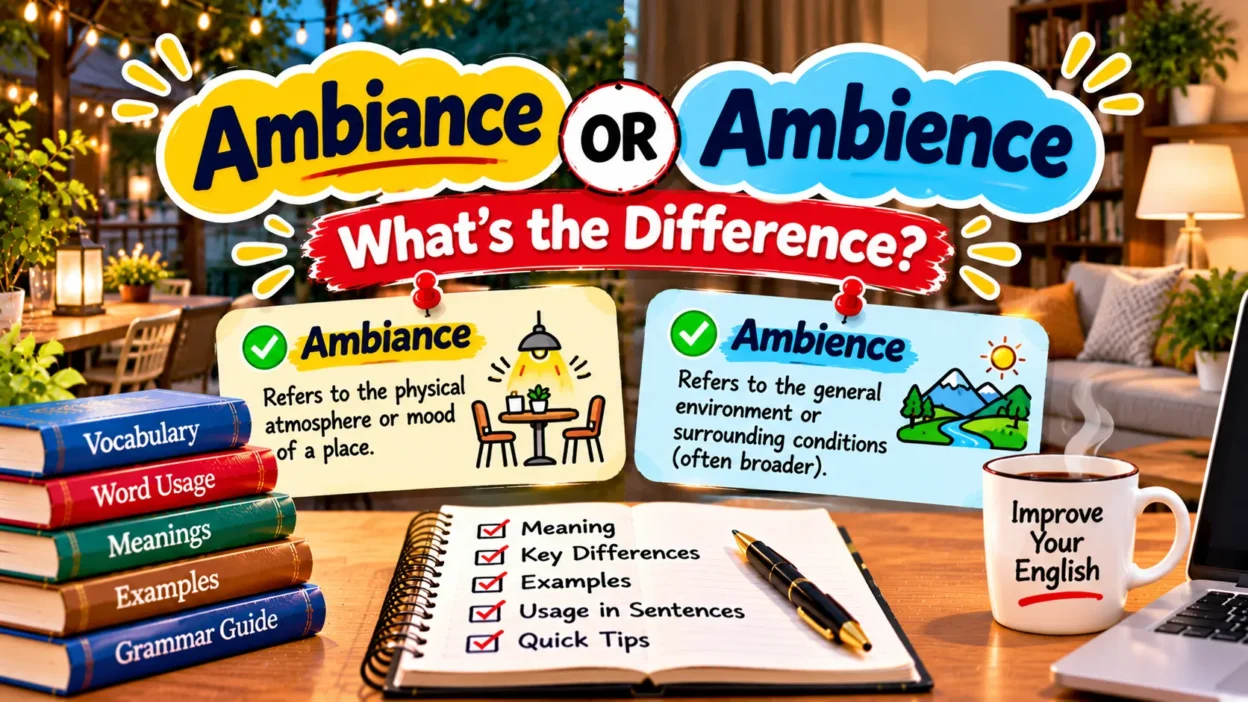
Ambiance or ambience is a common spelling question because both words look almost identical and carry exactly the same meaning. Whether you’re describing a cozy restaurant, a peaceful garden, a luxurious hotel, or a romantic evening, you may wonder which spelling is correct. The good news is that both forms are acceptable English words. The main difference comes down to regional spelling preferences rather than meaning or pronunciation.
In American English, ambiance is generally the preferred spelling, while ambience is traditionally more common in British English. Both words describe the overall atmosphere, mood, or character of a particular place or setting. They can refer to the feeling created by lighting, music, furniture, decoration, colors, sounds, and other surroundings. Understanding this small spelling difference can help you write more confidently, especially when creating content for a particular English-speaking audience.
Whether you’re writing a restaurant review, describing a hotel, preparing a business presentation, or publishing a lifestyle blog, choosing the right spelling helps maintain consistency. In this guide, you’ll learn the meanings of ambiance and ambience, their regional differences, pronunciation, grammatical usage, sentence examples, synonyms, common mistakes, and practical tips for choosing the correct form.
⚡ Quick Answer: Ambiance or Ambience?
Both ambiance and ambience are correct spellings of the same noun. They describe the atmosphere, mood, or overall feeling of a place. The distinction is mainly regional: American English generally favors ambiance, whereas British English traditionally favors ambience.
| Comparison | Ambiance | Ambience |
|---|---|---|
| Correct spelling | Yes | Yes |
| Meaning | Atmosphere or mood | Atmosphere or mood |
| Part of speech | Noun | Noun |
| American English | Preferred | Also understood |
| British English | Also used | Traditionally preferred |
| Pronunciation | Same | Same |
| Example | A romantic ambiance | A romantic ambience |
Remember this simple rule: Use ambiance when writing primarily for American readers and ambience when following traditional British English conventions. Both forms communicate the same idea.
📖 What Does Ambiance Mean?
Ambiance is a noun that describes the overall atmosphere, mood, or character of a place. It refers to the feeling people experience when they enter or spend time in a particular environment. This feeling can come from several details working together, including lighting, music, colors, furniture, temperature, decoration, and even the behavior of people in the surroundings.
For example, a restaurant with warm lighting, comfortable seating, soft music, and attractive decorations may create a cozy ambiance. A hotel with elegant furniture, beautiful artwork, and quiet surroundings may have a luxurious ambiance. The word does not describe just one physical object; instead, it expresses the combined impression created by the entire environment.
In American English, ambiance is the more familiar spelling. Writers commonly use it in restaurant reviews, travel articles, interior design descriptions, hospitality content, and everyday conversations.
Examples of ambiance in sentences:
- The restaurant has a warm and welcoming ambiance.
- Soft lighting creates a romantic ambiance in the dining room.
- We enjoyed the peaceful ambiance of the countryside hotel.
- The café’s modern decorations give it a stylish ambiance.
- Gentle music added a relaxing ambiance to the evening.
- The wedding venue had a beautiful ambiance that impressed every guest.
- Natural light gives the living room a fresh and cheerful ambiance.
- The luxury resort offers an elegant ambiance for its visitors.
In each sentence, ambiance describes the overall feeling of a place rather than one individual feature.
🇬🇧 What Does Ambience Mean?
Ambience is a noun that means the same thing as ambiance. It describes the general atmosphere, mood, or character of a location or setting. The word helps communicate how a particular environment feels to the people who experience it.
Imagine entering a small coffee shop with wooden tables, soft background music, warm lights, and the smell of freshly brewed coffee. You might describe the place as having a comfortable ambience. Similarly, a quiet library may have a peaceful ambience, while a brightly decorated party venue may have a lively ambience.
The spelling ambience is traditionally preferred in British English. It is widely understood in other English-speaking regions too, so readers can recognize it regardless of their location.
Examples of ambience in sentences:
- The café has a relaxing ambience that encourages customers to stay longer.
- The hotel combines modern furniture with a traditional ambience.
- Soft candles create a romantic ambience for dinner.
- The garden has a peaceful ambience during the early morning.
- The restaurant’s welcoming ambience makes it popular with families.
- The music and decorations contribute to the festive ambience.
- Visitors appreciate the calm ambience of the seaside resort.
- The old building has a charming ambience that reflects its history.
The meaning remains unchanged if you replace ambience with ambiance. The choice simply reflects the spelling convention you prefer.
🔍 Ambiance vs. Ambience: What Is the Difference?
The difference between ambiance and ambience is primarily a matter of spelling preference. Both words have the same definition, pronunciation, grammatical role, and general usage. Neither spelling is grammatically incorrect, and neither represents a different type of atmosphere.
The distinction becomes more noticeable when you consider regional writing conventions. American publications generally use ambiance, while British publications traditionally use ambience. However, you may encounter both spellings in international writing, books, websites, and business materials.
| Feature | Ambiance | Ambience |
|---|---|---|
| Definition | Overall atmosphere or mood | Overall atmosphere or mood |
| Spelling style | American preference | British preference |
| Pronunciation | /ˈæm.bi.əns/ | /ˈæm.bi.əns/ |
| Word type | Noun | Noun |
| Plural form | Ambiances | Ambiences |
| Common context | US lifestyle and hospitality writing | UK lifestyle and hospitality writing |
| Example | The ambiance feels welcoming. | The ambience feels welcoming. |
Here is the easiest way to understand the difference: If you’re writing an article for an American website, choose ambiance. If you’re following a British publisher’s spelling preferences, choose ambience. You do not need to change the sentence structure or meaning when switching between them.
🇺🇸 Is Ambiance American or British English?
Ambiance is generally the preferred spelling in American English. It is commonly used in the United States when people describe the atmosphere of restaurants, hotels, homes, offices, and entertainment venues.
American writers often choose this spelling because it follows the conventions used by many US dictionaries and publications. You will frequently see it in restaurant reviews, travel guides, interior design articles, and hospitality descriptions.
Consider these American English examples:
- The restaurant’s ambiance makes it ideal for date night.
- We chose the hotel because of its peaceful ambiance.
- The modern ambiance attracts young professionals.
- Warm decorations give the dining room a comfortable ambiance.
- The coffee shop has a friendly ambiance that makes visitors feel welcome.
Although ambience is also understood and accepted by American readers, ambiance is generally the safer choice for content specifically targeting a US audience.
🇬🇧 Is Ambience British or American English?
Ambience is traditionally associated with British English. Writers in the United Kingdom commonly use this spelling when describing the atmosphere or mood of a place.
British publications may prefer ambience because it follows their established spelling conventions. You can find the word in descriptions of restaurants, historic buildings, gardens, hotels, theaters, and other environments.
Consider these British English examples:
- The restaurant is famous for its elegant ambience.
- The hotel has a peaceful ambience throughout the day.
- The garden offers a relaxing ambience for visitors.
- The traditional furniture creates a charming ambience.
- Soft lighting gives the room a warm ambience.
However, British English does not make ambiance incorrect. Both forms are recognized, but ambience is the traditional regional preference.
🗣️ How Do You Pronounce Ambiance and Ambience?
Ambiance and ambience have the same pronunciation, even though their spellings differ. Both are commonly pronounced AM-bee-uhns.
| Word | Pronunciation | Syllables |
|---|---|---|
| Ambiance | AM-bee-uhns | 3 |
| Ambience | AM-bee-uhns | 3 |
The stress falls on the first syllable, AM. The remaining syllables follow naturally without a major change in sound.
Pronunciation tips:
- Start with the short sound “AM.”
- Follow it with “bee.”
- Finish with “uhns.”
- Keep the strongest emphasis on the first syllable.
Because both words sound alike, you cannot identify their spelling preference simply by hearing someone say them. You need to consider the written context or the regional English convention.
📝 Ambiance and Ambience in Different Contexts
Both spellings work naturally in almost any situation where you want to describe a place’s atmosphere. The context does not change the meaning, although certain environments make the word especially useful.
🍽️ Restaurant and Café Descriptions
Restaurants often use ambiance or ambience to describe the experience customers enjoy beyond the food. Lighting, seating arrangements, music, interior design, and background noise all contribute to the atmosphere.
Examples:
- The restaurant’s cozy ambiance makes it perfect for family dinners.
- Soft jazz creates a sophisticated ambiance in the dining area.
- The café has a welcoming ambience that attracts regular customers.
- Beautiful decorations give the restaurant a romantic ambiance.
- The outdoor seating area offers a refreshing ambience.
🏨 Hotel and Travel Writing
Travel writers use these words to describe the feeling of hotels, resorts, guesthouses, and vacation destinations. A location may feel luxurious, peaceful, rustic, lively, or welcoming depending on its design and surroundings.
Examples:
- The boutique hotel has a luxurious ambiance.
- Guests appreciate the peaceful ambience of the mountain resort.
- The seaside hotel offers a relaxed ambiance for vacationers.
- Traditional architecture gives the property a historic ambience.
- The resort’s tropical ambiance makes every stay memorable.
🏡 Home and Interior Design
Interior designers often describe ambiance when discussing how different design choices affect a room. Furniture, wall colors, lighting, curtains, artwork, and decorative accessories can all influence the overall atmosphere.
Examples:
- Warm lighting creates a cozy ambiance in the bedroom.
- Neutral colors give the living room a calming ambience.
- Indoor plants add a natural ambiance to the space.
- Minimalist furniture creates a clean and modern ambiance.
- Decorative lamps bring a welcoming ambience to the room.
💍 Weddings and Special Events
Weddings, birthday parties, celebrations, and formal gatherings often depend on the atmosphere created by decorations and lighting. Ambiance or ambience can describe whether an event feels romantic, festive, elegant, or intimate.
Examples:
- Fairy lights created a magical ambiance at the wedding.
- Fresh flowers added a romantic ambience to the reception.
- The elegant decorations gave the venue a luxurious ambiance.
- Music and lighting created a cheerful ambience at the birthday party.
- The candlelit dinner had a beautiful ambience.
🏢 Workplace and Office Environments
These words can also describe the overall feeling of a workplace. An office with natural lighting, comfortable furniture, and friendly colleagues may have a positive ambiance. A quiet workspace may create a focused ambience.
Examples:
- Natural light gives the office a pleasant ambiance.
- The friendly team creates a welcoming ambience.
- Comfortable seating contributes to a relaxed ambiance.
- The modern office has a professional ambience.
- A quiet environment creates a productive ambience.
🔄 Ambiance vs. Ambience: Examples in Different Sentence Structures
Understanding how a word works in different sentence structures makes it easier to use correctly. Since ambiance and ambience are nouns, they can function as subjects, direct objects, and objects of prepositions.
| Sentence Structure | Ambiance Example | Ambience Example |
|---|---|---|
| As a subject | The ambiance makes the café special. | The ambience makes the café special. |
| As an object | We loved the ambiance. | We loved the ambience. |
| After a preposition | The room is known for its ambiance. | The room is known for its ambience. |
| With an adjective | It has a peaceful ambiance. | It has a peaceful ambience. |
| In a longer description | The ambiance reflects the restaurant’s style. | The ambience reflects the restaurant’s style. |
More examples:
- The ambiance of the library encourages quiet study.
- A pleasant ambience can make customers feel comfortable.
- We selected the venue for its beautiful ambiance.
- The hotel is popular because of its relaxing ambience.
- Good lighting can improve the ambiance of a room.
- The peaceful ambience helped us unwind after a busy day.
- The restaurant’s ambiance matches its creative menu.
- The garden’s natural ambience makes it a lovely place to relax.
These examples show that both spellings follow the same grammatical patterns.
🌟 Synonyms for Ambiance and Ambience
If you want to avoid repeating ambiance or ambience throughout an article, you can use several related words. The best alternative depends on the meaning you want to communicate.
| Synonym | Meaning | Example |
|---|---|---|
| Atmosphere | The overall feeling of a place | The atmosphere was welcoming. |
| Mood | The emotional feeling created by a setting | The lighting changed the mood. |
| Environment | The surroundings or conditions | The environment felt peaceful. |
| Character | The distinctive quality of a place | The hotel has a unique character. |
| Feeling | The general impression something creates | The room had a cozy feeling. |
| Vibe | The informal impression of a place | The café has a friendly vibe. |
| Setting | The surroundings in which something happens | The setting was perfect for dinner. |
| Aura | A distinctive quality or impression | The building has a mysterious aura. |
| Tone | The general character or atmosphere | The decorations established a festive tone. |
| Spirit | The characteristic feeling of a place or event | The celebration captured the spirit of the season. |
Although these words are related, they are not always interchangeable. For instance, atmosphere is usually the closest general synonym, while vibe is more informal and aura can suggest a distinctive or almost intangible quality.
⚠️ Common Mistakes When Using Ambiance or Ambience
Even though the spelling difference is simple, writers sometimes make mistakes when choosing or using these words. Understanding the following points can help you avoid unnecessary errors.
1. Thinking One Spelling Is Incorrect
Both spellings are accepted. Ambiance is not a misspelling of ambience, and ambience is not an incorrect version of ambiance.
Incorrect assumption: Ambience is always wrong in American English.
Correct understanding: Ambience is understood and accepted, although ambiance is generally preferred in the United States.
2. Assuming the Words Have Different Meanings
Some writers believe ambiance describes a physical setting while ambience describes an emotional atmosphere. That distinction is not correct. Both words can describe the overall feeling of a location.
Example:
- The restaurant has a romantic ambiance.
- The restaurant has a romantic ambience.
Both sentences communicate the same idea.
3. Mixing Both Spellings in the Same Article
Using both forms in one article can make your writing appear inconsistent. Choose the spelling that matches your target audience and use it throughout the content.
For an American audience, use ambiance consistently. For a British audience, ambience may be the more appropriate choice.
4. Using Ambiance as an Adjective
Ambiance and ambience are nouns, not adjectives. You should not use them directly to describe another noun as if they were adjectives.
Incorrect: The restaurant has an ambiance atmosphere.
Better: The restaurant has a welcoming atmosphere.
Better: The restaurant has a pleasant ambiance.
5. Confusing Ambiance With Decoration
Ambiance does not mean decoration alone. Decorations can contribute to a place’s atmosphere, but ambiance includes the combined effect of many elements.
For example, a restaurant’s ambiance may come from its lighting, music, staff behavior, seating, cleanliness, and overall design.
6. Forgetting Regional Consistency
A writer may begin an article using ambiance and later switch to ambience. Although both are correct, this inconsistency can distract readers.
Choose one spelling based on your publication’s preferred English variety and keep it consistent.
💡 How to Create a Better Ambiance in a Room
The word ambiance is especially useful in interior design because it describes the overall feeling of a room. You can improve a room’s ambiance by adjusting several elements rather than relying on one decorative feature.
Here are some practical ideas:
- Choose suitable lighting: Use warm lighting to create a cozy and relaxing atmosphere.
- Select comfortable furniture: Arrange seating to make the room feel inviting.
- Add natural elements: Indoor plants and flowers can make a space feel fresh.
- Use complementary colors: Choose colors that support the mood you want to create.
- Play soft background music: Gentle music can make a room feel more peaceful.
- Reduce unnecessary clutter: A clean and organized space often feels more comfortable.
- Add personal decorations: Photographs, artwork, and meaningful objects can give a room character.
- Consider natural light: Open curtains and let daylight brighten the space.
- Use pleasant fragrances: Subtle scents can contribute to the overall experience.
- Maintain comfortable temperatures: A room should feel pleasant, not too hot or too cold.
These elements work together to shape the ambiance of a home, office, restaurant, or other environment.
📚 Ambiance or Ambience: Which Spelling Should You Choose?
The right spelling depends on your audience, publication, and preferred English style. Neither option is universally correct for every region, so consider where your readers are based before making a decision.
| Writing Situation | Recommended Spelling |
|---|---|
| American blog post | Ambiance |
| US restaurant review | Ambiance |
| American business website | Ambiance |
| British newspaper article | Ambience |
| UK lifestyle magazine | Ambience |
| British travel guide | Ambience |
| International English content | Follow the publication’s style guide |
| Academic writing | Follow the required style guide |
If you publish content for US readers, ambiance is the practical choice. It is familiar to American audiences and aligns with the spelling preference commonly used in US English.
For British readers, ambience is a natural option. However, consistency matters more than switching between the two forms without a clear reason.
🧠 Practice Quiz: Ambiance or Ambience?
Test your understanding by choosing the spelling that best fits each sentence. For this exercise, assume the writing follows American English conventions.
Choose the correct option:
- The restaurant has a beautiful ______ that makes guests feel welcome.
- A. Ambiance
- B. Ambience
- Warm lighting creates a romantic ______ in the dining room.
- A. Ambience
- B. Ambiance
- We enjoyed the peaceful ______ of the mountain hotel.
- A. Ambiance
- B. Ambience
- The café’s modern ______ attracts many young customers.
- A. Ambience
- B. Ambiance
- The wedding venue had an elegant ______.
- A. Ambiance
- B. Ambience
- Soft music improved the ______ of the evening.
- A. Ambience
- B. Ambiance
- The garden offers a relaxing ______ during the summer.
- A. Ambiance
- B. Ambience
- The hotel is famous for its luxurious ______.
- A. Ambience
- B. Ambiance
✅ Answer Key
| Question | Answer | Explanation |
|---|---|---|
| 1 | A. Ambiance | American English preference |
| 2 | B. Ambiance | American English preference |
| 3 | A. Ambiance | American English preference |
| 4 | B. Ambiance | American English preference |
| 5 | A. Ambiance | American English preference |
| 6 | B. Ambiance | American English preference |
| 7 | B. Ambiance | American English preference |
| 8 | B. Ambiance | American English preference |
Important: Both options are grammatically correct in every question. The answer key selects the preferred American English spelling, not the only acceptable spelling.
❓ Frequently Asked Questions About Ambiance or Ambience
1. Is ambiance or ambience correct?
Both ambiance and ambience are correct English spellings. They have the same meaning and pronunciation. Ambiance is generally preferred in American English, while ambience is traditionally preferred in British English.
2. Is ambiance American or British?
Ambiance is the more common spelling in American English. However, British English also recognizes and uses it. The spelling ambience is traditionally more common in the United Kingdom.
3. Is ambience British or American?
Ambience is traditionally associated with British English. It is also understood by American readers, but ambiance is generally the preferred US spelling.
4. Do ambiance and ambience mean the same thing?
Yes. Both words describe the atmosphere, mood, or overall character of a place. For example, a restaurant can have a peaceful ambiance or a peaceful ambience without any change in meaning.
5. How do you pronounce ambiance and ambience?
Both words are pronounced AM-bee-uhns, with the strongest stress on the first syllable. Their different spellings do not create a pronunciation difference.
6. Which spelling should I use in the United States?
Use ambiance when writing for an American audience. It is the more familiar and commonly preferred spelling in US English.
7. Which spelling should I use in the United Kingdom?
Ambience is traditionally preferred in British English. However, ambiance is also recognized, so follow the spelling conventions of your publisher or organization.
8. Is ambiance a noun or an adjective?
Ambiance is a noun. It names the overall atmosphere or feeling of a place. Words such as cozy, peaceful, romantic, and welcoming can describe the ambiance.
9. What is the plural of ambiance?
The plural form of ambiance is ambiances. Similarly, the plural form of ambience is ambiences. Both forms follow the regular English plural pattern.
10. Can I use ambiance in formal writing?
Yes. Ambiance is appropriate in formal and informal writing. You can use it in academic discussions, professional articles, restaurant reviews, business descriptions, and travel content.
11. What is another word for ambiance?
Atmosphere is one of the closest synonyms for ambiance. Other alternatives include mood, environment, character, feeling, vibe, and aura. Choose an alternative based on the exact meaning you want to express.
12. Is ambience a French word?
Both spellings are related to the French word ambiance, which refers to atmosphere or environment. English uses both ambiance and ambience as accepted spellings.
13. Can I use ambiance and ambience interchangeably?
Yes. You can use them interchangeably because their meanings are identical. However, maintaining one spelling throughout a document helps keep your writing consistent.
14. Is ambiance the preferred spelling for SEO content targeting the US?
Ambiance is generally the more suitable spelling for content targeting American readers. Use it naturally in your title, headings, and body text when it matches your target keyword. Avoid forcing both spellings into the article simply to repeat variations.
15. Does ambiance refer only to a physical place?
No. Although the word most commonly describes the atmosphere of a physical location, it can also describe the overall feeling of an event or setting. For example, you can discuss the ambiance of a wedding, celebration, dinner, or social gathering.
🎯 Conclusion: Ambiance or Ambience?
The choice between ambiance or ambience is simple once you understand their regional spelling preferences. Both words are correct, have the same pronunciation, and describe the atmosphere, mood, or overall character of a place. The difference is not in their meaning but in how English speakers traditionally spell them.
If you’re writing for an American audience, choose ambiance. If you’re following British English conventions, ambience is the traditional preference. Both forms work in restaurant descriptions, hotel reviews, interior design articles, event writing, and everyday communication. Choose the spelling that suits your audience, remain consistent, and use it confidently.

Miles Ellington enjoys exploring the subtle differences that can completely change how a word or phrase is understood. At Differology, he turns confusing language questions into straightforward explanations, covering word comparisons, vocabulary, grammar, usage, and everyday English.
With a practical and reader-focused approach, Miles uses real-world examples and clear comparisons to help readers choose the right word, understand its meaning, and communicate more precisely.