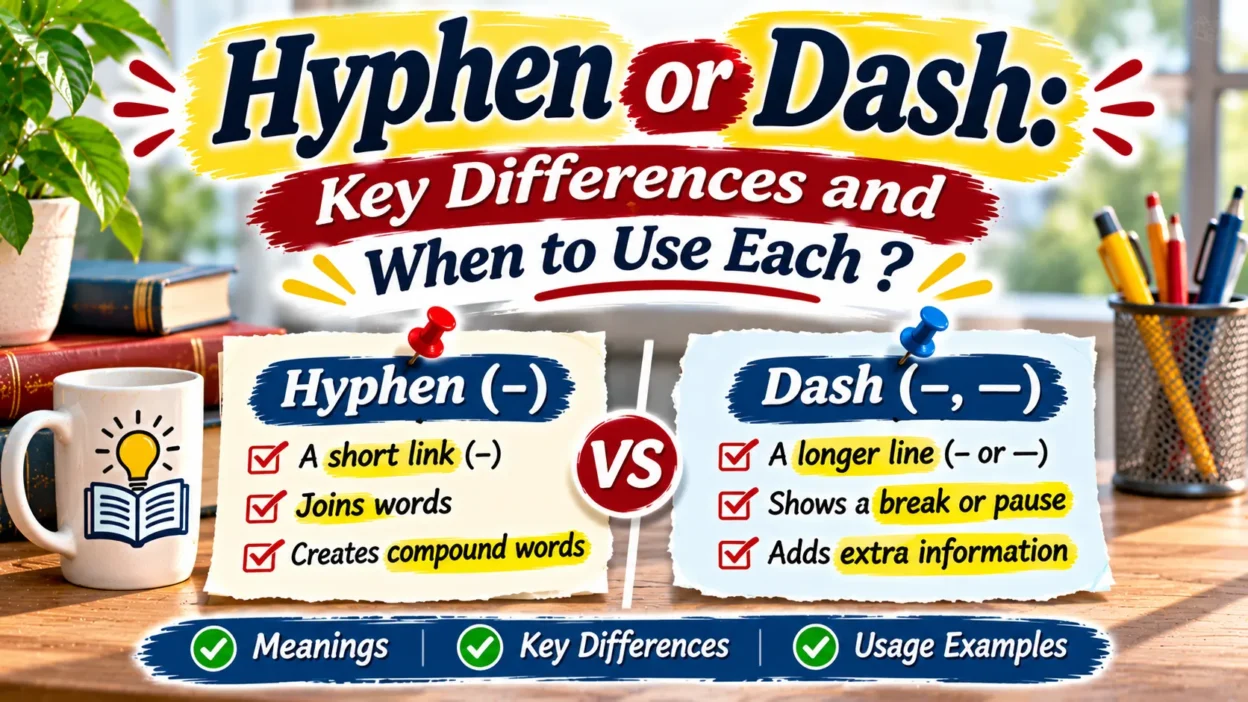
Hyphen or dash is a common punctuation question, especially for people who want to improve their writing, grammar, and sentence structure. Both marks look like short horizontal lines, but they serve different purposes. A hyphen (-) connects words or parts of words, while a dash (— or –) separates ideas, adds emphasis, or indicates a range.
You can find hyphens in expressions such as well-known author and part-time job. Dashes appear in sentences when writers want to add extra information, create a pause, or highlight an important thought. Although these punctuation marks may look similar, using the wrong one can make your writing confusing or grammatically incorrect.
In this guide, you will learn what a hyphen and a dash mean, how they differ, and when to use each one. We will also explore the three main types of dashes, provide practical examples, explain common punctuation mistakes, and answer frequently asked questions to help you use these marks confidently.
🔍 Hyphen or Dash: What’s the Main Difference?
A hyphen (-) is a short punctuation mark that joins words, word parts, or certain prefixes. A dash is a longer punctuation mark that separates or emphasizes parts of a sentence.
The most important difference is their purpose. Hyphens connect elements that work together as a single expression, while dashes create a break or interruption in a sentence.
| Feature | Hyphen (-) | Dash (— or –) |
|---|---|---|
| Appearance | Short line | Longer line |
| Main purpose | Connects words or word parts | Separates ideas or indicates ranges |
| Common use | Compound words | Interruptions and additional information |
| Example | Well-known writer | She finally arrived—after everyone left. |
| Spacing | Usually no spaces around it | Depends on the dash style and writing convention |
Quick answer: Use a hyphen to connect words, an en dash to show ranges or relationships, and an em dash to separate or emphasize ideas within a sentence.
✏️ What Is a Hyphen?
A hyphen (-) is a punctuation mark used to join two or more words or word elements. It helps readers understand that separate parts work together to express one idea.
You will often find hyphens in compound adjectives, compound nouns, certain prefixes, and written numbers. For example, full-time employee uses a hyphen to connect two words that jointly describe the employee.
Hyphens can also prevent confusion by showing how words relate to one another. Without the correct punctuation, a sentence may become difficult to understand.
Examples of hyphens:
- She works at a family-owned business.
- My brother has a part-time job.
- We attended a well-organized event.
- He is a twenty-year-old student.
- The company offers customer-focused services.
- They live in a high-rise apartment.
- She purchased a second-hand laptop.
- It was a last-minute decision.
In each example, the hyphen connects words that function together.
➖ What Is a Dash?
A dash is a punctuation mark used to create a break in a sentence, introduce additional information, show emphasis, or indicate a range. Unlike a hyphen, a dash is longer and usually separates larger parts of a sentence.
English writing commonly uses two types of dashes: the en dash (–) and the em dash (—). Each has a different purpose.
For example:
- I wanted to call you—but I forgot.
- The meeting runs from 9:00–11:00 a.m.
- She had one goal—success.
The first and third examples use an em dash to create a break or emphasize information. The second uses an en dash to show a time range.
📏 Types of Dashes in English
English punctuation includes two main types of dashes. Although they look similar, the en dash and em dash have different functions.
En Dash (–)
An en dash is longer than a hyphen but shorter than an em dash. It commonly indicates a range between numbers, dates, times, or pages. It can also connect two related terms, especially when they have an equal relationship.
Examples:
- The conference will take place June 10–12.
- Read pages 25–40 before the next class.
- The office is open Monday–Friday.
- The match ended 2–1.
- The course covers 2025–2026 developments.
- The New York–London flight was delayed.
- The team discussed the teacher–student relationship.
In most American English styles, an en dash used for a simple range does not have spaces around it.
Em Dash (—)
An em dash is the longest of the three marks. Writers use it to create a strong pause, add extra information, show an interruption, or emphasize part of a sentence.
It can sometimes replace commas, parentheses, or a colon, depending on the sentence.
Examples:
- I finally found my keys—under the sofa.
- She had one dream—to become a doctor.
- The weather was perfect—until it started raining.
- My favorite subject—English—was always enjoyable.
- He promised to arrive early—but he never came.
- There was only one problem—we had no transportation.
In American English, em dashes are commonly written without spaces around them, although some publications use spaces as a style choice.
🆚 Hyphen vs. En Dash vs. Em Dash
The hyphen, en dash, and em dash are three separate punctuation marks. Their different lengths and functions make them useful in different writing situations.
| Punctuation mark | Symbol | Main use | Example |
|---|---|---|---|
| Hyphen | – | Connects words | Long-term plan |
| En dash | – | Shows a range or relationship | 2024–2026 |
| Em dash | — | Creates a pause or adds emphasis | She agreed—without hesitation. |
A simple way to remember them is:
- Hyphen: Joins words.
- En dash: Shows a range or connection.
- Em dash: Creates a break or adds emphasis.
📝 When Should You Use a Hyphen?
Use a hyphen when two or more words need to work together as one expression. It is particularly common when multiple words appear before a noun and describe that noun as a single unit.
Here are some common situations in which you may need a hyphen.
Compound Adjectives Before Nouns
A compound adjective contains two or more words that work together to describe a noun. Writers often use a hyphen to make the relationship clear.
Examples:
- A well-written article
- A full-time employee
- A high-quality product
- A last-minute invitation
- A user-friendly website
- A long-term investment
- A five-year-old child
- A fast-moving vehicle
However, many compound adjectives do not need a hyphen when they appear after the noun.
For example:
- She is a well-known author.
- The author is well known.
The hyphen is commonly used before the noun but omitted in this particular construction after the noun.
Compound Numbers
Hyphens are used when writing out compound numbers from twenty-one through ninety-nine.
Examples:
- Twenty-one
- Thirty-five
- Forty-eight
- Fifty-six
- Sixty-nine
- Seventy-four
- Eighty-two
- Ninety-nine
For example, “My grandmother is seventy-five years old.”
Certain Prefixes
Some words use hyphens after prefixes to improve readability, avoid confusion, or follow established spelling conventions.
Examples:
- Ex-president
- Self-confidence
- Self-employed
- All-inclusive
- Anti-inflammatory
- Re-enter
- Non-English
- Pre-existing
Not every word with a prefix requires a hyphen. The correct form depends on the word and the style guide you follow.
Avoiding Confusion
A hyphen can sometimes clarify the meaning of a phrase by showing which words belong together.
Compare these examples:
- Small-business owner: An owner of a small business.
- Small business owner: This can be harder to interpret because the grouping is less clear.
Hyphens help readers understand the intended relationship between words.
💬 When Should You Use a Dash?
Use a dash when you want to separate ideas, create a pause, introduce an explanation, or emphasize particular information. Dashes can make writing feel conversational and expressive when used carefully.
Here are common situations where a dash is useful.
Adding Extra Information
An em dash can introduce additional information without interrupting the sentence too heavily.
Examples:
- My sister—who lives in California—is visiting next week.
- The restaurant—famous for its seafood—was completely full.
- Our teacher—a talented writer—published a new book.
- The old house—which had been empty for years—was finally renovated.
You can often replace the dashes with commas or parentheses, but dashes create a stronger pause.
Creating Emphasis
An em dash can draw attention to an important detail or reveal information at the end of a sentence.
Examples:
- I need only one thing—your honest opinion.
- She finally achieved her biggest dream—graduation.
- The winner was announced—and everyone cheered.
- There was one person I wanted to thank—my mother.
This punctuation mark works well when you want a sentence to feel more dramatic or memorable.
Showing Interruptions
An em dash can show that someone stops speaking suddenly or that another speaker interrupts.
Examples:
- I was going to tell you—but never mind.
- “Wait, I thought you said—”
- “I know what you mean—but listen first.”
- “If you had only—” she stopped speaking.
This use is common in dialogue, fiction, and informal writing.
Showing Ranges
An en dash can connect two endpoints to show a range of numbers, dates, pages, or times.
Examples:
- The library is open 9 a.m.–5 p.m.
- The event takes place July 14–16.
- Please review chapters 3–7.
- The company operated from 2010–2020.
When using an en dash for a range, avoid adding words such as from or between in a way that duplicates the range structure.
For example:
- Correct: The course runs from 2024 to 2026.
- Correct: The course runs 2024–2026.
- Incorrect: The course runs from 2024–2026.
⚠️ Common Hyphen and Dash Mistakes
Even experienced writers sometimes confuse hyphens and dashes. These mistakes usually happen because the marks look similar or because people do not know when to use each one.
Here are some common examples:
| Incorrect or less suitable | Better version | Reason |
|---|---|---|
| A well known author | A well-known author | Hyphenated compound adjective before a noun |
| The meeting is June 10-12 | The meeting is June 10–12 | En dash shows a range |
| She was happy – excited, actually. | She was happy—excited, actually. | Em dash creates a stronger break |
| A twenty five year old man | A twenty-five-year-old man | Hyphens connect compound number and age modifier |
| The pages 10-20 | Pages 10–20 | En dash indicates a page range |
| I need one thing – patience. | I need one thing—patience. | Em dash introduces emphasis |
The correct punctuation depends on the relationship between the words and ideas. A short line does not automatically work in every situation.
💻 How to Type a Hyphen, En Dash, and Em Dash
You can type all three punctuation marks using a computer, phone, or word-processing application.
| Mark | Symbol | How to type |
|---|---|---|
| Hyphen | – | Press the hyphen key |
| En dash | – | Windows: Alt + 0150 (numeric keypad) |
| Em dash | — | Windows: Alt + 0151 (numeric keypad) |
On many Mac keyboards:
- En dash: Option + Hyphen
- Em dash: Option + Shift + Hyphen
In Microsoft Word, typing two hyphens between words may automatically convert them into an em dash, depending on your AutoCorrect settings. Some applications also replace certain typed patterns with an en dash.
If keyboard shortcuts do not work, you can copy these symbols directly:
- Hyphen: –
- En dash: –
- Em dash: —
📚 Hyphen and Dash Examples in Everyday Writing
The following examples show how these punctuation marks work in different types of writing.
| Writing situation | Example |
|---|---|
| Business writing | We need a long-term strategy. |
| Academic writing | The study covers the 2018–2024 period. |
| Casual writing | I was excited—but also nervous. |
| News writing | The 20-year-old athlete won the competition. |
| Scheduling | The workshop runs 10 a.m.–2 p.m. |
| Storytelling | She opened the door—and froze. |
| Professional communication | Please review the client-focused proposal. |
| Descriptive writing | It was a once-in-a-lifetime experience. |
Using the right punctuation makes sentences easier to read and helps communicate your ideas accurately.
❓ Frequently Asked Questions
Is a hyphen the same as a dash?
No. A hyphen joins words or word parts, while a dash separates ideas, adds emphasis, or indicates a range. They also differ in length.
What is the difference between a hyphen and an em dash?
A hyphen is a short mark used to connect words, such as well-known. An em dash is longer and creates a break or emphasizes information, as in “She finally arrived—just in time.”
What is the difference between a hyphen and an en dash?
A hyphen connects words, while an en dash commonly indicates a range or relationship between two elements. For example, part-time job uses a hyphen, while Monday–Friday uses an en dash.
Should there be spaces around a hyphen?
No. A hyphen normally has no spaces around it. For example, write long-term goal, not long – term goal.
Should there be spaces around an em dash?
In American English, em dashes are commonly written without spaces around them. However, some publications and style guides prefer spaces. Follow the formatting rules of your chosen style guide.
Can a dash replace a comma?
Yes. An em dash can sometimes replace commas when separating additional information. However, it creates a stronger pause and draws more attention than a comma.
Can I use two hyphens instead of an em dash?
In plain-text writing, two consecutive hyphens (–) sometimes represent an em dash when the actual character is unavailable. However, polished documents should generally use the proper em dash symbol.
Which dash should I use for dates?
Use an en dash to indicate a date range, such as June 10–15. You can also write from June 10 to June 15 without using a dash.
Which dash should I use in compound words?
Use a hyphen for many compound words and compound adjectives, such as self-esteem, well-known, and part-time.
What are the three types of horizontal punctuation marks?
The three commonly discussed marks are the hyphen (-), en dash (–), and em dash (—). They have different lengths and punctuation functions.
✅ Conclusion
Understanding the difference between a hyphen or dash can make your writing clearer, more professional, and easier to read. A hyphen (-) connects words or word parts, while an en dash (–) indicates ranges or relationships. An em dash (—) creates a pause, separates additional information, or adds emphasis to a sentence.
Remember this simple rule: hyphens join, en dashes show ranges, and em dashes separate ideas. Once you understand these three functions, choosing the correct punctuation mark becomes much easier. Use them carefully in your articles, emails, assignments, and professional documents to improve your writing.

Miles Ellington enjoys exploring the subtle differences that can completely change how a word or phrase is understood. At Differology, he turns confusing language questions into straightforward explanations, covering word comparisons, vocabulary, grammar, usage, and everyday English.
With a practical and reader-focused approach, Miles uses real-world examples and clear comparisons to help readers choose the right word, understand its meaning, and communicate more precisely.