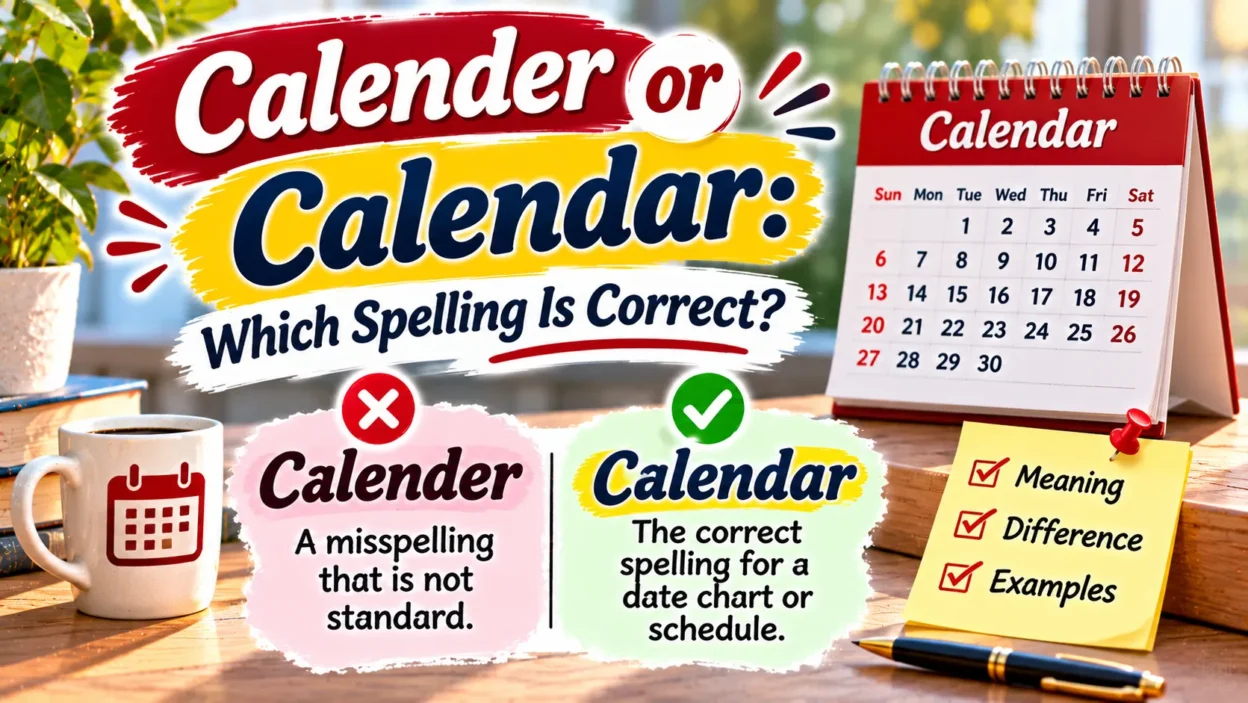
Calender or calendar is a common spelling confusion because both words look almost identical. However, they have different meanings, and only one is the correct choice when you are talking about dates, months, weeks, and yearly schedules. The correct spelling is calendar, not calender.
A calendar helps you organize your daily activities, remember important events, plan appointments, and keep track of holidays. You may use a wall calendar, desk calendar, digital calendar, or planner to manage your schedule. Although many people accidentally write “calender,” the correct spelling has an A in the second syllable.
In this guide, we will explain the difference between calendar and calender, explore their meanings, and provide simple sentence examples. You will also learn an easy spelling trick, discover common mistakes, and find answers to frequently asked questions so you can confidently use the correct word in your writing.
📅 Calender or Calendar: Which Spelling Is Correct?
Calendar is the correct spelling when referring to a system for organizing days, weeks, months, and years. It is also the word used for a schedule that lists appointments, meetings, holidays, and other important events.
Calender is a real English word, but it has a different and specialized meaning. It refers to a machine or process used to press, smooth, or finish materials such as paper, cloth, or rubber. Therefore, it is not an alternative spelling of calendar.
| Word | Meaning | Correct context |
|---|---|---|
| Calendar | A system or chart for organizing dates | Monthly calendar, yearly calendar |
| Calender | A machine or process for pressing and smoothing materials | Textile and paper manufacturing |
Quick answer: Use calendar when talking about dates and schedules. Use calender only when referring to the specialized manufacturing machine or process.
📖 What Does Calendar Mean?
A calendar is a system or chart that organizes days into weeks, months, and years. It helps people understand dates, plan activities, and keep track of important occasions.
Calendars are part of everyday life. Students use them to remember examination dates, businesses use them to schedule meetings, and families use them to plan birthdays, holidays, and special events.
You can find calendars in different formats, including printed wall calendars, pocket calendars, desk planners, and digital applications. Regardless of the format, their main purpose remains the same: helping people organize time.
Examples of calendar in sentences:
- I bought a new calendar for the coming year.
- Please mark the meeting date on your calendar.
- Our school calendar includes examination dates and holidays.
- She keeps a calendar to organize her daily activities.
- The company shared its annual marketing calendar.
- My digital calendar reminds me about important appointments.
- We use a family calendar to plan weekend activities.
- The calendar shows all twelve months of the year.
🏭 What Does Calender Mean?
Calender is a technical noun and verb associated with manufacturing. As a noun, it refers to a machine that uses rollers to press, smooth, flatten, or finish materials. As a verb, to calender means to process a material using such a machine.
This word commonly appears in industries that manufacture textiles, paper, rubber, and other materials. The process can improve a material’s smoothness, thickness, appearance, or surface finish.
For example, a textile manufacturer may use a calendering machine to create a smoother fabric surface. Similarly, paper manufacturers may use rollers to produce paper with a more even finish.
Examples of calender in sentences:
- The factory uses a calender to smooth textile fabric.
- The paper passed through a calendering machine during production.
- Calendering gives certain materials a smoother surface.
- The manufacturer installed a new calender for fabric finishing.
- Workers checked the rollers before starting the calendering process.
In ordinary conversations about dates, appointments, and schedules, you will almost always need calendar rather than calender.
🆚 Calendar vs. Calender: Key Differences
The biggest difference between these words is their meaning and everyday usage. Calendar belongs to daily planning and time management, while calender belongs mainly to industrial manufacturing.
| Feature | Calendar | Calender |
|---|---|---|
| Spelling | C-A-L-E-N-D-A-R | C-A-L-E-N-D-E-R |
| Meaning | A system for organizing dates | A machine or process for finishing materials |
| Part of speech | Noun | Noun and verb |
| Common usage | Daily life, business, education | Manufacturing and industrial production |
| Example | Check the calendar for the date. | The factory uses a calender to smooth fabric. |
| Everyday frequency | Very common | Specialized and less common |
Remember that the two words are not interchangeable. Writing calender when you mean a schedule is a spelling mistake.
✍️ How to Use Calendar in a Sentence
Use calendar whenever you discuss dates, schedules, events, or the organization of time. It works naturally in personal, academic, and professional writing.
Here are more examples:
- My calendar is full of important appointments this week.
- The teacher gave every student an examination calendar.
- We need to update the company calendar before Monday.
- She added her doctor’s appointment to her digital calendar.
- The holiday calendar helps families plan their vacations.
- I always check my calendar before accepting an invitation.
- Our office calendar includes upcoming meetings and deadlines.
- The new calendar features beautiful pictures of nature.
- He forgot to write the event date on his calendar.
- The school published its academic calendar online.
- I use a monthly calendar to track my goals.
- The calendar helps me remember birthdays and anniversaries.
These examples show how naturally the word calendar fits into everyday communication.
🧠 Easy Tricks to Remember Calendar vs. Calender
If you frequently confuse these spellings, a simple memory trick can help you remember the correct word.
Think of the letter A in calendar:
- Calendar = Dates: Remember the A in calendar when talking about dates, days, months, and appointments.
- Calender = Manufacturing: Remember that calender belongs to the specialized world of machines and material finishing.
You can also connect the word calendar with familiar expressions such as:
- Calendar year
- Calendar month
- Calendar date
- Calendar event
- Calendar reminder
All these expressions use the spelling calendar.
A useful practice sentence is: “I added the important date to my calendar.” Repeating this sentence can help you remember the correct spelling.
📆 Different Types of Calendars
Calendars come in several formats, and each one serves a different purpose. Some help people organize their personal schedules, while others support business planning, education, and long-term goals.
Here are some common types:
| Calendar type | Purpose |
|---|---|
| Wall calendar | Displays dates on a wall for easy reference |
| Desk calendar | Keeps dates and reminders visible at a workspace |
| Monthly calendar | Shows all the days and weeks in one month |
| Yearly calendar | Displays the months of an entire year |
| Digital calendar | Organizes events through electronic devices |
| Academic calendar | Lists school or university dates and holidays |
| Business calendar | Tracks meetings, deadlines, and company activities |
| Advent calendar | Counts down the days leading up to Christmas |
| Lunar calendar | Organizes months according to lunar cycles |
| Holiday calendar | Lists public holidays and special occasions |
These examples all use the correct spelling calendar because they relate to dates and time organization.
⚠️ Common Calendar Spelling Mistakes
Many people accidentally write calender when they mean calendar. This usually happens because the two words look similar and their pronunciations are close.
Here are some common spelling mistakes and their corrections:
| Incorrect spelling or phrase | Correct spelling or phrase |
|---|---|
| Monthly calender | Monthly calendar |
| Yearly calender | Yearly calendar |
| Digital calender | Digital calendar |
| Academic calender | Academic calendar |
| Calender year | Calendar year |
| Event calender | Event calendar |
| Holiday calender | Holiday calendar |
| Work calender | Work calendar |
| Printable calender | Printable calendar |
| Calender reminder | Calendar reminder |
Always use calendar when discussing schedules, dates, and important events.
🔤 Calendar: Related Words and Expressions
Learning related expressions can help you understand how to use calendar naturally in different situations.
- Calendar year: A year that begins on January 1 and ends on December 31.
- Calendar month: One of the twelve months in a calendar system.
- Calendar date: A specific day identified by its month and year.
- Calendar event: An activity or occasion recorded on a calendar.
- Calendar reminder: A notification that helps someone remember an upcoming event.
- Calendar invitation: A digital request inviting someone to an event or meeting.
- Calendar planning: The process of organizing activities according to dates.
- Calendar schedule: A list of planned events arranged by date and time.
For example, “The manager sent a calendar invitation for the project meeting.” This sentence uses the correct spelling because it refers to a scheduled event.
❓ Frequently Asked Questions
Is it calendar or calender?
Calendar is the correct spelling when referring to dates, months, years, and schedules. Calender is a different technical word related to machines used to press and smooth materials.
Is calender a real word?
Yes, calender is a real English word. It refers to a machine or process used to smooth, flatten, or finish materials such as paper and fabric. However, it is not the correct spelling of calendar.
What does calendar mean?
A calendar is a system or chart that organizes days, weeks, months, and years. People use calendars to plan activities, remember important dates, and manage appointments.
What does calender mean?
Calender refers to a machine that uses rollers to press and smooth materials. It can also describe the process of treating materials with that machine.
Why do people spell calendar as calender?
People often confuse these words because they look and sound similar. The difference is only one letter in the second syllable, which makes the mistake easy to overlook.
What is the plural of calendar?
The plural form is calendars.
Example: The store sells colorful calendars for homes and offices.
What is a calendar year?
A calendar year is the twelve-month period beginning on January 1 and ending on December 31.
Is calendar a noun or an adjective?
Calendar is primarily a noun. It can also function as a modifier before another noun, as in calendar year, calendar month, and calendar date.
How do you remember the spelling of calendar?
Remember that calendar contains the letter A in its second syllable. Connect it with dates, appointments, and annual schedules to avoid writing calender by mistake.
Are calendar and calender pronounced the same?
They are pronounced similarly, but standard pronunciations differ slightly. Their meanings are also different, so understanding the context is the best way to choose the correct spelling.
✅ Conclusion
When choosing between calender or calendar, remember that calendar is the correct word for dates, months, years, appointments, and schedules. It is the spelling you need for everyday writing, schoolwork, business communication, and personal planning.
Calender is also a real word, but it belongs to a specialized manufacturing context. It describes a machine or process used to press and smooth materials such as fabric and paper. The easiest way to remember the difference is to connect calendar with dates and calender with industrial rollers. Once you understand their meanings, choosing the correct spelling becomes simple.

Miles Ellington enjoys exploring the subtle differences that can completely change how a word or phrase is understood. At Differology, he turns confusing language questions into straightforward explanations, covering word comparisons, vocabulary, grammar, usage, and everyday English.
With a practical and reader-focused approach, Miles uses real-world examples and clear comparisons to help readers choose the right word, understand its meaning, and communicate more precisely.