
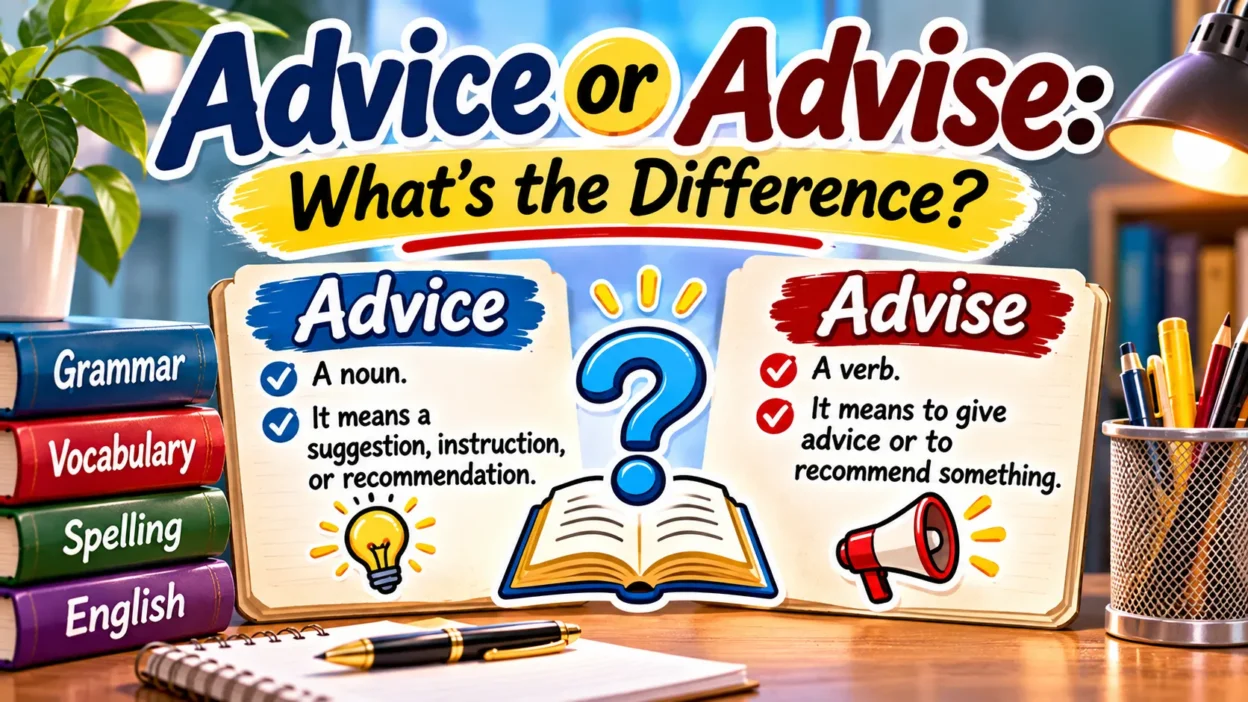
Advice or advise—which spelling should you use when writing an email, having a conversation, or sharing a helpful suggestion? These two words look almost identical, sound similar, and have closely related meanings. However, advice is a noun, while advise is a verb. Understanding this small grammatical difference will help you use both words correctly in everyday American English.
For example, you might say, “Thank you for your advice,” when someone gives you a helpful suggestion. However, you would say, “I advise you to get enough sleep,” when describing the action of giving guidance. Although both words relate to recommendations and guidance, they perform different jobs in a sentence. Mixing them up is a common writing mistake, especially in emails, school assignments, professional messages, and social media posts. In this guide, you’ll discover their meanings, pronunciations, grammar rules, sentence examples, and easy tricks to remember which word belongs where. By the end, you’ll know exactly when to use advice and when to use advise.
📖 Advice or Advise: What’s the Difference?
The main difference between advice and advise is their part of speech. Both words relate to guidance or recommendations, but they are not interchangeable.
- Advice: A noun that means a suggestion, recommendation, or helpful information.
- Advise: A verb that means to give someone a suggestion, recommendation, or guidance.
Here is a quick comparison:
| Word | Part of Speech | Meaning | Example |
|---|---|---|---|
| Advice | Noun | A suggestion or recommendation | She gave me useful advice. |
| Advise | Verb | To give guidance or recommend something | I advise you to study regularly. |
Easy way to remember:
- Use advice when talking about the suggestion itself.
- Use advise when talking about the action of giving a suggestion.
For example:
- My teacher gave me excellent advice.
- My teacher will advise me about my career.
The first sentence names the guidance, while the second describes the action of providing it.
💡 What Does Advice Mean?
Advice is a noun that refers to an opinion, recommendation, or suggestion someone gives to help another person make a decision or handle a situation.
People give advice about many subjects, including relationships, education, careers, finances, health, and everyday problems.
Unlike many nouns, advice is generally an uncountable noun in standard English. This means you normally should not say “an advice” or “two advices.”
Instead, use expressions such as:
- A piece of advice
- Some advice
- A bit of advice
- A word of advice
- Helpful advice
- Professional advice
Examples of advice in sentences:
- My father gave me valuable advice about saving money.
- I need some advice before making this important decision.
- Her advice helped me choose the right college.
- Thank you for your advice and support.
- His financial advice helped the family manage its expenses.
- The counselor offered useful advice to the students.
- She ignored everyone’s advice and made her own decision.
- Good advice can make a difficult situation easier.
- I always ask my older sister for relationship advice.
- The doctor gave him advice about maintaining a healthy lifestyle.
In each example, advice refers to the guidance or recommendation itself.
🗣️ What Does Advise Mean?
Advise is a verb that means to recommend something, provide guidance, or tell someone what you think they should do.
You use it when describing the action of helping someone make a decision or suggesting a particular course of action.
The word often appears with a person or an action that follows the recommendation.
Examples of advise in sentences:
- I advise you to read the instructions carefully.
- My parents advise me to save money.
- The teacher advised the students to prepare for the exam.
- Doctors advise people to exercise regularly.
- I would advise against making a rushed decision.
- She advised him to apply for the position.
- The lawyer advised her to review the agreement.
- We advise customers to keep their receipts.
- His manager advised him to improve his communication skills.
- I strongly advise you to arrive early.
In these sentences, advise describes the act of giving someone a recommendation.
🔍 Advice vs. Advise: Key Differences Explained
Although advice and advise have similar meanings, their grammatical functions are different. Recognizing whether your sentence needs a noun or a verb is the easiest way to choose the correct spelling.
| Feature | Advice | Advise |
|---|---|---|
| Part of speech | Noun | Verb |
| Meaning | Guidance or recommendation | To give guidance |
| Pronunciation | /ədˈvaɪs/ | /ədˈvaɪz/ |
| Ending sound | S sound | Z sound |
| Can describe an action? | No | Yes |
| Example | I need your advice. | Please advise me. |
Compare these examples:
- I appreciate your advice.
- I appreciate the way you advise me.
In the first sentence, advice is the guidance someone provides. In the second, advise describes the action of providing that guidance.
Here are more comparisons:
- Her advice was helpful.
- She advised me to stay positive.
- I need some advice.
- Can you advise me on this matter?
- The advice was valuable.
- The manager advised the employee.
Remember that the spelling depends on the grammatical role, not simply the subject of the sentence.
🔊 How to Pronounce Advice and Advise
One useful way to distinguish these words is by listening to their final sounds.
Although the words have almost identical spelling, their final consonants are pronounced differently.
Advice:
- Pronunciation: /ədˈvaɪs/
- Sounds like: uh-DVICE
- Final sound: S, as in “snake”
Advise:
- Pronunciation: /ədˈvaɪz/
- Sounds like: uh-DVIZE
- Final sound: Z, as in “zebra”
The easiest pronunciation trick is to remember that advice ends with an unvoiced S sound, while advise ends with a voiced Z sound.
Try saying both words aloud:
- Advice: S sound
- Advise: Z sound
This pronunciation difference can help you identify the correct word when speaking.
✍️ When Should You Use Advice?
Use advice when you need a noun to describe a suggestion, recommendation, or piece of guidance.
It usually appears after words such as “some,” “good,” “helpful,” “valuable,” and “professional.”
Common expressions with advice:
- Good advice
- Helpful advice
- Financial advice
- Career advice
- Relationship advice
- Legal advice
- Expert advice
- Practical advice
- Friendly advice
- Useful advice
- Personal advice
- Professional advice
More sentence examples:
- My best friend always gives me good advice.
- She asked her professor for career advice.
- His advice helped me solve the problem.
- I appreciate your honest advice.
- The company provides professional advice to new business owners.
- We received helpful advice from an experienced teacher.
- Her financial advice helped me plan my budget.
- I need a little advice about my upcoming interview.
- The book contains practical advice for beginners.
- Sometimes, the best advice comes from personal experience.
Whenever you are referring to the guidance itself, choose advice.
📝 When Should You Use Advise?
Use advise when you need a verb to describe the action of giving someone guidance or a recommendation.
It can appear in different verb forms depending on the tense and structure of your sentence.
Common expressions with advise:
- Advise someone
- Advise against something
- Advise someone to do something
- Strongly advise
- Professionally advise
- Advise a customer
- Advise a student
- Advise a client
- Advise someone on a subject
- Advise someone about a decision
More sentence examples:
- I advise you to check your work before submitting it.
- The doctor advises patients to drink enough water.
- My parents advised me to focus on my education.
- The manager will advise the team about the new policy.
- I would advise against spending too much money.
- Her teacher advised her to practice every day.
- Experts advise homeowners to review their insurance coverage.
- We advise customers to contact support for assistance.
- The lawyer advised his client to read the contract.
- I strongly advise you to consider all your options.
Whenever you are describing the act of recommending or guiding, use advise.
📚 Advice and Advise in Different Tenses
One important difference between these words is that advise changes form according to tense, while advice remains a noun.
Here are the common forms of the verb advise:
| Verb Form | Example |
|---|---|
| Base form: Advise | I advise you to prepare early. |
| Third-person singular: Advises | She advises students about college. |
| Past tense: Advised | He advised me to wait. |
| Present participle: Advising | They are advising the new employees. |
| Past participle: Advised | I have advised her before. |
Notice that the spelling changes from advise to advised when you use the past tense.
Examples in different tenses:
- Present: I advise my friends to stay organized.
- Present continuous: She is advising the students.
- Past: My teacher advised me to practice more.
- Future: I will advise you after reviewing the details.
- Present perfect: The consultant has advised several businesses.
The noun advice does not have these verb forms. You can use it with different tenses of other verbs:
- I need your advice.
- She gave me advice.
- They have received useful advice.
- We will consider your advice.
⚠️ Is Advice Countable or Uncountable?
Advice is an uncountable noun in standard English. This is one of the most important grammar rules to remember when using the word.
You should not normally write:
- An advice
- Two advices
- Many advices
- Several advices
Instead, use:
- A piece of advice
- Two pieces of advice
- Some advice
- Much advice
- A little advice
- Several helpful suggestions
Incorrect: My teacher gave me an advice.
Correct: My teacher gave me some advice.
Incorrect: She shared three advices with me.
Correct: She shared three pieces of advice with me.
Incorrect: I have many advices for you.
Correct: I have a lot of advice for you.
Remember that advice is generally uncountable, even when you are talking about several recommendations.
🚫 Common Mistakes to Avoid When Using Advice and Advise
Writers often confuse these words because their spelling and meanings are closely related. Fortunately, you can avoid most mistakes by checking whether your sentence needs a noun or a verb.
Here are some common errors and their corrections:
| Incorrect Sentence | Correct Sentence |
|---|---|
| Thank you for your advise. | Thank you for your advice. |
| Please advice me. | Please advise me. |
| She gave me an advice. | She gave me a piece of advice. |
| I need your advise. | I need your advice. |
| He gave me two advices. | He gave me two pieces of advice. |
| My parents advice me. | My parents advise me. |
| Can you give me some advise? | Can you give me some advice? |
| The counselor gave helpful advise. | The counselor gave helpful advice. |
How to avoid these mistakes:
- Check whether the word names guidance or describes an action.
- Use advice as a noun.
- Use advise as a verb.
- Remember that advice is uncountable.
- Listen for the final S or Z sound when speaking.
- Read your sentence aloud to check whether the word fits naturally.
A quick grammar check can prevent these mistakes in emails, essays, articles, and professional communication.
💬 Advice vs. Advise in Everyday Conversations
Both words are common in daily conversations, but people use them in different sentence structures.
Examples using advice:
- Do you have any advice for me?
- Thanks for the advice!
- I could use some advice right now.
- That is excellent advice.
- Your advice means a lot to me.
- I need some career advice.
- Can I ask you for a little advice?
- I appreciate the advice you shared.
Examples using advise:
- What would you advise me to do?
- I would advise you to take a break.
- Can you advise me about this problem?
- My parents advise me to work hard.
- What does your teacher advise?
- I advise against making that choice.
- Please advise me on the next step.
- The manager will advise us tomorrow.
You can see that advice commonly follows expressions such as “give,” “need,” and “ask for.” Meanwhile, advise often follows a subject such as “I,” “she,” “they,” or “we.”
🧠 Easy Tricks to Remember Advice or Advise
If you regularly mix up these spellings, use these simple memory tricks.
Remember advice with the letter C:
The word advice contains a C. Think of C as standing for “counsel” or “counseling.” Advice is the guidance someone receives.
Remember advise with the letter S:
The word advise contains an S. Think of “suggest.” To advise someone means to suggest or recommend something.
Another helpful trick is to check the sentence structure:
- If you can replace the word with “guidance,” use advice.
- If you can replace the word with “recommend,” use advise.
For example:
- I need your guidance. → I need your advice.
- I recommend that you wait. → I advise you to wait.
These substitutions make the difference easier to understand.
📖 Advice vs. Advise: Synonyms and Related Words
Learning synonyms can improve your vocabulary and help you express recommendations more naturally.
Synonyms for advice:
- Guidance
- Suggestion
- Recommendation
- Counsel
- Direction
- Instruction
- Tip
- Opinion
- Input
- Encouragement
- Consultation
- Warning
- Information
- Insight
- Feedback
Synonyms for advise:
- Recommend
- Suggest
- Guide
- Counsel
- Direct
- Instruct
- Encourage
- Inform
- Caution
- Urge
- Mentor
- Warn
- Recommend
- Advocate
- Propose
These words have related meanings, but they are not always interchangeable. Choose the synonym that best fits your sentence.
❓ Frequently Asked Questions About Advice or Advise
Here are answers to common questions about the spelling, pronunciation, grammar, and correct usage of these two words.
Is it advice or advise?
Both spellings are correct, but they have different grammatical functions. Advice is a noun meaning guidance or a recommendation, while advise is a verb meaning to give guidance.
What is the easiest way to remember advice vs. advise?
Remember that advice is the thing you receive, while advise is the action of giving it. You receive advice, and someone advises you.
Is advice a noun or a verb?
Advice is a noun. It refers to guidance, recommendations, or suggestions that help someone make a decision.
Is advise a noun or a verb?
Advise is a verb. It describes the action of recommending something or providing guidance to another person.
Is it correct to say an advice?
No. In standard English, advice is an uncountable noun. Say “a piece of advice” or “some advice” instead.
Is it correct to say please advise?
Yes. “Please advise” is grammatically correct because advise is a verb. It is commonly used in professional emails when asking someone to provide guidance or recommendations.
What is the past tense of advise?
The past tense of advise is advised. For example: “My teacher advised me to study harder.”
What is the plural of advice?
Advice generally does not have a plural form in standard English. To count individual recommendations, use “pieces of advice” or “suggestions.”
Do advice and advise sound different?
Yes. Advice ends with an unvoiced S sound, while advise ends with a voiced Z sound. Their pronunciations are /ədˈvaɪs/ and /ədˈvaɪz/, respectively.
Which word should I use in a professional email?
Use advice when referring to guidance and advise when requesting or providing guidance. For example, “I would appreciate your advice” and “Please advise me on the next steps” are both correct.
Can advice and advise be used in the same sentence?
Yes. For example: “My manager gave me useful advice and advised me to improve my communication skills.” Both words are correct because they perform different grammatical roles.
Is advice the same as advise in American English?
Their meanings and grammatical functions are the same in American English and British English. Both varieties use advice as a noun and advise as a verb.
✅ Conclusion: Advice or Advise?
The difference between advice and advise is simple once you understand their grammatical roles. Advice is a noun that refers to a suggestion, recommendation, or helpful guidance. Advise is a verb that describes the action of giving someone that guidance.
For example, you can say, “My teacher gave me valuable advice,” or “My teacher advised me to prepare for the exam.” Both sentences are correct because each word performs a different function. Remember the simple rule: You receive advice, but someone advises you. Keep this distinction in mind, and you’ll use both words confidently in everyday conversations, emails, and professional writing.

Miles Ellington enjoys exploring the subtle differences that can completely change how a word or phrase is understood. At Differology, he turns confusing language questions into straightforward explanations, covering word comparisons, vocabulary, grammar, usage, and everyday English.
With a practical and reader-focused approach, Miles uses real-world examples and clear comparisons to help readers choose the right word, understand its meaning, and communicate more precisely.