
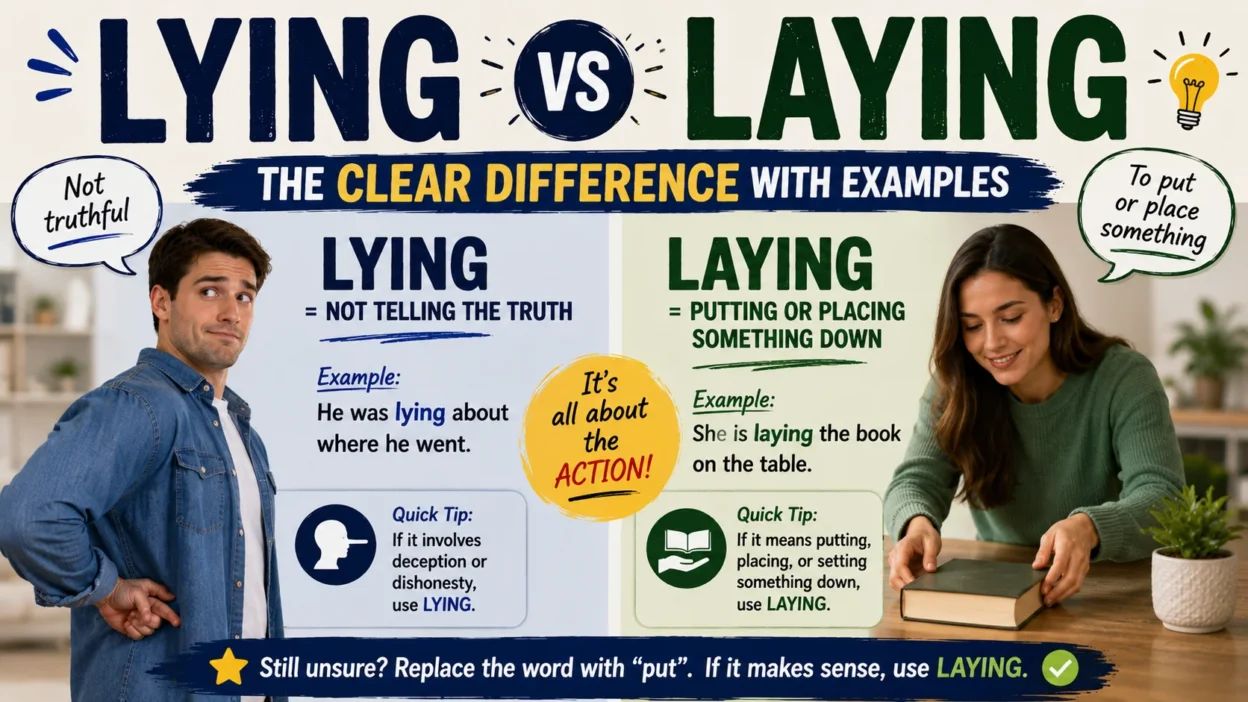
Lying vs laying is one of the most confusing verb pairs in English because both words describe something being in a resting position, but they come from different verbs. The confusion becomes even greater because lay is the past tense of lie, while laying is the -ing form of lay.
The easiest way to separate them is to ask one question: Is the subject resting, or is the subject putting something somewhere?
Use lying when a person or thing is resting in a position. Use laying when someone is placing or putting something somewhere.
For example:
- I am lying on the bed.
- I am laying the book on the bed.
Once you understand what each verb needs as an object, the difference becomes much easier.
Lying vs Laying: Quick Comparison
| Word | Base Verb | Meaning | Needs an Object? | Example |
|---|---|---|---|---|
| Lying | Lie | Resting or being in a position | No | She is lying on the sofa. |
| Laying | Lay | Putting something somewhere | Yes | She is laying the blanket on the sofa. |
The key rule:
Lying = resting
Laying = placing something
What Does Lying Mean?
Lying is the present participle of lie when lie means to rest, recline, or remain in a particular position.
It does not take a direct object in this meaning.
Examples:
- I am lying on the couch.
- The cat is lying under the table.
- She is lying in bed.
- The book is lying on the desk.
- They are lying on the beach.
In each example, the subject is simply resting or remaining somewhere.
Lying Does Not Need an Object
This is one of the most useful grammar clues.
You can say:
I am lying on the bed.
But you would not normally say:
I am lying the book on the bed.
If you are putting the book somewhere, you need laying:
I am laying the book on the bed.
What Does Laying Mean?
Laying is the present participle of lay.
Lay means to put, place, or set something somewhere. Because it describes an action performed on something, it normally takes a direct object.
Examples:
- She is laying the baby in the crib.
- I am laying the keys on the table.
- He is laying the clothes on the bed.
- They are laying the foundation.
- We are laying the cards on the table.
Notice that each sentence answers the question What is being placed?
That object makes laying different from lying.
The Object Test
When you are unsure whether to use lying or laying, look for an object.
No Object → Lying
She is lying on the sofa.
What is she placing?
Nothing. She is resting.
Object → Laying
She is laying the blanket on the sofa.
What is she placing?
The blanket.
This simple test works in many everyday sentences.
Lying vs Laying Examples
Here are some examples that show the difference clearly:
| Lying | Laying |
|---|---|
| I am lying on the floor. | I am laying the carpet on the floor. |
| The dog is lying beside me. | She is laying the dog on the blanket. |
| He is lying in bed. | He is laying the baby in bed. |
| The book is lying on the desk. | She is laying the book on the desk. |
| They are lying on the grass. | They are laying the towels on the grass. |
The left side describes something already in a position. The right side describes someone putting something into that position.
Lie vs Lay: The Forms You Need to Know
The biggest problem with lying vs laying becomes clearer when you look at the full verb forms.
Lie
When lie means to rest:
- Present: lie
- Present participle: lying
- Past: lay
- Past participle: lain
Examples:
- I lie down every afternoon.
- I am lying down now.
- Yesterday, I lay on the sofa.
- I have lain here for an hour.
Lay
When lay means to put or place something:
- Present: lay
- Present participle: laying
- Past: laid
- Past participle: laid
Examples:
- I lay the book on the desk.
- I am laying the book on the desk.
- Yesterday, I laid the book on the desk.
- I have laid the book on the desk.
This is why the verbs cause so much confusion.
The Most Important Difference
The difference can be reduced to two basic ideas:
Lie → You Rest
I am lying on the bed.
You are not doing something to an object. You are resting.
Lay → You Place Something
I am laying the blanket on the bed.
You are placing an object somewhere.
Remember:
Lie → no direct object
Lay → needs a direct object
When to Use Lying
Use lying when the subject is already resting, reclining, or remaining in a particular place.
Examples:
- The dog is lying by the door.
- She is lying on the grass.
- I found him lying on the couch.
- The phone was lying beside the laptop.
- The children were lying on the floor.
Here, the subject does not place another object anywhere.
When to Use Laying
Use laying when someone is actively putting or placing something somewhere.
Examples:
- She is laying the dishes on the table.
- He is laying the documents on my desk.
- I am laying the baby in the crib.
- They are laying tiles on the floor.
- We are laying the foundation for the building.
Each sentence contains an object that receives the action.
Lying vs Laying in Everyday Conversation
These verbs appear frequently in everyday situations.
At Home
I am lying on the couch.
You are resting.
I am laying the pillows on the couch.
You are placing something.
At Work
The files are lying on my desk.
The files are already there.
I am laying the files on my desk.
You are putting them there.
At the Beach
We are lying on the beach.
You are resting.
We are laying the towels on the sand.
You are putting the towels down.
Common Mistakes With Lying and Laying
Mistake 1: Saying I’m Laying Down
A very common sentence is:
I am laying down.
When you mean that you are going to rest yourself, standard English calls for:
I am lying down.
Why?
Because you are not placing an object. You are describing your own position.
Mistake 2: Using Laying Without an Object
If laying means placing something, it normally needs an object.
Incorrect:
She is laying on the bed.
If she is resting, write:
She is lying on the bed.
Correct:
She is laying the blanket on the bed.
Mistake 3: Forgetting That Lay Is the Past of Lie
This is where many learners get confused.
Present:
I lie on the couch.
Past:
Yesterday, I lay on the couch.
Present continuous:
I am lying on the couch.
The word lay in the second sentence does not mean that you placed something. It is the past form of lie.
A Timeline That Makes It Easier
Consider the verb lie:
Today: I lie on the couch.
Right now: I am lying on the couch.
Yesterday: I lay on the couch.
Before that: I have lain on the couch for an hour.
Now consider lay:
Today: I lay the book on the desk.
Right now: I am laying the book on the desk.
Yesterday: I laid the book on the desk.
Before that: I have laid the book on the desk.
The two verb families follow different patterns.
Lying vs Laying: A Simple Formula
You can remember the difference with this formula:
Lie → lying → rested position
Lay → laying → place an object
For example:
The baby is lying in the crib.
The baby is resting.
The mother is laying the baby in the crib.
The mother is placing the baby there.
How to Choose Between Lying and Laying
Ask yourself:
Am I resting or is something resting?
If yes, use lying.
The dog is lying on the floor.
Am I putting something somewhere?
If yes, use laying.
I am laying the blanket on the floor.
This quick question can solve most present-tense situations.
Lying vs Laying With Animals and People
The same rule applies to people and animals.
Resting
- The cat is lying on the chair.
- The baby is lying in the crib.
- The dog is lying beside the door.
- He is lying on the grass.
Placing
- She is laying the baby in the crib.
- He is laying the cat on the blanket.
- They are laying the dog on the towel.
The person or animal can be the object of laying when someone is placing them somewhere.
What About Laying Eggs?
There is another common use of laying that has nothing to do with putting an ordinary object somewhere.
Animals can lay eggs.
Examples:
- The hen is laying eggs.
- Turtles are laying eggs on the beach.
- The bird is laying an egg.
Here, laying comes from lay, and the eggs function as the object.
You would not use lying in these sentences.
Special Case: Laying Foundations
Laying also appears in established expressions where something is being established, constructed, or put into place.
Examples:
- The workers are laying the foundation.
- The company is laying the groundwork for expansion.
- The project is laying the basis for future development.
- They are laying plans for the next phase.
These expressions all involve the idea of putting something into place.
Pronunciation
Lying and laying are pronounced differently.
- Lying: LY-ing
- Laying: LAY-ing
The first syllable changes from lie to lay, which can help you remember which verb you are using.
A Quick Practice Test
Choose lying or laying in each sentence.
- I am ___ on the sofa.
- She is ___ the books on the table.
- The dog is ___ beside the door.
- He is ___ the baby in the crib.
- We are ___ on the grass.
- The workers are ___ bricks on the wall.
Answers
- lying
- laying
- lying
- laying
- lying
- laying
The pattern stays consistent: lying describes a resting position, while laying describes placing something.
Frequently Asked Questions
What is the difference between lying and laying?
Lying comes from lie and means resting or being in a particular position. Laying comes from lay and means putting or placing something somewhere.
Is it lying down or laying down?
When you mean resting yourself, the standard form is lying down.
Example:
I am lying down.
Use laying when you are placing an object:
I am laying the blanket down.
Is the dog lying or laying on the floor?
Use lying if the dog is resting on the floor.
The dog is lying on the floor.
Is it laying the book or lying the book?
Use laying because the book is the object being placed.
She is laying the book on the table.
Is laying always followed by an object?
When laying means placing something, yes, it normally takes a direct object.
She is laying the book on the desk.
Why is lay the past tense of lie?
English has irregular verb forms. When lie means to rest, its past tense is lay.
Today I lie down.
Yesterday I lay down.
What is the past tense of laying?
The verb lay has the past tense laid.
For example:
Yesterday, she laid the book on the table.
Is “I am laying down” always wrong?
If you mean that you are placing something down, it can be correct:
I am laying the book down.
If you mean that you are reclining or resting yourself, use:
I am lying down.
Final Thoughts
The difference between lying vs laying becomes much easier when you focus on whether someone or something is resting or being placed. Lying comes from lie and describes a person or thing that is resting in a position. Laying comes from lay and describes the action of putting something somewhere.
Remember the most useful rule: lying means resting, while laying means placing something. If you can identify the object receiving the action, laying is usually the right choice. If no object exists and the subject simply rests, use lying.
This distinction also explains why I am lying down is correct when you mean that you are resting, while I am laying the book down is correct when you are putting a book somewhere.

Miles Ellington enjoys exploring the subtle differences that can completely change how a word or phrase is understood. At Differology, he turns confusing language questions into straightforward explanations, covering word comparisons, vocabulary, grammar, usage, and everyday English.
With a practical and reader-focused approach, Miles uses real-world examples and clear comparisons to help readers choose the right word, understand its meaning, and communicate more precisely.