
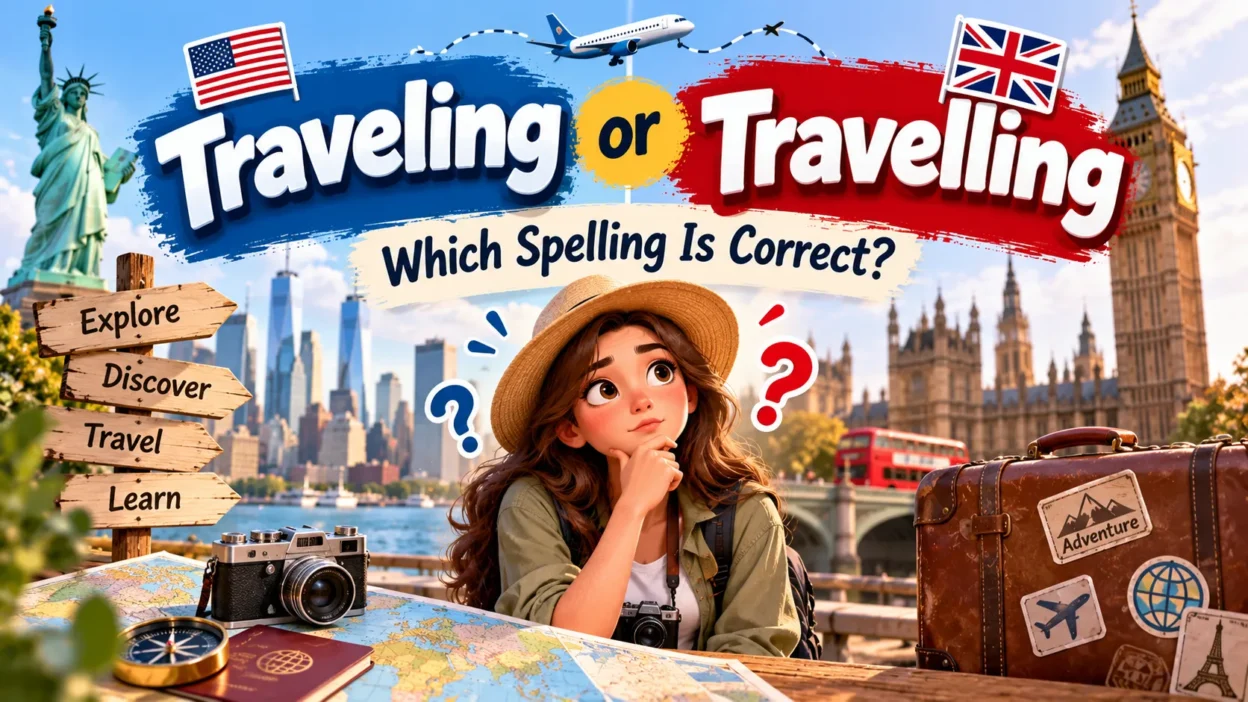
Have you ever wondered whether traveling or travelling is the correct spelling? Both forms are correct, but the right choice depends on the type of English you are using. American English generally prefers traveling with one L, while British English typically uses travelling with two Ls.
Although the difference looks small, choosing the appropriate spelling can make your writing more consistent and professional. Whether you are writing a travel blog, preparing an essay, creating social media captions, or sending a business email, understanding this spelling difference will help you avoid confusion.
In this guide, you will learn the meanings of traveling and travelling, discover which spelling is preferred in the United States and the United Kingdom, explore examples, and understand related words such as traveled, travelled, traveler, and traveller.
✈️ Traveling vs. Travelling: The Quick Answer
Traveling is the preferred spelling in American English, whereas travelling is the standard spelling in British English and many other varieties of English.
Both words mean the same thing: going from one place to another, usually for pleasure, business, education, or another purpose.
Here is the basic difference:
- Traveling: Preferred in American English.
- Travelling: Preferred in British English.
- Meaning: Identical in both spellings.
- Pronunciation: The same.
- Grammar: Both forms are present participles of the verb travel and can also function as gerunds.
For example:
- American English: I am traveling to California next week.
- British English: I am travelling to London next week.
Neither spelling is universally wrong. The important thing is to choose the version appropriate for your audience and use it consistently throughout your writing.
🇺🇸 Why Does American English Use Traveling?
American English generally follows a spelling convention that drops the final consonant before adding certain suffixes when the final syllable is not stressed in the relevant way. This is why American writers usually spell the word traveling with one L.
The same pattern appears in several other words, including canceled, labeled, and modeled. British English often doubles the final consonant in these words, producing cancelled, labelled, and modelled.
Here are some examples of American English usage:
- We are traveling across the United States this summer.
- She enjoys traveling alone.
- My brother is traveling for work.
- They are traveling by train.
- I was traveling when you called.
If you are writing for an American audience, especially for a US-based website, school assignment, or business, traveling is generally the best choice.
However, remember that American English has its own spelling conventions, and the single-L form is not a different word with a different meaning.
🇬🇧 Why Does British English Use Travelling?
British English generally doubles the final L in travel when adding the suffix -ing. As a result, travelling is the standard spelling in British English.
This convention also appears in words such as cancelled, labelled, modelling, and signalling.
Consider these examples:
- We are travelling to Edinburgh by train.
- She loves travelling around Europe.
- My parents are travelling abroad this month.
- He is travelling for business.
- They were travelling through the countryside.
The double-L spelling is also common in other varieties of English that follow British conventions, including Australian and New Zealand English.
If your audience is primarily in the United Kingdom, Australia, or New Zealand, travelling is usually the more suitable spelling.
📖 What Does Traveling or Travelling Mean?
Traveling and travelling are forms of the verb travel. They describe the activity of moving from one location to another.
People may travel for leisure, work, education, family visits, medical appointments, or many other reasons. The activity can involve driving, flying, walking, taking a train, or using another form of transportation.
For example:
- Traveling helps me discover new cultures.
- She is travelling to visit her grandparents.
- We enjoy traveling during the holidays.
- He has been travelling for three weeks.
The word can also describe something that moves or passes from one place to another.
For example, in the sentence Light travels faster than sound, the verb describes movement or propagation. When discussing the ongoing activity, you might say, Light is traveling through the material.
In everyday conversation, however, traveling or travelling most often refers to taking a trip or journey.
📝 Traveling or Travelling in a Sentence
Understanding how the word works in context makes it easier to choose the correct spelling for your writing. The following examples demonstrate how both forms can be used naturally.
Examples with Traveling
These sentences use the American English spelling:
- I am traveling to New York for a conference.
- Traveling with friends makes every trip more enjoyable.
- She has been traveling around the country for months.
- We are traveling by plane instead of driving.
- My job requires traveling to different cities.
- He enjoys traveling because it introduces him to new cultures.
- They were traveling when the storm began.
- Traveling alone has helped her become more independent.
- I will be traveling next weekend.
- The traveling exhibition will visit several museums.
Examples with Travelling
These sentences use the British English spelling:
- I am travelling to Manchester tomorrow.
- Travelling by train is convenient in the United Kingdom.
- She enjoys travelling during the summer holidays.
- We are travelling abroad for the first time.
- He has been travelling throughout Europe.
- They were travelling when they received the message.
- Travelling alone can be a rewarding experience.
- My sister will be travelling next month.
- The family is travelling to Scotland for a holiday.
- Travelling for work can be tiring.
Both sets of examples communicate the same ideas. Only the spelling convention changes.
🔤 Traveling or Travelling: What About Traveled and Travelled?
The difference between American and British spelling does not stop at the present participle. It also appears in the past tense and past participle of the verb travel.
American English generally uses traveled, while British English generally uses travelled.
Here are the common forms:
- American English: travel, traveling, traveled, traveler.
- British English: travel, travelling, travelled, traveller.
Examples:
- American: We traveled to Florida last year.
- British: We travelled to France last year.
- American: She is traveling around the world.
- British: She is travelling around the world.
- American: The traveler asked for directions.
- British: The traveller asked for directions.
The spelling pattern remains consistent across these related words. If you choose American English, use traveling, traveled, and traveler. If you choose British English, use travelling, travelled, and traveller.
Some dictionaries and publications may recognize variations, but these are the standard preferences in their respective varieties.
🌎 Traveling vs. Travelling in American and British English
The easiest way to remember the distinction is to connect each spelling with its primary English variety.
| Word | American English | British English |
|---|---|---|
| Present participle | Traveling | Travelling |
| Past tense | Traveled | Travelled |
| Past participle | Traveled | Travelled |
| Person who travels | Traveler | Traveller |
| Travel-related | Traveling-related constructions vary by context | Travelling-related constructions vary by context |
The last row is not a strict spelling pair because natural phrasing depends on the sentence. For example, traveling expenses and travelling expenses follow the relevant regional spelling, but a phrase such as travel expenses avoids the issue entirely.
Tip: When writing for an international audience, you do not need to combine the two spelling systems. Choose one recognized variety of English and apply it throughout the article or document.
💼 Which Spelling Should You Use in Professional Writing?
The best spelling depends on your audience, your organization, and any style guide you have been asked to follow.
For American businesses, universities, newspapers, and websites, traveling is usually the appropriate choice. For British organizations and publications, travelling is normally preferred.
Consistency is especially important in professional writing because mixed spelling conventions can make a document appear poorly edited.
For example, this sentence uses American spelling consistently:
Our traveler is traveling across the country after having traveled through Canada.
The equivalent British English sentence is:
Our traveller is travelling across the country after having travelled through Canada.
Both versions are grammatically correct. The issue is not correctness but consistency with the selected style.
If your employer, client, publisher, or school has a style guide, follow its instructions even if they differ from your usual preference.
🌐 Traveling or Travelling for Blogs and Websites
If you publish online content, your target audience can help determine which spelling to use.
For a website aimed primarily at American readers, traveling is generally the natural choice. For a British audience, travelling is usually more appropriate.
The same principle applies to related words, including traveled, travelled, traveler, and traveller.
For example, a US-focused travel blog might use headings such as:
- Best Places to Visit While Traveling Alone
- Traveling Tips for Your First International Trip
- How to Stay Safe While Traveling Abroad
- The Benefits of Traveling With Friends
A UK-focused travel website might instead use:
- Best Places to Visit While Travelling Alone
- Travelling Tips for Your First International Trip
- How to Stay Safe While Travelling Abroad
- The Benefits of Travelling With Friends
You generally do not need to use both spellings repeatedly to target different countries. Instead, write naturally for your intended audience and maintain consistent regional spelling throughout the page.
Search engines can understand regional spelling variations, so there is no need to awkwardly repeat both forms in every paragraph. Useful information, clear writing, and a good reader experience matter more than forcing spelling variants into your content.
🎓 Is Traveling or Travelling More Grammatically Correct?
Neither spelling is more grammatically correct than the other. Both are accepted forms of the same word, and both follow established English spelling conventions.
The distinction is regional rather than grammatical.
American English generally prefers traveling, while British English generally prefers travelling. Both can appear in grammatically correct sentences.
For example:
- Traveling is one of my favorite hobbies.
- Travelling is one of my favourite hobbies.
The second sentence also uses the British spelling favourite, while the first uses the American spelling favorite. The meaning remains the same.
Grammar concerns how words function and relate to one another in a sentence. Spelling conventions determine how those words are written. A sentence can use the correct grammatical structure while still mixing spelling styles, so proofreading should consider both.
🚗 Is It Traveling or Travelling When Talking About a Journey?
When describing a journey, either spelling works. Your choice depends on the English variety you are following.
For instance, you could write:
- I am traveling to work by car.
- I am travelling to work by car.
Both sentences are correct. The first follows American spelling, while the second follows British spelling.
The same applies when describing long journeys, holidays, business trips, international flights, road trips, or everyday commutes.
Examples include:
- We are traveling across the country.
- She is travelling to another city for university.
- They enjoy traveling by train.
- He prefers travelling by bus.
There is no difference in the type of journey described. The spelling does not tell you whether the trip is short or long, domestic or international, or for work or pleasure.
💬 Traveling or Travelling in Everyday Conversation
Both spellings are widely understood in everyday English. In spoken conversation, there is no difference in pronunciation between traveling and travelling.
If you tell someone, “I am traveling next week,” or “I am travelling next week,” they will understand that you plan to go somewhere.
The difference becomes visible in writing, including text messages, emails, captions, online posts, and travel journals.
Here are a few casual examples:
- I’m traveling this weekend!
- We’re travelling to the coast tomorrow.
- I love traveling to new places.
- Travelling with family is always memorable.
In informal digital communication, readers may encounter both spellings regularly. However, when writing a formal assignment, professional email, or published article, it is best to follow the spelling standard expected by your audience.
✍️ Common Mistakes to Avoid When Using Traveling or Travelling
Although the difference between the two spellings is simple, writers sometimes make mistakes by mixing regional conventions or adding unnecessary letters.
Keep these points in mind:
- Do not treat either spelling as universally incorrect. Both are accepted.
- Do not mix spelling conventions without a reason. Choose American or British English for your document.
- Remember the related forms. American English usually uses traveled and traveler, while British English generally uses travelled and traveller.
- Do not confuse spelling with pronunciation. The two forms are pronounced the same.
- Use your publisher’s style guide when available. It may specify a preferred variety of English.
- Do not assume every British spelling rule applies to every word. English spelling contains exceptions, so check unfamiliar words individually.
- Proofread the entire document. A spell-checker set to the wrong language may suggest changes that do not match your intended audience.
A useful editing technique is to search your document for both spellings and their related forms. This can help you identify accidental inconsistencies before publishing.
📚 Traveling vs. Travelling vs. Travelling: Understanding the Word Forms
The spelling difference becomes easier to remember when you look at the word family.
The base verb is travel, which is spelled the same way in both American and British English. The difference appears when certain endings are added.
In American English:
- Travel
- Traveling
- Traveled
- Traveler
In British English:
- Travel
- Travelling
- Travelled
- Traveller
The reason for the difference is a regional spelling convention involving the final L. American English typically does not double it in these forms, while British English generally does.
Although the doubled-L spelling is familiar in British English, do not automatically double the final consonant in every English word. For example, open becomes opening and opened, not openn ing or openned. The spelling depends on the word and the applicable rule.
❓ Frequently Asked Questions About Traveling or Travelling
1. Is traveling or travelling correct?
Both are correct. Traveling is the preferred American English spelling, while travelling is the preferred British English spelling.
2. Is traveling American or British English?
Traveling is primarily American English. British English generally uses travelling.
3. Is travelling American or British English?
Travelling is primarily British English and is also common in Australian and New Zealand English.
4. Why does travelling have two Ls?
British English generally doubles the final L of travel before adding the suffix -ing. This produces travelling.
5. Why does American English spell it traveling?
American English generally keeps a single L in this form. Therefore, traveling is the standard American spelling.
6. Is traveled or travelled correct?
Both are correct. American English generally uses traveled, while British English generally uses travelled.
7. Is it traveler or traveller?
Both spellings are accepted. Traveler is standard American English, while traveller is standard British English.
8. Do traveling and travelling mean the same thing?
Yes. Both describe the activity of going from one place to another. They have the same meaning and pronunciation.
9. Which spelling should I use in an American blog post?
Use traveling if your blog follows American English. For consistency, also consider using traveled and traveler.
10. Which spelling should I use in a British essay?
Use travelling if your essay follows British English. Keep related forms such as travelled and traveller consistent with that style.
11. Does Google prefer traveling or travelling?
Neither spelling is inherently preferred by Google in every context. Use the form that fits your intended audience, and focus on clear, useful, well-written content.
12. Is travelling with two Ls a spelling mistake?
No. It is a standard spelling in British English and several other English varieties. It is not a mistake simply because American English uses one L.
13. Is travel the same in American and British English?
Yes. The base word travel is spelled the same way in both varieties. Differences typically appear in forms such as traveling/travelling and traveled/travelled.
14. How can I remember the difference?
A simple memory trick is to associate the single L in traveling with American English and the double L in travelling with British English. Apply the same pattern to traveled/travelled and traveler/traveller.
✅ Conclusion: Traveling or Travelling?
The choice between traveling and travelling comes down to regional spelling conventions. Both words are correct, have the same meaning, and are pronounced identically.
Use traveling for American English and travelling for British English. If you are writing for a US audience, the single-L spelling is usually the best choice. If your readers are primarily in the United Kingdom, Australia, or New Zealand, the double-L spelling is generally more suitable.
Most importantly, remain consistent. Use the same spelling style for related words such as traveled/travelled and traveler/traveller. With this simple rule in mind, you can use either form confidently in essays, emails, blog posts, and everyday writing.

Miles Ellington enjoys exploring the subtle differences that can completely change how a word or phrase is understood. At Differology, he turns confusing language questions into straightforward explanations, covering word comparisons, vocabulary, grammar, usage, and everyday English.
With a practical and reader-focused approach, Miles uses real-world examples and clear comparisons to help readers choose the right word, understand its meaning, and communicate more precisely.


