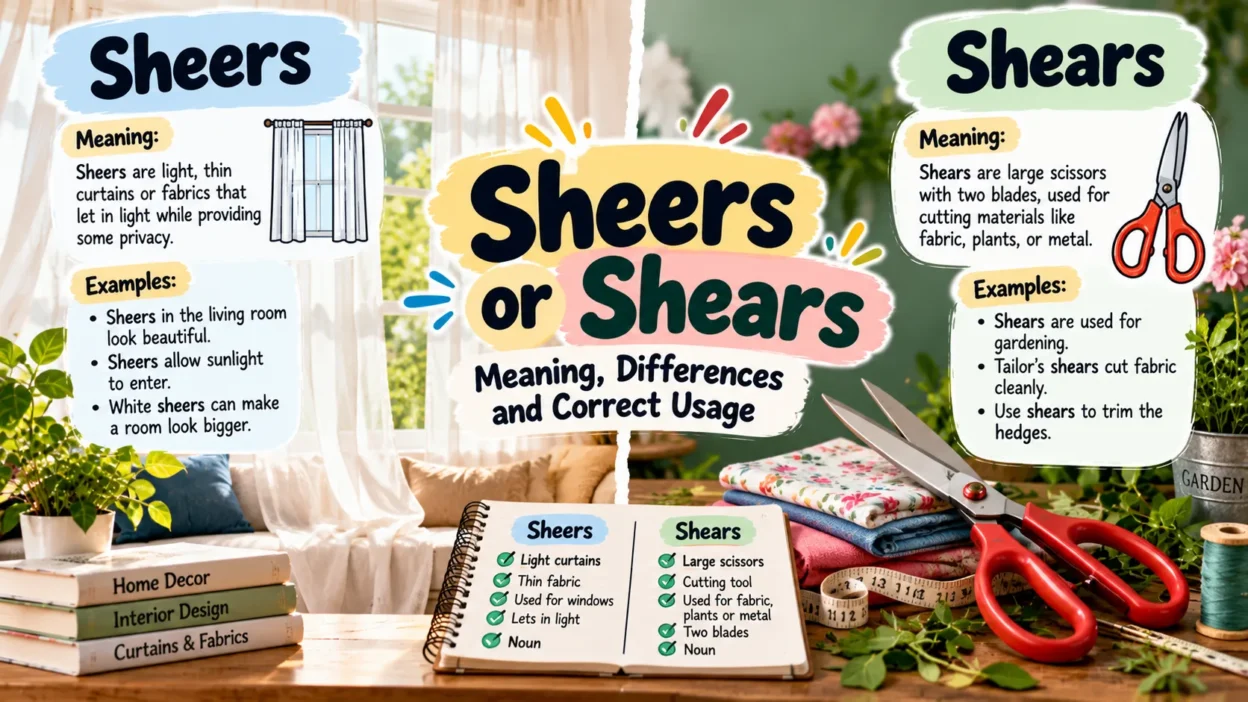
English spelling can be tricky when two words look and sound similar but carry different meanings. Sheers and shears are a good example. Both are legitimate English words, yet they are used in different contexts. Choosing the wrong one can make an otherwise clear sentence confusing, particularly when writing about clothing, gardening, hairdressing, or cutting tools.
The distinction becomes easier when you understand the role each word plays in a sentence. Shears usually refers to a cutting tool, while sheers is the plural form of sheer or a third-person singular form of the verb sheer, depending on the context.
Although the two spellings differ by only a few letters, their grammatical functions and meanings are not interchangeable.
Sheers vs. Shears: A Side-by-Side Comparison
| Feature | Sheers | Shears |
|---|---|---|
| Base word | Sheer | Shear |
| Common meaning | Plural of sheer, or a form of the verb sheer | A cutting instrument |
| Typical context | Fabrics, curtains, transparency, movement | Gardening, tailoring, hairdressing, livestock |
| Example | The sheer curtains softened the sunlight. | Shears are useful for trimming hedges. |
| Can refer to a cutting tool? | Not normally | Yes |
The most important distinction is that shears is the standard spelling for the cutting instrument. Sheers, on the other hand, can refer to sheer fabrics or curtains in some contexts, although the precise meaning depends on how the word is used.
What Does Shears Mean?
Shears are cutting tools with two blades that pivot around a central point. They are generally designed for cutting materials that may be too thick, tough, or demanding for ordinary scissors.
Shears come in different forms, depending on the task. Gardeners use hedge shears to trim shrubs, tailors use fabric shears to cut textiles, and professionals may use specialized shears for grooming or other precision work.
The word shears is plural in form. It is commonly treated as a plural noun when referring to a cutting tool, as in “These shears are sharp.” A single instrument can therefore be called a pair of shears.
Common Types of Shears
Garden shears: Used to trim plants, small branches, and shrubs. Their design depends on whether the user needs precision cutting or broader trimming.
Hedge shears: Designed for shaping hedges and cutting multiple small stems efficiently. They usually have long blades and handles that provide leverage.
Fabric shears: Used for cutting cloth during sewing, tailoring, and garment construction. They are designed to make clean cuts through textiles.
Pruning shears: Compact cutting tools used to remove individual stems, flowers, and small branches. They are also commonly called pruning snips or secateurs, depending on the design and region.
Sheep shears: Specialized tools used to remove wool from sheep. Traditional versions are manually operated, while modern equipment may be powered.
Examples of Shears in Sentences
- The gardener used hedge shears to shape the bushes.
- These fabric shears should be reserved for cutting cloth.
- The landscaper sharpened the shears before starting work.
- A pair of pruning shears can help remove damaged stems.
- The tailor selected professional shears for the heavy fabric.
- Please store the shears safely after using them.
In these examples, shears refers to cutting equipment. If your sentence describes a tool used to cut, trim, or shape something, this is usually the spelling you need.
What Does Sheers Mean?
Sheers has several possible uses because it is associated with the word sheer, which can function as an adjective or a verb.
As a plural noun, sheers can refer to sheer curtains or lightweight, translucent window coverings. These fabrics allow light to pass through while providing some degree of visual softness and privacy.
For example, “The white sheers allowed natural light to enter the room” uses sheers to describe lightweight curtains.
As a verb, sheers is the third-person singular form of sheer. The verb can mean to move suddenly away from a direction or course, often to avoid something.
For example, “The driver sheers away from the obstacle” uses sheers as a verb, although sheers away is less common in some varieties of English than veers away.
Sheers in Home Decor
In interior design, sheer curtains are lightweight window treatments made from fabrics that allow some light to pass through. People often layer them with heavier curtains or blinds to balance natural lighting, privacy, and decoration.
Examples include:
- The designer chose white sheers for the living room.
- Light gray sheers gave the bedroom a softer appearance.
- The sunlight filtered gently through the window sheers.
- We replaced the heavy drapes with lightweight sheers.
In these sentences, sheers refers to the curtains rather than a cutting tool.
Sheers as a Verb
The verb sheer can describe an abrupt change in direction or movement away from a path. Its form changes to sheers when the subject is third-person singular in the present tense.
Examples:
- The cyclist sheers away from the parked vehicle.
- The boat sheers off course in rough water.
- The animal sheers to one side when startled.
In many everyday contexts, alternatives such as veers, swerves, or moves sharply away may sound more natural. The appropriate choice depends on the intended meaning and writing style.
When Should You Use Sheers or Shears?
The correct word depends on what you are describing. Instead of focusing only on spelling, identify the object or action in your sentence.
| Your intended meaning | Correct word | Example |
|---|---|---|
| A tool for trimming hedges | Shears | The gardener cleaned the shears. |
| A tool for cutting fabric | Shears | She used fabric shears to cut the material. |
| Lightweight, translucent curtains | Sheers | The sheers softened the afternoon light. |
| Moving abruptly away from a course | Sheers | The vehicle sheers to the left. |
| A pair of cutting tools | Shears | He bought a new pair of shears. |
A practical memory aid is to associate shears with shearing and cutting. The verb to shear means to cut or remove something, such as wool from a sheep. This connection makes shears easier to remember when writing about tools.
For sheers, think of sheer curtains or the adjective sheer, which can describe something thin, transparent, steep, or complete, depending on the context.
Why Are Sheers and Shears Confused?
The words look similar and are pronounced alike in many varieties of English. This makes them easy to mix up, especially when typing quickly or writing about unfamiliar subjects.
Another source of confusion is that sheer and shear are themselves distinct words with different meanings.
- Sheer can mean transparent, very steep, or complete, as in “sheer fabric,” “a sheer cliff,” or “sheer determination.”
- Shear means to cut or remove something, especially wool, hair, or plant material.
- Sheers can refer to sheer curtains or function as a verb.
- Shears commonly refers to cutting tools.
Because both spellings are valid, a spelling checker may not identify an error when one is used in place of the other. The sentence must be checked for meaning as well as spelling.
Common Mistakes to Avoid
Using Sheers for Cutting Tools
Incorrect: “The gardener used the sheers to trim the hedge.”
Correct: “The gardener used the shears to trim the hedge.”
When referring to cutting equipment, use shears.
Using Shears for Curtains
Incorrect: “The white shears allowed sunlight to filter into the room.”
Correct: “The white sheers allowed sunlight to filter into the room.”
When sheers refers to lightweight curtains, the spelling with an e before the final r is appropriate.
Confusing Sheer With Shear
Incorrect: “The tailor used sheer to cut the fabric.”
Correct: “The tailor used shears to cut the fabric.”
The first sentence uses the wrong word for the cutting tool. Sheer and shear have different meanings, even though they differ by only one letter.
Treating Every Similar-Sounding Word as Interchangeable
Words with similar pronunciations are not necessarily synonyms. Before selecting a spelling, check whether the word functions as a noun, adjective, or verb and whether its meaning fits the sentence.
Frequently Asked Questions
Are sheers and shears pronounced the same?
Yes. In many English accents, sheers and shears are homophones, meaning they share the same pronunciation but have different meanings and spellings.
Is shears the correct word for cutting tools?
Yes. Shears is the standard word for cutting instruments used in gardening, tailoring, grooming, and other tasks. A single instrument is commonly called a pair of shears.
Can sheers mean curtains?
Yes. Sheers can refer to lightweight, translucent curtains. These curtains are commonly used to soften incoming sunlight and complement heavier window coverings.
Is it a pair of shears or a pair of shear?
The correct expression is a pair of shears. The noun is generally used in the plural form when referring to the cutting instrument.
What is the difference between sheer and shear?
Sheer can describe something transparent, steep, or complete. Shear means to cut or remove material, particularly wool, hair, or vegetation. The correct word depends on the intended meaning.
Which spelling should I use when writing about gardening?
Use shears when referring to tools used to trim hedges, prune plants, or cut branches. For example, “The gardener sharpened the pruning shears.”
Conclusion
The difference between sheers and shears depends on meaning and context. Shears refers primarily to cutting tools, while sheers can refer to lightweight curtains or serve as a form of the verb sheer.
When writing about gardening, sewing, or cutting equipment, choose shears. When describing translucent curtains or a movement away from a course, sheers may be appropriate.
Remembering the connection between shears and cutting is a simple way to avoid the most common mistake. With careful attention to context, you can use both words accurately in everyday and professional writing.

Miles Ellington enjoys exploring the subtle differences that can completely change how a word or phrase is understood. At Differology, he turns confusing language questions into straightforward explanations, covering word comparisons, vocabulary, grammar, usage, and everyday English.
With a practical and reader-focused approach, Miles uses real-world examples and clear comparisons to help readers choose the right word, understand its meaning, and communicate more precisely.