If you often get confused about to vs for, you are not alone. These two small words appear everywhere in English, but they serve different purposes in a sentence. Sometimes they both seem to describe a reason, person, or action, which makes choosing the correct one tricky.
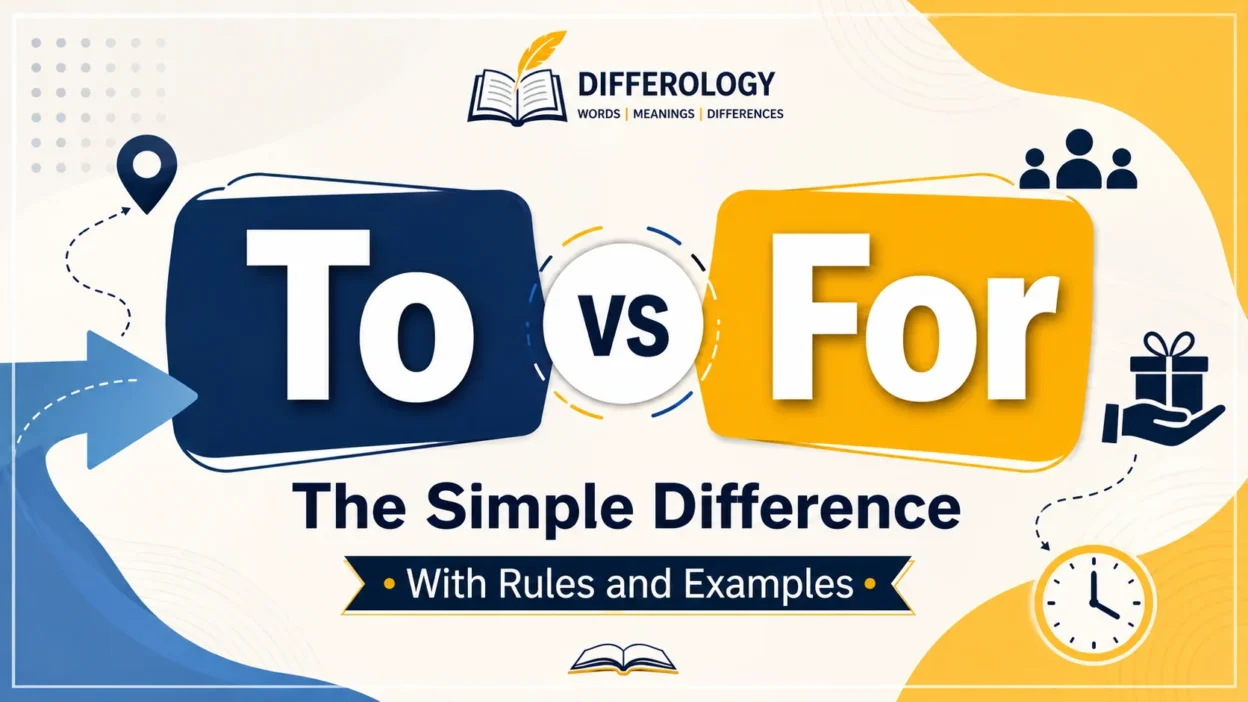
A simple starting point is that to often expresses direction, a destination, a recipient, or an action, while for commonly expresses benefit, purpose, duration, or intended use. However, there are several other patterns that you need to understand to use them correctly.
In this guide, you will learn the difference between to and for, when to use each one, common mistakes to avoid, and practical examples that make the rules easier to remember.
Quick Answer
To commonly shows direction, movement, a recipient, or purpose followed by a verb. For commonly shows benefit, purpose followed by a noun, duration, or intended use. For example, I went to the store to buy milk, while I bought milk for my family.
To vs For: At a Glance
| Word | Common Use | Main Idea | Example |
|---|---|---|---|
| To | Direction | Movement toward something | We walked to the park. |
| To | Recipient | Person receiving something | Give the book to Sarah. |
| To | Purpose + verb | Reason for an action | I went there to study. |
| For | Benefit | Someone who benefits | I bought it for Sarah. |
| For | Purpose + noun | Intended purpose | We went out for dinner. |
| For | Duration | Length of time | She stayed for two hours. |
The easiest way to start is to look at what comes after the preposition and what relationship you want to express.
What Does To Mean?
To is commonly used as a preposition to show direction, movement, destination, or a recipient. It is also used before the base form of a verb to create an infinitive.
To for Direction or Movement
Use to when someone or something moves toward a place or destination.
Examples:
- We drove to the airport.
- She walked to the library.
- They traveled to California.
- He ran to the door.
- I am going to work.
In these examples, to identifies where someone or something is moving.
To for a Recipient
Use to when something is given, sent, shown, explained, or transferred to another person.
Examples:
- I sent the email to my manager.
- She gave the keys to her brother.
- Please explain the problem to me.
- He handed the documents to the receptionist.
- We sent a card to our grandmother.
Here, to identifies the person who receives something or becomes the target of an action.
To + Verb
One of the most important patterns is to + base verb.
Examples:
- I went outside to get some fresh air.
- She studies every evening to improve her English.
- We stopped at the store to buy bread.
- He called to ask a question.
- They left early to avoid traffic.
This structure frequently expresses purpose.
What Does For Mean?
For is commonly used to express benefit, purpose, duration, intended use, support, or exchange.
For to Show Benefit
Use for when someone or something is intended to help or benefit another person.
Examples:
- I bought a gift for my sister.
- She made dinner for her children.
- This guide is for beginners.
- He saved a seat for his friend.
- I prepared some coffee for you.
The focus is on the person who benefits from the action or receives something intended for them.
For to Show Purpose With a Noun
A useful pattern is:
to + verb
for + noun
Compare:
- I went to the store to buy milk.
- I went to the store for milk.
More examples:
- She went to the kitchen to make coffee.
- She went to the kitchen for coffee.
- We went outside to get some fresh air.
- We went outside for fresh air.
The structure changes depending on whether you use a verb or noun to express the purpose.
For to Show Duration
Use for when you describe how long something lasts.
Examples:
- I waited for twenty minutes.
- She lived there for five years.
- We talked for an hour.
- They stayed in New York for a week.
- He has worked here for three months.
In each example, for introduces a period of time.
To vs For: What’s the Difference?
The main difference depends on the relationship you want to express.
To often points toward a destination, recipient, or action.
For often identifies a benefit, purpose, duration, or intended use.
Compare these examples:
- She sent a package to John.
- She bought a package for John.
In the first sentence, John is the recipient. In the second, John is the person the package is intended for.
Another comparison:
- I went to the gym to exercise.
- I went to the gym for exercise.
The first sentence uses to + verb. The second uses for + noun.
When to Use To
1. Use To for a Destination
- We went to the beach.
- She traveled to Spain.
- He walked to school.
- They moved to Boston.
2. Use To for a Recipient
- Give the book to James.
- Send the message to me.
- She explained the situation to her parents.
- He gave the documents to his assistant.
3. Use To + Verb for Purpose
- I called to ask about the appointment.
- He works hard to support his family.
- They left early to avoid traffic.
- She joined the course to improve her writing.
4. Use To in Certain Fixed Expressions
Some words naturally take to.
Examples include:
- similar to
- important to
- married to
- related to
- responsible to
- addicted to
For example:
- This problem is similar to the one we discussed yesterday.
- Family is important to me.
These combinations are best learned as natural expressions rather than trying to apply one rule to every situation.
When to Use For
1. Use For to Show Benefit
- I made this cake for you.
- She opened the door for the elderly man.
- This program is designed for students.
- He bought flowers for his mother.
2. Use For to Show Duration
- We stayed there for three days.
- He worked there for ten years.
- I waited for an hour.
3. Use For to Show Purpose With a Noun
- We went out for dinner.
- She is studying for an exam.
- He stopped by for coffee.
- They went to the store for groceries.
4. Use For to Show Support
- I am for the proposal.
- Are you for or against the plan?
Here, for means in support of something.
5. Use For to Show Exchange
- I bought the shirt for $30.
- She traded her old phone for a newer one.
- He exchanged his ticket for another seat.
To vs For When Talking About Purpose
Purpose is one of the areas where to and for are most frequently confused.
The basic pattern is:
To + verb
For + noun
Examples:
- I went to the library to study.
- I went to the library for research.
- She went outside to exercise.
- She went outside for exercise.
- He went to the store to buy bread.
- He went to the store for bread.
- We met to discuss the project.
- We met for a discussion about the project.
This is a useful rule, but it should not be treated as an absolute rule for every English sentence. Fixed expressions and natural word combinations also influence which preposition sounds correct.
To vs For When Talking About People
Both words can appear before a person’s name, but they often express different relationships.
Compare:
I bought a present for Maria.
Maria is the person the present is intended for.
I gave the present to Maria.
Maria is the person who receives the present.
Another example:
She cooked dinner for her husband.
The dinner was prepared for his benefit.
She served dinner to her husband.
Her husband is the person receiving the food.
This distinction can help you choose the correct preposition when talking about people.
Common Mistakes With To and For
Mistake 1: Using For Before a Purpose Verb
Incorrect:
I went to the store for buy some milk.
Correct:
I went to the store to buy some milk.
When the purpose is followed by a base verb, use to.
Mistake 2: Using To for Duration
Incorrect:
I lived there to five years.
Correct:
I lived there for five years.
Use for when describing how long something lasts.
Mistake 3: Confusing a Recipient With a Beneficiary
Incorrect:
I sent a gift for my friend.
If you mean your friend actually received the gift, use:
I sent a gift to my friend.
But this is correct:
I bought a gift for my friend.
The first sentence focuses on the recipient, while the second focuses on the person the gift was intended for.
Mistake 4: Assuming To and For Are Interchangeable
They are not.
- She went to the store.
- She went for groceries.
The first sentence focuses on the destination. The second focuses on the purpose.
Both can be correct, but they communicate different information.
Easy Way to Remember the Difference
A simple memory trick is:
TO = toward, destination, recipient, or action
FOR = benefit, purpose, duration, or intended use
Think about these examples:
- Go to a place.
- Give something to a person.
- Use to + verb for an action or purpose.
- Do something for someone.
- Use for with a period of time.
- Use for + noun when expressing purpose.
One sentence can show all three patterns:
I went to the store to buy flowers for my mother.
Here:
- to the store = destination
- to buy = purpose + verb
- for my mother = intended beneficiary
Special Cases and Fixed Expressions
Some uses of to and for cannot be explained with one simple rule because English contains many fixed expressions.
For example:
- respond to
- similar to
- listen to
- belong to
- pay for
- search for
- wait for
- apply for
Examples:
- She responded to my email.
- This design is similar to the original.
- Please listen to the instructions.
- I need to pay for the tickets.
- They are searching for a new apartment.
- She decided to apply for the position.
Learning common word-and-preposition combinations can make your English sound much more natural.
To vs For in Everyday English
In Text Messages
I’m going to the mall.
This tells someone your destination.
I went there for a gift.
This explains your purpose.
In Workplace Communication
Please send the report to the manager.
The manager is the recipient.
This report is for the manager.
The report is intended for the manager.
In Everyday Conversation
I went out to get coffee.
The purpose is expressed with to + verb.
I went out for coffee.
The purpose is expressed with for + noun.
Both sentences are natural, but the grammatical structure is different.
Related Questions About To vs For
Is to or for used before a verb?
When expressing purpose, to is normally followed by a base verb.
Example:
I went there to study.
For does not normally replace this structure.
Is it used to or used for?
These structures have different meanings.
Used to + verb can describe a past habit.
I used to walk to school.
Used for + noun or -ing form describes purpose or function.
This tool is used for cutting paper.
Is important to me or important for me correct?
Both can be correct, depending on meaning.
Family is important to me.
This expresses personal significance.
Exercise is important for me.
This can emphasize that exercise is beneficial or necessary.
Can to and for be used interchangeably?
Usually not. They perform different grammatical functions, although some sentences can express similar ideas using different constructions.
Do you use to or for with time?
Use for when describing duration.
I stayed there for three hours.
To can appear in expressions involving a point or range of time.
It is ten minutes to six.
Is it a gift to me or a gift for me?
Both expressions can be correct, but the focus differs.
A gift for me emphasizes that the gift is intended for you.
A gift to me can emphasize the act or relationship of giving.
Which is correct: to study or for study?
When expressing an action or purpose with a verb, use to + verb.
I went to the library to study.
For study can occur in specific noun-based contexts, but it is not a direct replacement for to study.
How can I remember the difference between to and for?
Remember that to often points toward a destination, recipient, or action, while for often shows benefit, purpose, or duration. Then learn common fixed expressions separately.
Final Takeaway
Understanding to vs for becomes much easier when you focus on the relationship each word expresses. Use to for destinations, movement, recipients, and purposes followed by a base verb. Use for for benefits, intended purposes with nouns, duration, support, and several established expressions.
A useful shortcut is to + verb for many purpose statements and for + noun when the purpose is expressed as a noun. However, English contains many fixed combinations, so context still matters.
The best way to master the difference is to notice these words in real sentences and practice using them in your own writing. With regular practice, choosing between to and for will become much more natural.ription

Miles Ellington enjoys exploring the subtle differences that can completely change how a word or phrase is understood. At Differology, he turns confusing language questions into straightforward explanations, covering word comparisons, vocabulary, grammar, usage, and everyday English.
With a practical and reader-focused approach, Miles uses real-world examples and clear comparisons to help readers choose the right word, understand its meaning, and communicate more precisely.