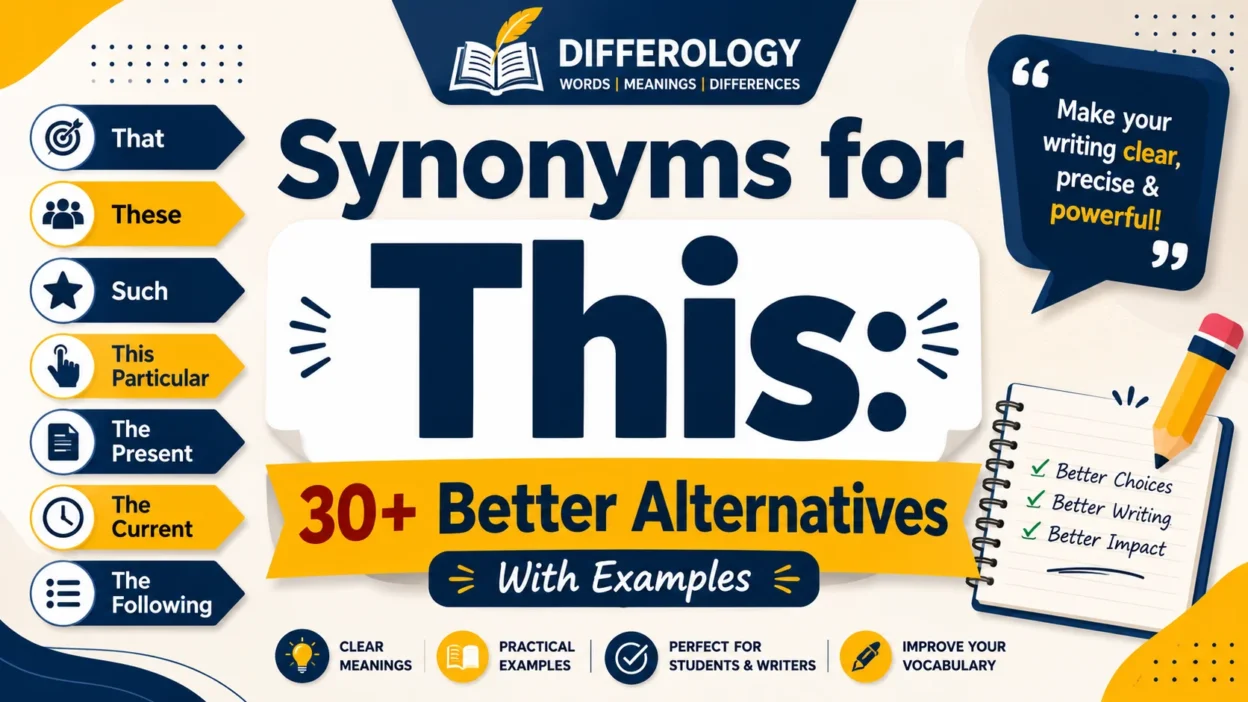
The word this is one of the most common words in English, and it is usually the right choice. However, using it repeatedly can make writing feel repetitive, vague, or less polished. Finding suitable synonyms for this can help you vary your language while making your meaning more precise.
The important thing to remember is that this does not have one universal synonym. The best alternative depends on whether this is being used as a determiner, pronoun, or adverb and what exactly it refers to. Common alternatives include that, these, such, this particular, the aforementioned, the present, the following, and the one in question, but they do not all work in the same situations.
In this guide, you will learn the meaning of this, its grammatical uses, useful alternatives for different contexts, and examples showing when each option works best.
Quick Answer
Some useful alternatives to this include that, these, such, this particular, the present, the aforementioned, the following, the one in question, this one, and the current. However, the correct choice depends on context. In many cases, rewriting the sentence with a specific noun is clearer than replacing this with another vague word.
What Does This Mean?
This is a demonstrative word used to point to a particular person, object, idea, situation, or period that is close to the speaker or writer in distance, time, or context.
For example:
- This book belongs to me.
- This problem needs attention.
- This is exactly what I wanted.
- This week has been extremely busy.
This can function as both a determiner and a pronoun. It can also appear in expressions where it functions adverbially.
The meaning changes slightly depending on how it is used.
This as a Determiner
When this comes before a noun, it identifies a specific singular person, thing, idea, or situation.
Examples:
- This article explains the difference.
- This computer is new.
- This idea could work.
- This situation requires attention.
This as a Pronoun
When this stands alone, it refers to a specific thing, person, idea, or situation.
Examples:
- This is my favorite.
- This looks interesting.
- I did not expect this.
- This was difficult to understand.
This for Time
This can also refer to the present period or a time close to the speaker.
Examples:
- This morning, I went for a walk.
- This week has been busy.
- We are working on it this month.
- I will finish it this year.
Because this has several grammatical roles, there is no single replacement that works everywhere.
30+ Synonyms and Alternatives for This
Here are some useful alternatives, grouped according to context.
| Alternative | Best Used For | Example |
|---|---|---|
| That | Something more distant | That idea sounds interesting. |
| These | Multiple nearby things | These examples are useful. |
| Such | Referring to something of a particular kind | Such behavior is unacceptable. |
| This particular | Emphasis or precision | This particular method works well. |
| The present | Formal or academic writing | The present study examines language. |
| The current | Something happening now | The current situation is changing. |
| The following | Introducing information that comes next | The following examples explain the rule. |
| The aforementioned | Formal reference to something already mentioned | The aforementioned issue requires attention. |
| The above | Referring to information already presented | The above example demonstrates the rule. |
| The one in question | Specific item under discussion | The one in question needs revision. |
| The given | A specified item or situation | The given example is useful. |
| The particular | A specific item | The particular issue is easy to solve. |
| This one | A specific individual item | This one is better. |
| The same | Referring to an identical thing | The same approach was used. |
| The current one | Presently relevant item | The current one is more effective. |
| The present case | Formal reference to a situation | The present case is unusual. |
| The matter | A subject or issue | The matter requires attention. |
| The subject | Something being discussed | The subject deserves further study. |
| The item | A specific object or entry | The item was removed. |
| The example | A previously mentioned example | The example illustrates the point. |
| The point | A previously discussed idea | The point is important. |
| The idea | A specific thought or concept | The idea could be improved. |
| The issue | A problem or topic | The issue remains unresolved. |
| The situation | A specific circumstance | The situation changed quickly. |
| The concept | An abstract idea | The concept is easy to understand. |
| The case | A particular situation | The case is different here. |
| The information | Previously provided facts | The information is useful. |
| The statement | A previously mentioned statement | The statement needs clarification. |
| The approach | A previously mentioned method | The approach is practical. |
| The method | A particular process | The method produces better results. |
Best Synonyms for This in Formal Writing
In professional and academic writing, repeatedly using this can sometimes create vague references. More precise alternatives can improve clarity.
1. The Present
The present works well when referring to the current study, situation, document, or period.
Examples:
- The present study examines vocabulary development.
- The present analysis focuses on word usage.
- The present situation requires further attention.
This alternative is particularly useful in academic contexts.
2. The Current
Use the current when referring to something happening or existing now.
Examples:
- The current situation is difficult.
- The current approach is more effective.
- The current system needs improvement.
3. The Aforementioned
The aforementioned refers to something that was already mentioned earlier.
Example:
- The aforementioned issue requires additional research.
This expression is formal and can sound overly stiff in casual writing, so use it when the tone calls for it.
4. The Following
Use the following when you are about to introduce information, examples, points, or details.
Examples:
- Consider the following examples.
- The following points explain the difference.
- The following information may help you understand the topic.
This is often better than repeatedly using this when introducing material.
5. The Above
The above can refer to information already presented.
Example:
- The above example demonstrates the difference.
- The above points support the argument.
However, naming the exact subject can often make professional writing clearer.
Synonyms for This in Academic Writing
Academic writing usually benefits from precision rather than simply replacing common words with complicated alternatives.
Instead of:
- This shows that the results are important.
You could write:
- The result shows that the findings are important.
- The evidence indicates that the findings are important.
- This result indicates that the findings are important.
Notice that the third example still uses this, but it adds the noun result. That often creates more clarity than replacing this with an unnecessarily formal synonym.
For example:
Instead of:
- This demonstrates the importance of vocabulary.
Try:
- This finding demonstrates the importance of vocabulary.
- The evidence demonstrates the importance of vocabulary.
- The result highlights the importance of vocabulary.
A strong writing practice is to identify what this refers to and name it directly.
Synonyms for This in Professional Writing
In workplace communication, clarity usually matters more than using sophisticated vocabulary.
Instead of:
- This needs to be completed by Friday.
You can write:
- The report needs to be completed by Friday.
- The project needs to be completed by Friday.
- The requested task needs to be completed by Friday.
If the noun is already obvious, this may be perfectly acceptable:
- This needs to be completed by Friday.
The best choice depends on whether your reader can easily identify what this refers to.
Synonyms for This in Essays
Students often look for alternatives to this because they use it repeatedly in essays.
Consider:
- This shows that the character is unhappy.
- This proves that the argument is weak.
- This demonstrates the importance of education.
Instead of replacing this every time, make the reference more specific:
- The character’s behavior shows that he is unhappy.
- The lack of evidence suggests that the argument is weak.
- The research findings demonstrate the importance of education.
This approach makes academic writing clearer and more precise.
This vs That
This and that are related demonstratives, but they are not always interchangeable.
Generally, this points to something closer, while that points to something farther away in physical, temporal, or conversational context.
Examples:
- This book is in my hand.
- That book is on the other table.
The same distinction can apply to ideas and situations.
- This problem needs immediate attention.
- That problem we discussed last month has been resolved.
In many contexts, the choice depends on how close or distant the speaker considers the subject.
This vs These
The difference between this and these is mainly grammatical number.
Use this with singular nouns:
- This book
- This idea
- This problem
- This example
Use these with plural nouns:
- These books
- These ideas
- These problems
- These examples
Examples:
- This example is easy to understand.
- These examples are easy to understand.
Therefore, these is not simply a synonym for this. It is the plural form used with multiple things.
This vs Such
Such can sometimes replace this when referring to something of a particular type or kind.
Compare:
- This behavior is unacceptable.
- Such behavior is unacceptable.
The first sentence points more directly to a specific behavior. The second emphasizes the type or nature of the behavior.
More examples:
- This situation is unusual.
- Such a situation is unusual.
- This mistake can cause confusion.
- Such mistakes can cause confusion.
The meaning is related, but the emphasis changes.
This vs The Following
These expressions often serve different purposes.
Use this to refer to something currently being discussed:
- This example is important.
Use the following to introduce information that comes next:
- The following example explains the difference.
Examples:
- This section explains the rule.
- The following section explains the rule.
The first points to the current section, while the second introduces something that follows.
This vs The Aforementioned
The aforementioned refers specifically to something already mentioned.
Example:
- The aforementioned study provides useful evidence.
It can replace this in some formal contexts, but it is not always the best option.
For example:
- This study provides useful evidence.
is simpler and more natural in most writing.
The aforementioned can sound excessively formal when used repeatedly. Therefore, use it selectively.
When You Should Not Replace This
Not every use of this needs a synonym.
Sometimes this is the clearest and most natural word.
Examples:
- This is my favorite book.
- This looks great.
- This is exactly what I needed.
- I cannot believe this happened.
- This morning was beautiful.
Replacing these sentences with formal alternatives could make them sound unnatural.
Good writing is not about eliminating common words. It is about using the right word for the context.
Common Mistakes When Replacing This
1. Choosing a Synonym That Changes the Meaning
Do not replace this with that simply to avoid repetition.
The two words can indicate different degrees of proximity.
2. Using Overly Formal Language
Words such as aforementioned and heretofore can sound unnatural in everyday writing.
For example:
- The aforementioned issue…
may be unnecessarily formal when:
- The issue mentioned earlier…
would be clearer.
3. Using This Without a Clear Reference
A vague this can confuse readers.
For example:
- The company changed its pricing and redesigned its website. This caused problems.
What does this refer to: the pricing change, the redesign, or both?
A clearer version might be:
- The pricing change caused problems for existing customers.
Naming the exact subject removes ambiguity. Writing guidance from Penn State similarly recommends making the noun referred to by this explicit when the reference could otherwise be unclear.
4. Using a Plural Alternative With a Singular Noun
Incorrect:
- This examples are useful.
Correct:
- This example is useful.
- These examples are useful.
Always match the demonstrative with the noun’s number.
How to Choose the Right Alternative for This
Use the context to decide which alternative works best.
| Situation | Best Choice |
|---|---|
| Referring to something farther away | That |
| Referring to multiple things | These |
| Referring to a type or kind | Such |
| Adding precision | This particular |
| Academic writing | The present |
| Current situation | The current |
| Introducing information | The following |
| Referring to earlier information | The aforementioned |
| Referring to information above | The above |
| Specific item under discussion | The one in question |
| Casual speech | This one |
| Maximum clarity | Specific noun |
The goal is not to replace this every time. The goal is to choose the expression that communicates your meaning most accurately.
Examples of Better Alternatives for This
Here are some quick sentence transformations:
Original
This method works well.
More Specific
The method described above works well.
Original
This problem is common.
More Specific
The grammar problem is common.
Original
This shows that the plan failed.
More Specific
The final result shows that the plan failed.
Original
This is important for students.
More Specific
The distinction is important for students.
Original
This information is useful.
More Specific
The information in the previous section is useful.
These examples show why a specific noun can sometimes be better than a traditional synonym.
Frequently Asked Questions
What is the best synonym for this?
There is no single best synonym. Depending on context, useful alternatives include that, these, such, the present, the current, the following, this particular, and the aforementioned.
What is a formal word for this?
Depending on the context, the present, the aforementioned, the following, or the particular may work. However, formal does not always mean better. The simplest accurate word is usually preferable.
Can I use that instead of this?
Sometimes. That generally refers to something farther away in physical, temporal, or conversational context. Changing this to that can therefore change the meaning.
Is these a synonym for this?
Not exactly. This is singular, while these is plural. Use this with one thing and these with multiple things.
What can I use instead of this in an essay?
Try a specific noun such as the result, the evidence, the argument, the finding, the example, or the study. These alternatives often make academic writing clearer than simply replacing this with a formal synonym.
What can I say instead of this in professional writing?
Depending on the context, you can use the current, the present, the following, the specific issue, the relevant point, or a precise noun that identifies what you mean.
Is the aforementioned a synonym for this?
It can function as a contextual alternative when referring to something already mentioned. However, it is more formal and should not be used as a replacement for every occurrence of this.
How do I avoid repeating this in writing?
First determine what this refers to. Then consider whether you can replace it with a specific noun, such as the issue, the result, the finding, the method, or the example. This often improves clarity more than using another vague demonstrative.
Final Thoughts
There are many useful synonyms for this, but the best alternative depends on the sentence and the meaning you want to communicate. Words such as that, these, such, the current, the present, the following, and the aforementioned can work in specific contexts, but they are not interchangeable.
For clear writing, do not feel that you must eliminate this completely. It is a normal and useful English word. Instead, watch for repeated or vague references and replace them with a more precise expression when necessary. In many cases, the strongest alternative is not another synonym at all but a specific noun that tells readers exactly what you mean.

Miles Ellington enjoys exploring the subtle differences that can completely change how a word or phrase is understood. At Differology, he turns confusing language questions into straightforward explanations, covering word comparisons, vocabulary, grammar, usage, and everyday English.
With a practical and reader-focused approach, Miles uses real-world examples and clear comparisons to help readers choose the right word, understand its meaning, and communicate more precisely.