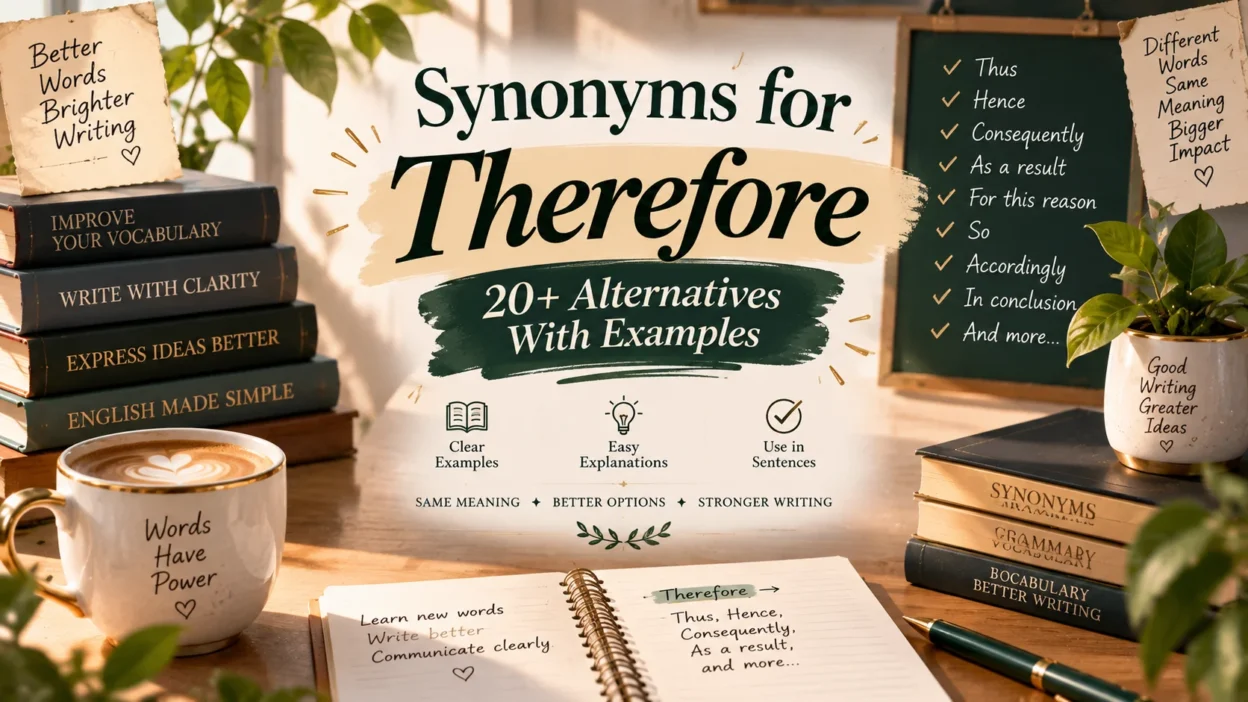
The word therefore is commonly used to show a result, conclusion, or logical connection between two ideas. It is especially common in academic writing, essays, reports, business communication, and formal English. While it is useful, repeating therefore too often can make your writing sound repetitive.
Fortunately, there are many synonyms for therefore that can help you express the same general idea in different ways. Common alternatives include thus, hence, consequently, accordingly, as a result, for this reason, and that’s why. However, these expressions are not always interchangeable because some sound formal, some are conversational, and others work best when introducing a clear consequence.
This guide explains the best alternatives to therefore, what they mean, how formal they sound, and how to use them naturally in sentences.
Quick Answer
The best synonyms for therefore include thus, hence, consequently, accordingly, as a result, for this reason, because of this, for that reason, and that’s why. For academic and formal writing, use words such as thus, hence, consequently, and accordingly. For everyday English, so, that’s why, and because of this usually sound more natural.
Synonyms for Therefore at a Glance
| Alternative | Tone | Best Use | Example |
|---|---|---|---|
| Thus | Formal | Academic and logical conclusions | The data was incomplete; thus, the results were limited. |
| Hence | Formal | Conclusions and explanations | The road was closed; hence, we took another route. |
| Consequently | Formal | Clear results | He missed the deadline; consequently, the project was delayed. |
| Accordingly | Formal | Actions based on circumstances | The plan changed, and we acted accordingly. |
| As a result | Neutral | Cause and effect | It rained heavily; as a result, the match was canceled. |
| For this reason | Neutral/Formal | Explaining why | The product was defective. For this reason, we requested a refund. |
| Because of this | Neutral | Direct consequence | The store was closed. Because of this, we went elsewhere. |
| That’s why | Casual | Everyday conversation | I was tired. That’s why I went home early. |
| So | Casual/Neutral | Everyday speech | It was late, so we left. |
What Does Therefore Mean?
Therefore is an adverb used to introduce a result, conclusion, or consequence that follows from something previously stated.
Examples:
- The weather was severe; therefore, the flight was canceled.
- She studied consistently; therefore, she passed the exam.
- The evidence was insufficient; therefore, the case was dismissed.
- The store was closed; therefore, we returned home.
The basic relationship is:
Cause or reason → therefore → result
For example:
The road was flooded; therefore, we took another route.
The flooding is the reason, and taking another route is the result.
1. Thus
Thus is one of the closest alternatives to therefore. It is common in academic, technical, professional, and formal writing.
Examples:
- The sample was too small; thus, the results were inconclusive.
- He failed to submit the form; thus, his application was rejected.
- The evidence was limited; thus, further research was required.
Thus is concise and works especially well when you want to show a logical conclusion.
2. Hence
Hence is a formal alternative that introduces a consequence or conclusion.
Examples:
- The road was blocked; hence, we had to find another route.
- The evidence was incomplete; hence, the investigation continued.
- The company reduced its expenses; hence, its profits increased.
Hence can sometimes sound more formal or traditional than therefore, so it is more common in academic, technical, and formal writing than casual conversation.
3. Consequently
Consequently means as a result or because of what happened previously.
Examples:
- He ignored the warning; consequently, he faced serious problems.
- Sales declined; consequently, the company reduced production.
- The team practiced regularly; consequently, its performance improved.
This word strongly emphasizes the connection between a cause and its result.
4. Accordingly
Accordingly can mean as a result and is often used when someone takes action based on a situation.
Examples:
- The circumstances changed, and we acted accordingly.
- The instructions were updated; the employees were trained accordingly.
- Demand increased; the company adjusted its production accordingly.
It is especially useful in professional and formal writing.
5. As a Result
As a result is one of the clearest and most natural alternatives to therefore.
Examples:
- It rained all night. As a result, the streets flooded.
- She worked hard. As a result, she earned a promotion.
- The company improved its service. As a result, customer satisfaction increased.
Unlike some formal alternatives, as a result works well in both everyday and professional writing.
6. For This Reason
For this reason means because of the reason just explained.
Examples:
- The instructions were unclear. For this reason, many people made mistakes.
- The road was unsafe. For this reason, the area was closed.
- He wanted more experience. For this reason, he accepted the position.
It is particularly useful when you want to make the connection between a reason and a conclusion very clear.
7. Because of This
Because of this directly identifies the previous situation as the reason for what follows.
Examples:
- The weather changed suddenly. Because of this, the event was postponed.
- The machine stopped working. Because of this, production slowed down.
- She had limited experience. Because of this, she received additional training.
This expression is natural and easy to understand.
8. For That Reason
For that reason is similar to for this reason, but it usually refers to something previously mentioned.
Examples:
- The road was dangerous. For that reason, we avoided it.
- He wanted to save money. For that reason, he chose the cheaper option.
- The evidence was unreliable. For that reason, the claim was rejected.
It works well in formal and neutral writing.
9. That’s Why
That’s why is a natural conversational alternative to therefore.
Examples:
- I was feeling sick. That’s why I stayed home.
- She studied hard. That’s why she passed the test.
- The store was closed. That’s why we went somewhere else.
It is friendly and conversational, making it better suited to speech, messages, blogs, and informal writing.
10. So
So is one of the most common everyday alternatives to therefore.
Examples:
- It was raining, so we stayed inside.
- I was tired, so I went to bed early.
- The restaurant was full, so we chose another one.
Although so is extremely natural, it is usually less formal than therefore.
More Synonyms for Therefore
Here are additional alternatives and related expressions:
- Thus
- Hence
- Consequently
- Accordingly
- As a result
- For this reason
- For that reason
- Because of this
- Because of that
- That’s why
- So
- As a consequence
- In consequence
- It follows that
- On that account
- Due to this
- Due to that
- Resultantly
- Ergo
- Thereupon
- From this
- For this purpose
- In light of this
- Given this
- Based on this
- In response
- As such
- In turn
- This means that
- This resulted in
Some of these are not exact synonyms in every sentence. They express a related cause-and-effect relationship and should be chosen according to context.
Synonyms for Therefore in Formal Writing
If you are writing an academic paper, report, essay, or professional document, these alternatives are particularly useful:
- Thus
- Hence
- Consequently
- Accordingly
- As a result
- For this reason
- It follows that
- In light of this
- As a consequence
Examples:
- The sample size was limited; thus, the findings should be interpreted carefully.
- The evidence was inconsistent; consequently, further research was necessary.
- The circumstances changed; accordingly, the original plan was revised.
These choices can make formal writing more varied without making the language unnecessarily complicated.
Synonyms for Therefore in Academic Writing
Academic writing often uses therefore to connect evidence with a conclusion.
Instead of repeating it, you can use:
- Thus
- Hence
- Consequently
- Accordingly
- As a result
- It follows that
- For this reason
Examples:
The study included a limited number of participants. Therefore, the findings cannot be generalized.
Alternative:
The study included a limited number of participants. Thus, the findings cannot be generalized.
Another option:
The study included a limited number of participants. Consequently, the findings cannot be generalized.
The important thing is to maintain the logical relationship between the two ideas.
Synonyms for Therefore in Essays
When writing an essay, variety can improve readability.
Instead of:
The character made several poor decisions. Therefore, the situation became worse.
You could write:
The character made several poor decisions. As a result, the situation became worse.
Or:
The character made several poor decisions. Consequently, the situation became worse.
Or:
The character made several poor decisions. For this reason, the situation became worse.
Choose the alternative based on the tone and relationship between the ideas.
Synonyms for Therefore in Professional Writing
Professional writing usually benefits from clear and direct language.
Good alternatives include:
- Consequently
- Accordingly
- As a result
- For this reason
- Thus
- Because of this
Examples:
The supplier increased its prices. As a result, our operating costs increased.
The deadline was moved forward. Accordingly, the team adjusted its schedule.
The product did not meet the required standards. For this reason, we requested a replacement.
Synonyms for Therefore in Casual Writing
In everyday conversations and informal messages, formal alternatives can sound unnecessarily stiff.
Instead, use:
- So
- That’s why
- Because of this
- Because of that
- As a result
Examples:
I was exhausted, so I went home.
I missed the bus. That’s why I was late.
The restaurant was closed. So we ordered takeout.
These expressions sound more natural in conversation.
Therefore vs Thus
Therefore and thus are very close in meaning and can often replace each other.
Compare:
The experiment failed; therefore, we repeated it.
The experiment failed; thus, we repeated it.
Both sentences express a conclusion based on the previous information.
However, thus can sometimes mean in this way or in this manner, so its meaning depends on context.
Therefore vs Hence
Both words can introduce a result or conclusion.
Compare:
The road was closed; therefore, we turned around.
The road was closed; hence, we turned around.
Both are grammatically possible. Hence tends to sound more formal or literary.
Therefore vs Consequently
Both can introduce a result, but consequently often puts stronger emphasis on the consequence.
Compare:
The company lost several major customers; therefore, it reduced its expenses.
The company lost several major customers; consequently, it reduced its expenses.
The second version emphasizes the direct consequence of losing customers.
Therefore vs As a Result
These expressions are often interchangeable.
Compare:
The weather was severe; therefore, the flight was canceled.
The weather was severe. As a result, the flight was canceled.
As a result is often easier for general readers to understand and sounds natural in both formal and neutral writing.
Therefore vs So
The biggest difference is usually formality.
Formal:
The evidence was insufficient; therefore, the claim could not be verified.
Everyday:
The evidence wasn’t enough, so we couldn’t verify the claim.
Both express a result, but so is much more common in everyday speech.
How to Choose the Right Synonym for Therefore
Think about the tone and the type of relationship you want to express.
| Context | Best Alternatives |
|---|---|
| Academic | Thus, hence, consequently |
| Formal | Therefore, consequently, accordingly |
| Professional | Accordingly, as a result, consequently |
| Neutral | As a result, for this reason |
| Casual | So, that’s why |
| Clear explanation | Because of this, for that reason |
| Strong consequence | Consequently, as a consequence |
| Logical conclusion | Thus, hence, it follows that |
Choosing based on context makes your writing sound more natural.
Common Mistakes When Using Synonyms for Therefore
Using a Formal Word in Casual Conversation
Words like hence, thus, and accordingly can sound overly formal in everyday speech.
Instead of:
I was tired; hence, I went home.
A natural conversation would usually use:
I was tired, so I went home.
Using Therefore Without a Clear Cause
Therefore should connect an idea with a logical result.
Weak:
She likes coffee. Therefore, the meeting was successful.
The two ideas do not have a clear logical connection.
Better:
The team prepared thoroughly. Therefore, the meeting was successful.
Confusing Cause With Result
Therefore introduces the result, not the cause.
The road was flooded; therefore, we stayed home.
The flooding is the cause, and staying home is the result.
Overusing Therefore
Repeating therefore in every paragraph can make writing monotonous.
Instead, vary your transitions naturally:
- Therefore
- Thus
- As a result
- Consequently
- For this reason
However, do not replace it simply for the sake of variation. The transition should fit the sentence.
Punctuation With Therefore
The punctuation used with therefore depends on its position in the sentence.
Therefore Between Two Independent Clauses
A semicolon can be used before therefore, followed by a comma.
Example:
The weather was severe; therefore, the event was canceled.
Therefore at the Beginning of a Sentence
A comma commonly follows therefore when it introduces the sentence.
Example:
Therefore, the team decided to postpone the meeting.
Within a Sentence Therefore
Therefore can also appear in the middle of a sentence.
Example:
The team was therefore unable to continue.
The punctuation depends on the sentence structure rather than the word itself.
Frequently Asked Questions
What is the best synonym for therefore?
The best alternative depends on context. Thus, hence, consequently, as a result, and for this reason are among the most useful choices.
What is a simple word for therefore?
So is the simplest and most common everyday alternative. As a result is another clear option.
What is a formal synonym for therefore?
Common formal alternatives include thus, hence, consequently, accordingly, and as a consequence.
Can I use thus instead of therefore?
Yes, in many sentences. Both can introduce a logical result or conclusion. However, thus has additional meanings in some contexts, so always check the sentence.
Is hence the same as therefore?
In many formal contexts, yes. Both can introduce a consequence or conclusion. Hence generally has a more formal or traditional tone.
What can I use instead of therefore in an essay?
Good choices include thus, consequently, hence, as a result, for this reason, and accordingly.
What is the casual alternative to therefore?
So and that’s why are natural casual alternatives.
How can I avoid repeating therefore?
Use a variety of context-appropriate transitions such as thus, consequently, as a result, for this reason, and accordingly. You can also restructure sentences instead of adding a transition every time.
Final Thoughts
There are many useful synonyms for therefore, but choosing the right one depends on your audience, tone, and the relationship between your ideas. Thus and hence are strong formal alternatives, while consequently emphasizes a result. As a result and for this reason are clear and versatile, while so and that’s why work naturally in casual English.
The goal is not to replace therefore every time you use it. Instead, choose the transition that best explains the connection between your ideas. When the relationship is clear and the wording matches the context, your writing will sound more natural, precise, and professional.

Miles Ellington enjoys exploring the subtle differences that can completely change how a word or phrase is understood. At Differology, he turns confusing language questions into straightforward explanations, covering word comparisons, vocabulary, grammar, usage, and everyday English.
With a practical and reader-focused approach, Miles uses real-world examples and clear comparisons to help readers choose the right word, understand its meaning, and communicate more precisely.