
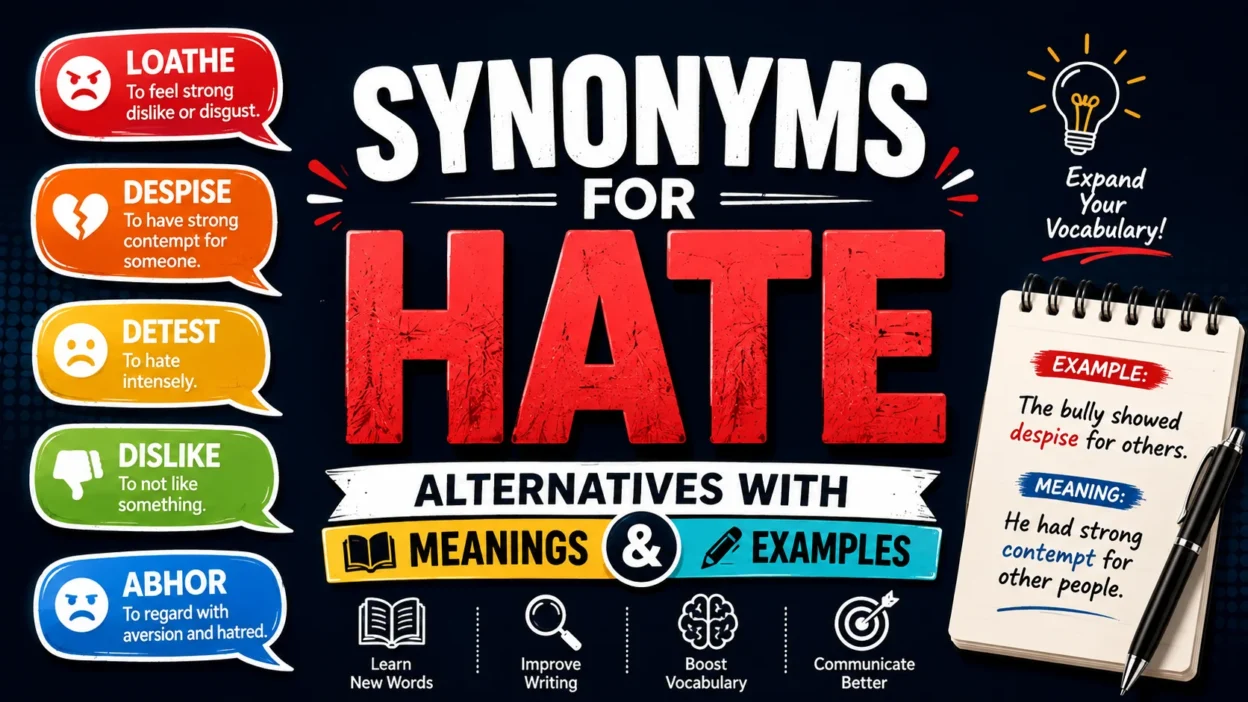
The word hate expresses a very strong feeling of dislike, hostility, or intense negativity toward a person, thing, activity, or situation. However, hate can have different levels of intensity. You might simply dislike something, detest it strongly, or loathe it with extreme intensity.
Choosing the right synonym makes your writing more precise. For example, dislike sounds much milder than hate, while despise and detest communicate a much stronger reaction. Words such as resent, abhor, and disdain add different shades of meaning rather than simply repeating the same idea.
Quick Guide to Hate Synonyms
| Word | Meaning | Strength | Example |
|---|---|---|---|
| Dislike | Not like something | Mild | I dislike crowded places. |
| Detest | Strongly dislike | Very strong | She detests dishonesty. |
| Loathe | Hate intensely | Very strong | He loathes being ignored. |
| Despise | Regard with intense contempt | Very strong | They despise corruption. |
| Abhor | Hate deeply, especially for moral reasons | Very strong | She abhors cruelty. |
| Disdain | Regard as unworthy or beneath you | Strong | He disdains dishonest behavior. |
| Resent | Feel anger about unfair treatment | Strong | She resents being treated unfairly. |
| Detest | Strongly dislike | Very strong | I detest unnecessary drama. |
What Does Hate Mean?
Hate means to feel intense dislike, hostility, or strong negative emotion toward someone or something.
It can describe:
- People
- Activities
- Situations
- Behaviors
- Ideas
- Experiences
- Objects
Examples:
- I hate waiting in long lines.
- She hates dishonesty.
- He hates being ignored.
- They hate unfair treatment.
The word can function as both a verb and a noun.
As a verb:
She hates loud noises.
As a noun:
His hate for injustice was obvious.
Synonyms for Hate by Intensity
Not every alternative has the same emotional strength. This scale can help you choose a more accurate word.
Mild Dislike
Use these when you do not actually feel intense hatred:
- Dislike
- Disapprove of
- Object to
- Avoid
- Be uncomfortable with
- Have no liking for
- Be opposed to
Examples:
- I dislike overly sweet food.
- She objects to unnecessary rules.
- He is uncomfortable with public speaking.
Strong Dislike
When your reaction is much stronger, consider:
- Detest
- Loathe
- Despise
- Abhor
- Disdain
- Resent
- Disfavor
- Disapprove strongly
Examples:
- She detests dishonesty.
- He loathes being lied to.
- They despise corruption.
Extreme or Dramatic Alternatives
For literary or highly emotional writing, you might use:
- Abhor
- Despise
- Loathe
- Detest
- Abominate
- Vilify
- Curse
- Reject
- Condemn
- Execrate
These words can sound much stronger or more dramatic than ordinary hate.
Synonyms for Hate That Focus on Dislike
Dislike
Dislike is the most common mild alternative to hate.
It communicates negative feelings without suggesting extreme hostility.
Examples:
- I dislike crowded restaurants.
- She dislikes being late.
- He dislikes spicy food.
If hate sounds too strong for your sentence, dislike is often the best replacement.
Detest
Detest means to dislike something or someone intensely.
Examples:
- I detest dishonesty.
- She detests rude behavior.
- He detests wasting time.
Detest is stronger than dislike but natural in both everyday and formal writing.
Loathe
Loathe means to hate or dislike something intensely.
Examples:
- She loathes hypocrisy.
- He loathes getting up early.
- They loathe unnecessary meetings.
Loathe often sounds more emotional than detest.
Synonyms for Hate That Show Contempt
Sometimes hate involves looking down on someone rather than simply disliking them.
Despise
Despise means to regard someone or something as extremely bad, worthless, or unworthy of respect.
Examples:
- She despises dishonesty.
- He despises people who abuse their power.
- They despise corruption.
Despise combines strong dislike with contempt.
Disdain
Disdain means to feel that someone or something is unworthy of respect or attention.
Examples:
- He disdains dishonest tactics.
- She disdains shallow criticism.
- The manager showed disdain for the proposal.
Disdain is often more formal than hate.
Synonyms for Hate That Show Moral Opposition
Some alternatives work best when you strongly reject something because you believe it is wrong.
Abhor
Abhor means to hate something intensely, especially because you consider it morally wrong or offensive.
Examples:
- She abhors cruelty.
- He abhors discrimination.
- They abhor violence.
Abhor is especially useful in formal and serious writing.
Condemn
Condemn does not mean exactly the same thing as hate. It means to strongly criticize or declare something wrong.
Examples:
- Leaders condemned the attack.
- The organization condemned the discriminatory policy.
Use condemn when the focus is public or moral disapproval rather than personal emotion.
Synonyms for Hate That Express Anger
Resent
Resent means to feel bitterness or anger because of something unfair, unpleasant, or offensive.
Examples:
- She resents being treated unfairly.
- He resents the criticism.
- They resent the extra workload.
Resent is different from hate because it usually involves a specific reason for the anger.
Begrudge
Begrudge means to feel unhappy or resentful about something another person has or receives.
Examples:
- She does not begrudge him his success.
- He begrudged them the opportunity.
It is usually more specific than hate.
Hate Synonyms for Formal Writing
In formal or academic writing, choose words that describe the exact kind of negative response.
Useful options include:
- Abhor
- Detest
- Disdain
- Condemn
- Reject
- Oppose
- Disapprove
- Resent
- Deplore
- Vilify
Examples:
- The organization condemned the practice.
- Researchers disapproved of the policy.
- The author criticized the decision.
- The community opposed the proposal.
These alternatives can sound more precise than simply saying everyone hated the decision.
Hate Synonyms for Casual English
Everyday English usually favors simple vocabulary.
Try:
- Dislike
- Can’t stand
- Can’t bear
- Can’t tolerate
- Can’t stand the sight of
- Be sick of
- Be fed up with
- Not be a fan of
Examples:
- I can’t stand waiting in traffic.
- She can’t bear loud chewing.
- He is not a fan of early mornings.
- We are fed up with the delays.
These expressions are conversational rather than formal.
Hate Synonyms for Strong Emotional Writing
If you are writing a story, poem, personal essay, or dramatic description, stronger vocabulary can create more emotion.
Consider:
- Loathe
- Detest
- Despise
- Abhor
- Abominate
- Disdain
- Resent
- Vilify
- Curse
- Reject
Examples:
- She loathed the betrayal.
- He despised the man who betrayed him.
- The character abhorred injustice.
Choose the word according to the emotion you want readers to feel.
Hate vs Dislike
Dislike is much milder than hate.
Compare:
I dislike horror movies.
I hate horror movies.
The first sentence expresses a negative preference. The second communicates a much stronger emotional reaction.
If you are trying to avoid exaggeration, dislike is usually a better choice.
Hate vs Detest
Detest is a strong synonym for hate.
Compare:
She hates dishonesty.
She detests dishonesty.
Both sentences express strong dislike. Detest can sound slightly more formal and deliberate.
Hate vs Loathe
Loathe expresses intense dislike and often carries strong emotional force.
Compare:
He hates being ignored.
He loathes being ignored.
Loathe emphasizes the intensity of the negative feeling.
Hate vs Despise
Despise adds an element of contempt.
Compare:
They hate the corrupt official.
They despise the corrupt official.
Despise suggests that they not only dislike the person but also consider the person contemptible or unworthy of respect.
Hate vs Abhor
Abhor often appears when someone strongly rejects something morally offensive.
Examples:
- She abhors cruelty.
- He abhors discrimination.
- They abhor injustice.
Abhor is particularly effective when the subject involves ethics or serious wrongdoing.
Hate vs Resent
These words describe different emotions.
Hate means intense dislike or hostility.
Resent means feeling anger or bitterness because of something you believe is unfair or offensive.
Compare:
I hate dishonesty.
I resent being treated dishonestly.
The second sentence focuses on the personal unfairness involved.
Hate Synonyms by Situation
| Situation | Best Alternative |
|---|---|
| Mild negative preference | Dislike |
| Very strong dislike | Detest |
| Intense emotional hatred | Loathe |
| Hatred mixed with contempt | Despise |
| Moral hatred | Abhor |
| Feeling bitterness | Resent |
| Looking down on something | Disdain |
| Public rejection | Condemn |
| Strong disagreement | Oppose |
| Casual conversation | Can’t stand |
| Formal criticism | Deplore |
| Literary expression | Abominate |
50+ Synonyms and Related Alternatives for Hate
- Dislike
- Detest
- Loathe
- Despise
- Abhor
- Disdain
- Resent
- Abominate
- Condemn
- Deplore
- Oppose
- Reject
- Disapprove
- Vilify
- Criticize
- Denounce
- Revile
- Scorn
- Spurn
- Shun
- Avoid
- Reject
- Abominate
- Disfavor
- Disapprove of
- Object to
- Condemn
- Detest deeply
- Loathe deeply
- Despise intensely
- Can’t stand
- Can’t bear
- Can’t tolerate
- Be sick of
- Be fed up with
- Be opposed to
- Have no liking for
- Feel hostility toward
- Feel animosity toward
- Feel resentment toward
- Be hostile toward
- Scorn
- Spurn
- Vilify
- Denigrate
- Revile
- Curse
- Abominate
- Execrate
- Disfavor
- Shun
- Repudiate
- Detest intensely
- Regard with contempt
- Hold in contempt
Some of these are related expressions rather than perfect synonyms. Their meanings and grammatical uses can differ, so context matters.
Choosing a Hate Synonym by Tone
The same idea can sound completely different depending on your word choice.
Neutral
I dislike the policy.
Strong
I detest the policy.
Emotional
I loathe the policy.
Contemptuous
I despise the policy.
Moral
I abhor the policy.
Formal
I strongly oppose the policy.
Choosing the right level prevents your writing from sounding either too weak or unnecessarily dramatic.
Common Mistakes With Hate Synonyms
Using Dislike When You Need Strong Emotion
Dislike is relatively mild. If you want to communicate intense negative feelings, detest or loathe may work better.
Using Abhor for Everyday Preferences
Abhor sounds serious and often carries moral weight.
Saying I abhor broccoli can sound deliberately dramatic.
I dislike broccoli is more natural.
Confusing Resent With Hate
Resent usually involves a specific source of unfairness or frustration.
You can resent someone’s behavior without actually hating that person.
Using Condemn as an Exact Replacement
Condemn means strongly criticize or declare something wrong. It does not necessarily mean you personally hate it.
Overusing Dramatic Words
Words such as abominate, execrate, and loathe can make ordinary writing sound exaggerated. Use simpler words when the situation does not require strong emotion.
How to Choose the Right Word
Before replacing hate, think about the exact feeling you want to communicate.
Just don’t like something?
Use dislike.
Strongly dislike it?
Use detest.
Feel intense emotional hatred?
Use loathe.
Feel contempt as well as hatred?
Use despise.
Consider something morally unacceptable?
Use abhor.
Feel bitter because of unfair treatment?
Use resent.
Think something is beneath your respect?
Use disdain.
Want to publicly criticize it?
Use condemn.
This distinction makes your vocabulary much more accurate.
Frequently Asked Questions
What is the best synonym for hate?
Common alternatives include dislike, detest, loathe, despise, abhor, disdain, and resent. The right choice depends on the intensity and type of emotion.
What is a simple synonym for hate?
Dislike is the simplest and mildest common alternative.
What is a strong word for hate?
Detest, loathe, despise, abhor, and abominate are strong alternatives.
What is a formal synonym for hate?
Formal choices include abhor, detest, disdain, deplore, condemn, and oppose, depending on the intended meaning.
What is a synonym for hate someone?
You can say despise someone, detest someone, loathe someone, abhor someone, or dislike someone, depending on how strong you want the meaning to be.
What is a synonym for hate something?
Use dislike, detest, loathe, abhor, despise, or can’t stand, depending on context and tone.
Is dislike the same as hate?
No. Dislike is generally much milder than hate.
Is despise stronger than dislike?
Yes. Despise expresses very strong dislike and often includes contempt.
What is the difference between hate and resent?
Hate describes intense dislike or hostility, while resent usually involves anger or bitterness caused by something perceived as unfair or offensive.
What is the difference between hate and abhor?
Abhor means to hate something intensely and often suggests strong moral rejection.
Final Thoughts
There are many useful synonyms for hate, but each one communicates a slightly different emotion. Dislike works for mild negative feelings, while detest and loathe express much stronger dislike. Despise adds contempt, abhor often suggests moral rejection, and resent focuses on bitterness caused by unfairness or offense.
The best synonym depends on your sentence and the intensity you want to express. In casual writing, simple expressions such as can’t stand may sound natural. In formal writing, words such as oppose, condemn, deplore, or disapprove can provide more precise meaning.
Rather than using the strongest word available, choose the one that accurately describes the emotion. That will make your writing clearer, more natural, and more effective.

Miles Ellington enjoys exploring the subtle differences that can completely change how a word or phrase is understood. At Differology, he turns confusing language questions into straightforward explanations, covering word comparisons, vocabulary, grammar, usage, and everyday English.
With a practical and reader-focused approach, Miles uses real-world examples and clear comparisons to help readers choose the right word, understand its meaning, and communicate more precisely.