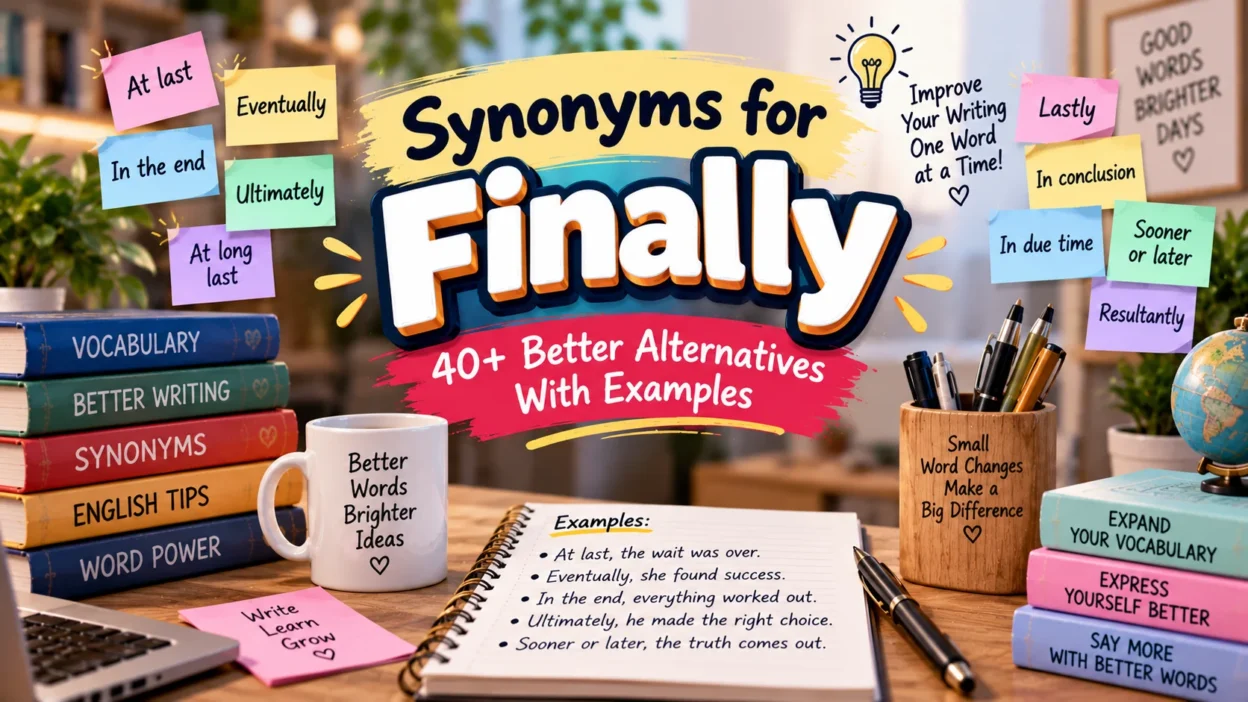
The word finally is commonly used to show that something happens at the end, after a long wait, following several steps, or as the last point in a sequence. Because it has several meanings, the best synonym depends on the context.
For example, eventually works when something happens after a period of time, while ultimately emphasizes the final result. At last often expresses relief after waiting, and in conclusion works when wrapping up an explanation or argument. Other alternatives, such as lastly, in the end, and at the end of the day, have their own specific uses.
Understanding these differences helps you replace finally naturally without changing the meaning of your sentence.
Quick Picks: Alternatives to Finally
| Alternative | Main Use | Example |
|---|---|---|
| Eventually | Something happens after time | She eventually found the answer. |
| Ultimately | Final result or outcome | The plan ultimately succeeded. |
| At last | Relief after waiting | At last, the bus arrived. |
| In the end | Final outcome | In the end, we chose the simpler option. |
| Lastly | Final item in a list | Lastly, check your spelling. |
| At long last | After a very long wait | At long last, construction was complete. |
| Finally | Last step or event | Finally, we reached the destination. |
| To conclude | Ending an argument or discussion | To conclude, the evidence supports the claim. |
| In conclusion | Formal ending | In conclusion, the results were positive. |
| All in all | Overall final assessment | All in all, it was a successful trip. |
What Does Finally Mean?
Finally can express several related ideas.
It can mean at the end of a sequence:
- Finally, we checked the final section.
It can mean after a long wait:
- She finally arrived.
It can mean as the last point in a list:
- Finally, remember to save the document.
It can also introduce a final conclusion or result:
- After several discussions, they finally reached an agreement.
Because of these different meanings, there is no single synonym that works perfectly in every sentence.
Finally Synonyms by Meaning
When Finally Means After a Long Wait
When something happens after waiting, delays, or repeated attempts, these alternatives can work:
- At last
- At long last
- Eventually
- In the end
- After all this time
- Ultimately
Examples:
- At last, the doctor called her name.
- Eventually, they found a solution.
- At long last, the project was completed.
- In the end, everything worked out.
When Finally Means Last in a Sequence
If you are describing steps or items in order, use:
- Lastly
- Last
- As the final step
- To finish
- As a final point
- In the final stage
Examples:
- Lastly, review your answers.
- As the final step, submit the form.
- As a final point, consider the cost.
- To finish, add the remaining details.
When Finally Means the Final Result
When you want to show what happened after everything else, consider:
- Ultimately
- In the end
- Eventually
- In the final analysis
- At the end of the process
- When all was said and done
Examples:
- The strategy ultimately failed.
- In the end, they accepted the offer.
- When all was said and done, the decision was worthwhile.
Eventually
Eventually means something happens after some time or after a series of events.
Example:
She eventually agreed to the proposal.
It is especially useful when you want to emphasize that an outcome took time.
Finally vs Eventually
These words often overlap, but they are not always identical.
Finally can emphasize the moment something happens after waiting.
She finally arrived.
Eventually emphasizes that something happened after a period of time.
She eventually arrived.
Both are correct, but finally can carry a stronger feeling of relief, impatience, or completion.
Ultimately
Ultimately focuses on the final result or conclusion after considering everything.
Examples:
- The decision ultimately benefited the company.
- She ultimately chose to study abroad.
- The project ultimately became successful.
It is particularly useful in analytical, professional, and academic writing.
Instead of:
The team finally reached an agreement.
You might write:
The team ultimately reached an agreement.
The second version focuses more on the outcome than the waiting.
At Last
At last often expresses relief, satisfaction, or impatience after waiting.
Examples:
- At last, the rain stopped.
- At last, we reached the hotel.
- At last, she received the news.
It is a natural alternative when the speaker has been waiting for something.
At Long Last
At long last is a stronger version of at last.
It emphasizes that something took a particularly long time.
Examples:
- At long last, the new library opened.
- At long last, they completed the renovation.
- At long last, he achieved his goal.
This expression works especially well in storytelling and expressive writing.
In the End
In the end refers to the final outcome after a situation develops.
Examples:
- In the end, we decided to stay home.
- In the end, the plan worked.
- In the end, she chose the second option.
It often suggests that several possibilities existed before the final result became clear.
Lastly
Lastly is especially useful when introducing the final item in a list or series.
Examples:
- First, gather the materials. Next, prepare the workspace. Lastly, clean everything.
- Lastly, we need to discuss the budget.
- Lastly, remember to save your work.
Unlike eventually, lastly does not usually describe something happening after a long wait. It simply indicates the final point.
In Conclusion
In conclusion is commonly used to introduce the final summary of an essay, report, article, or formal discussion.
Example:
In conclusion, the evidence supports the proposed solution.
It should not normally replace finally when you are describing a physical event or sequence.
Incorrect use:
In conclusion, the train arrived.
Better:
Finally, the train arrived.
To Conclude
To conclude works similarly to in conclusion and is useful when wrapping up an argument or explanation.
Example:
To conclude, the study demonstrates the importance of regular exercise.
It is more appropriate for formal writing than everyday conversation.
In the Final Analysis
In the final analysis means after considering everything carefully.
Example:
In the final analysis, the benefits outweighed the costs.
This phrase works particularly well in analytical or formal writing.
When All Is Said and Done
When all is said and done refers to the final judgment or outcome after everything has happened.
Example:
When all is said and done, the experience was worth it.
It is more conversational than in the final analysis.
Finally Synonyms for Essays
When writing an essay, you may want to avoid repeatedly using finally to introduce your conclusion.
Consider:
- In conclusion
- To conclude
- Ultimately
- In the final analysis
- Overall
- All in all
- In summary
- To sum up
- In the end
- On balance
Examples:
In conclusion, the evidence supports the argument.
Ultimately, the findings suggest that the strategy was effective.
Overall, the research highlights several important factors.
These expressions do not all have exactly the same function, so choose one based on the sentence.
Finally Synonyms for Formal Writing
For professional or academic writing, these alternatives are particularly useful:
| Expression | Tone | Typical Use |
|---|---|---|
| Ultimately | Formal | Final result |
| In conclusion | Formal | Essay or report ending |
| To conclude | Formal | Final argument |
| Lastly | Neutral-formal | Final point |
| In the final analysis | Formal | Overall judgment |
| Overall | Neutral-formal | General assessment |
| On balance | Formal | Weighing advantages and disadvantages |
| In summary | Formal | Summarizing information |
Finally Synonyms for Casual Writing
For everyday conversations, these options sound more natural:
- At last
- Eventually
- In the end
- At long last
- After all this time
- When all is said and done
Examples:
- At last, we’re home.
- Eventually, he called me back.
- In the end, we had a great time.
- At long last, the weekend arrived.
Finally vs Lastly
These two words are often confused.
Finally can describe the last event in a sequence or something that happens after waiting.
Lastly usually introduces the final item in a list.
Examples:
Finally, we arrived at the station.
Lastly, check the spelling before submitting the article.
A simple way to remember it is:
Finally = final event or outcome
Lastly = final point in a list
Finally vs Eventually
Finally often emphasizes completion or relief.
Eventually focuses on the passage of time before an outcome.
Examples:
She finally answered my message.
She eventually answered my message.
Both are possible, but finally can suggest that the speaker had been waiting impatiently.
Finally vs Ultimately
Finally can describe the last step or event.
Ultimately usually focuses on the final outcome or conclusion.
Examples:
Finally, we locked the door.
The decision ultimately benefited everyone.
The first describes a final action. The second emphasizes the eventual result.
Finally vs At Last
Both can indicate that something happened after waiting.
However, at last often expresses stronger relief or satisfaction.
Examples:
The package finally arrived.
At last, the package arrived.
The second sentence gives the arrival more emotional emphasis.
Finally vs In the End
These expressions can overlap when discussing a final outcome.
Examples:
Finally, they reached an agreement.
In the end, they reached an agreement.
However, in the end often emphasizes the final result after different possibilities or difficulties.
Finally vs In Conclusion
These expressions serve different purposes.
Finally can introduce the last event, step, or point.
In conclusion introduces the final summary of an argument.
Examples:
Finally, add the remaining ingredients.
In conclusion, the evidence supports the proposed explanation.
Using in conclusion for a sequence of actions would sound unnatural.
Alternatives to Finally for Different Situations
| Situation | Best Alternative |
|---|---|
| Something happened after waiting | At last |
| Something happened after a long period | Eventually |
| Final outcome | Ultimately |
| Final item in a list | Lastly |
| Final result after several events | In the end |
| Formal essay ending | In conclusion |
| Final argument | To conclude |
| Overall judgment | On balance |
| Overall summary | In summary |
| Strong emotional relief | At long last |
40+ Synonyms and Related Expressions for Finally
- Eventually
- Ultimately
- At last
- At long last
- In the end
- Lastly
- Last
- In conclusion
- To conclude
- In summary
- To sum up
- Overall
- All in all
- On balance
- In the final analysis
- When all is said and done
- In the end result
- At the conclusion
- At the final stage
- As a final point
- As a final step
- In the final stage
- In the closing stage
- At the close
- At the finish
- At the completion
- Afterward
- After all this time
- In due course
- In time
- In due time
- Eventually afterward
- In the long run
- Ultimately speaking
- In the final reckoning
- As a result
- Consequently
- Therefore
- Thus
- Hence
- When everything was considered
- After everything
- In retrospect
- At the end of the process
Some of these are related expressions rather than direct replacements. Words such as therefore, thus, and hence express results, while finally primarily indicates sequence, completion, or a final point.
Strong Alternatives for Better Writing
If you want to make your writing more varied, choose the alternative based on your exact meaning.
Instead of:
Finally, the project was completed.
Try:
At last, the project was completed.
Or:
Eventually, the project was completed.
Instead of:
Finally, the research proves the theory.
Try:
Ultimately, the research supports the theory.
Instead of:
Finally, we need to discuss the budget.
Try:
Lastly, we need to discuss the budget.
Instead of:
Finally, the evidence shows that the strategy worked.
Try:
In conclusion, the evidence shows that the strategy worked.
Common Mistakes With Finally Synonyms
Using Lastly for a Final Outcome
Lastly usually introduces the final item in a sequence or list. It does not normally emphasize a long wait.
Using Eventually for a List
Eventually describes something that happens after time. It does not simply mean the final item.
Using In Conclusion for Every Final Sentence
In conclusion is mainly useful for wrapping up an argument, essay, report, or explanation.
Using Ultimately for a Simple Sequence
Ultimately emphasizes a final outcome rather than merely indicating the last step.
Overusing Formal Expressions
Phrases such as in the final analysis and on balance can sound unnecessarily formal in casual writing. Sometimes simply using finally is the clearest choice.
How to Choose the Right Alternative
Ask what finally means in your sentence.
Something happened after waiting?
Use at last or eventually.
You are describing the final result?
Use ultimately or in the end.
You are introducing the last point?
Use lastly or as a final point.
You are ending an essay or argument?
Use in conclusion or to conclude.
You are giving an overall judgment?
Use overall, all in all, or on balance.
This makes your vocabulary more precise without forcing unnecessary synonyms into your writing.
Frequently Asked Questions
What is the best synonym for finally?
The best alternative depends on the meaning. Eventually, ultimately, at last, in the end, and lastly are among the most useful choices.
What is a simple word for finally?
Eventually and lastly are simple alternatives, but they have different uses.
What is a formal synonym for finally?
Try ultimately, in conclusion, to conclude, in the final analysis, or on balance.
What is another word for finally in an essay?
For an essay conclusion, in conclusion, to conclude, ultimately, in summary, or overall can work.
Is eventually the same as finally?
They can overlap, but eventually emphasizes that something happens after a period of time, while finally can emphasize completion or the last event.
Is lastly the same as finally?
Not always. Lastly usually introduces the final item in a list, while finally has broader uses.
What is the difference between finally and ultimately?
Finally can indicate the last step or event. Ultimately usually emphasizes the final outcome or result.
What is the difference between finally and at last?
Both can describe something happening after waiting, but at last often expresses stronger relief or satisfaction.
Can I use in conclusion instead of finally?
Only when you are concluding an argument, essay, report, or explanation. It is not a universal replacement for finally.
What is a casual synonym for finally?
At last, eventually, and in the end are natural choices in casual writing.
Final Thoughts
There are many useful synonyms for finally, but the right choice depends on what you want the word to accomplish. Use at last when something happens after a long wait, eventually when an outcome takes time, and ultimately when focusing on the final result. For the last item in a list, lastly is usually the better choice.
When finishing an essay or formal discussion, in conclusion, to conclude, or in summary can provide a clear transition. Meanwhile, in the end works naturally when describing the final outcome of a situation.
You do not need to replace finally every time it appears. The goal is simply to choose the expression that fits the meaning, tone, and structure of your sentence. A precise alternative can make your writing more varied while keeping it natural and easy to understand.

Miles Ellington enjoys exploring the subtle differences that can completely change how a word or phrase is understood. At Differology, he turns confusing language questions into straightforward explanations, covering word comparisons, vocabulary, grammar, usage, and everyday English.
With a practical and reader-focused approach, Miles uses real-world examples and clear comparisons to help readers choose the right word, understand its meaning, and communicate more precisely.