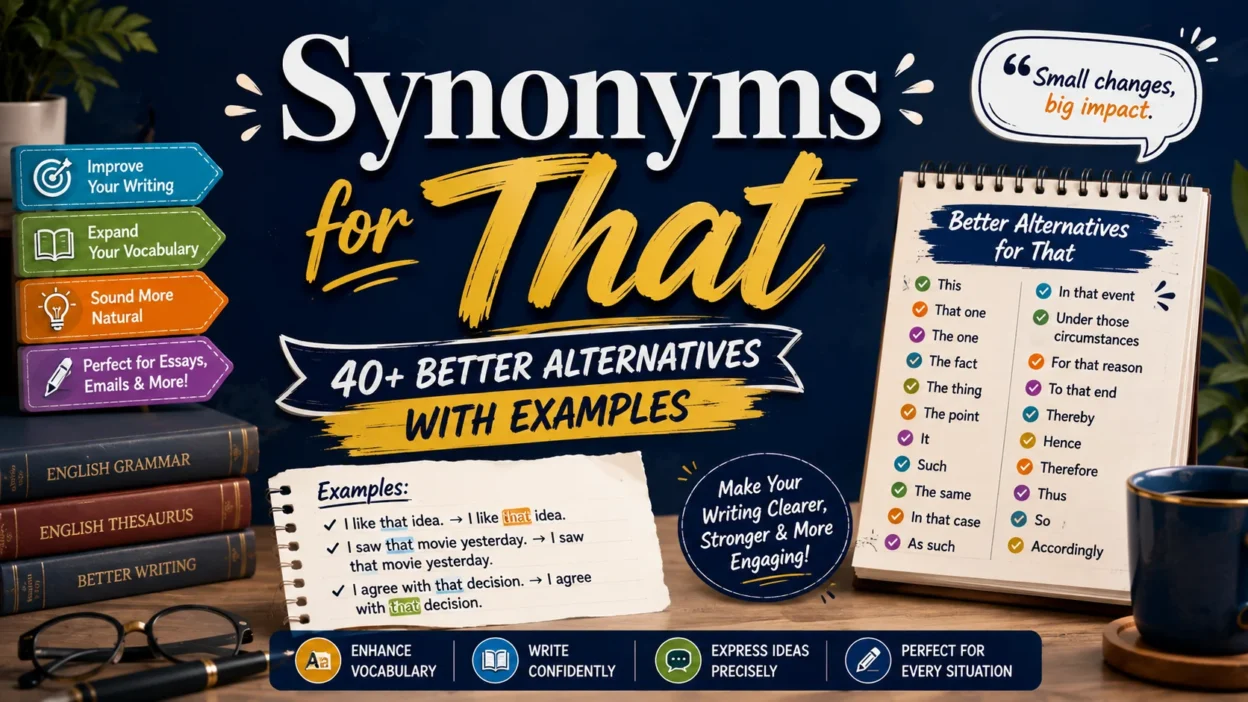
The word that is one of the most frequently used words in English. It can introduce a clause, identify a particular person or thing, point to something already mentioned, or add information to a sentence. Because it performs several different grammatical jobs, there is no single synonym that can replace that in every situation.
Depending on the sentence, alternatives can include which, who, what, those, the, such, the fact that, so, and in order to. Sometimes, the best alternative is actually to remove that completely and make the sentence more direct.
Understanding how that works is more useful than simply searching for another word. Once you know its grammatical role, you can choose an alternative that keeps your sentence natural and clear.
Quick Guide to Alternatives for That
| Use of That | Possible Alternative | Example |
|---|---|---|
| Refers to a person | Who | The person who called me left. |
| Refers to a thing | Which | The book which I bought is useful. |
| Introduces information | The fact that | The fact that he won surprised us. |
| Points to something | This / That / Those | Those are the shoes I wanted. |
| Refers to a previously mentioned idea | This | The plan failed. This caused delays. |
| Introduces a result | So | It was so cold that we stayed inside. |
| Defines a specific noun | The | The book that I recommended → The book I recommended. |
| Adds a clause | Often nothing | I think that she is right → I think she is right. |
What Does That Mean?
That has several roles in English, which is why replacing it requires context.
- It can work as a demonstrative:
- That car belongs to my neighbor.
2. It can introduce a relative clause:
- The book that I bought was expensive.
3. It can introduce a noun clause:
- I know that she is coming.
4. It can introduce a result clause:
- It was so cold that we stayed inside.
Each use requires a different approach.
That as a Demonstrative
When that points to a specific person, thing, idea, or situation, possible alternatives include:
- This
- That
- These
- Those
- The
- Such
- The particular
Examples:
- That house is beautiful.
- The house across the street is beautiful.
- That idea sounds interesting.
- Such an idea could create problems.
The choice depends on distance, number, and context.
That vs This
That often points to something farther away or something previously mentioned.
This usually points to something closer or currently being discussed.
Examples:
- This book is in my hand.
- That book is on the other shelf.
In writing, this and that can also refer to ideas rather than physical objects.
That as a Relative Pronoun
One of the most common uses of that is introducing a relative clause.
Example:
The movie that we watched was excellent.
In many cases, you can replace that with which when referring to things.
Example:
The movie which we watched was excellent.
For people, who is generally more natural.
Example:
The person who helped me was very kind.
That vs Which
When referring to things, that and which can sometimes be interchangeable in restrictive clauses.
Examples:
The phone that I bought is expensive.
The phone which I bought is expensive.
However, punctuation and meaning can differ when using which in nonrestrictive clauses.
Example:
My phone, which I bought last year, still works perfectly.
In this structure, which provides additional information rather than identifying which phone you mean.
That vs Who
When the noun refers to a person, who is often the better alternative.
Example:
The woman that helped me was friendly.
More natural:
The woman who helped me was friendly.
For people, who often sounds more natural and precise.
Removing That Completely
One of the easiest ways to avoid repeating that is to remove it when the sentence remains grammatically correct.
For example:
I think that she is right.
can become:
I think she is right.
Another example:
He said that he would arrive early.
can become:
He said he would arrive early.
This is especially useful in conversational and general English.
You do not need to replace every that with another word.
That vs The Fact That
When that introduces an important fact or situation, the fact that can sometimes make the meaning more explicit.
Example:
That he refused surprised everyone.
More explicit:
The fact that he refused surprised everyone.
However, the longer version should only be used when emphasizing the fact itself. Otherwise, the simpler construction is often better.
That vs What
What can sometimes replace a construction involving that, but the sentence structure changes.
Compare:
I know that she wants.
I know what she wants.
These sentences do not mean the same thing.
That introduces information.
What refers to the thing or information being discussed.
So, what is not a universal synonym for that.
That vs Which
A useful rule is:
- That often introduces a defining or restrictive clause.
- Which can introduce a clause referring to a thing.
- Which is commonly used after a comma for additional information.
Examples:
The laptop that I bought is fast.
My laptop, which I bought last year, is still fast.
The second sentence gives extra information about an already identified laptop.
That vs Who vs Which
A simple comparison can help:
| Word | Usually Refers To | Example |
|---|---|---|
| That | People or things in restrictive clauses | The book that I bought |
| Who | People | The woman who called |
| Which | Things | The car which broke down |
| Whose | Possession | The student whose book was lost |
| Where | Places | The house where I grew up |
| When | Time | The year when we moved |
Choosing the right relative word makes your sentence more precise.
That in Noun Clauses
Another common use appears after verbs such as:
- Think
- Believe
- Know
- Say
- Hope
- Remember
- Understand
- Explain
- Assume
- Notice
Examples:
- I think that he is right.
- She believes that the plan will work.
- We know that the meeting starts at nine.
- He said that he was tired.
In many of these sentences, that can simply disappear.
Examples:
I think he is right.
She believes the plan will work.
We know the meeting starts at nine.
This often makes writing more concise.
That After Reporting Verbs
After verbs such as say, think, believe, and explain, that often introduces what someone said or thought.
Examples:
- She said that she was busy.
- He explained that the system had failed.
- They believed that the plan would succeed.
More concise versions:
- She said she was busy.
- He explained the system had failed.
- They believed the plan would succeed.
Whether you remove that depends on clarity and rhythm.
That in Formal Writing
In formal writing, that can be useful for connecting ideas clearly.
Examples:
The researchers concluded that the treatment was effective.
The report shows that consumer behavior has changed.
However, you should not add that to every possible sentence simply because the writing is formal.
A concise sentence can often be stronger:
The researchers concluded the treatment was effective.
Both versions are grammatical in appropriate contexts.
That in Casual English
In everyday speech, speakers frequently omit that when the meaning remains clear.
Examples:
I think you’re right.
I knew you’d come.
She said she was tired.
We hope you can join us.
This makes the conversation sound natural.
Alternatives to That in Different Situations
| Sentence | Better Alternative |
|---|---|
| The person that called | The person who called |
| The book that I read | The book which I read |
| I think that she knows | I think she knows |
| He said that he was tired | He said he was tired |
| That idea is interesting | This idea is interesting |
| That information surprised me | The information surprised me |
| The fact that he left | His departure |
| The car that broke down | The car which broke down |
| The house that we bought | The house we bought |
| The student that won | The student who won |
That vs This
These words are related but have opposite demonstrative roles.
This usually refers to something near the speaker, currently being discussed, or recently introduced.
That can refer to something farther away or previously mentioned.
Examples:
- This problem needs immediate attention.
- That problem was discussed yesterday.
In writing, both can refer to ideas:
This suggests that the method worked.
That explains why the results changed.
That vs Those
That is singular.
Those is plural.
Examples:
- That book is mine.
- Those books are mine.
When referring to multiple people or things, those may be the correct replacement.
That vs Such
Such can sometimes replace a phrase beginning with that when referring to something of a particular kind or nature.
Example:
That behavior is unacceptable.
Such behavior is unacceptable.
However, such changes the structure and emphasis. It is not a direct synonym in every sentence.
That vs The
Sometimes that can be removed and replaced by a more direct noun phrase.
Example:
The book that I recommended is popular.
The book I recommended is popular.
In this case, the best alternative is not another word. Simply removing that makes the sentence shorter.
40+ Alternatives and Related Words for That
- This
- Those
- Which
- Who
- Whose
- Where
- When
- What
- The
- Such
- The fact that
- The idea that
- The notion that
- The claim that
- The belief that
- The point that
- The reason that
- The statement that
- The information that
- The evidence that
- The suggestion that
- The possibility that
- The fact
- This idea
- This point
- This situation
- This information
- That idea
- That point
- That situation
- Those things
- Those ideas
- Those who
- The one
- The ones
- The particular
- Such a thing
- Such an idea
- The circumstance
- The situation
- The reason
- The way
- The place
- The time
These are context-based alternatives, not direct synonyms. Because that has multiple grammatical functions, its replacement must match the sentence.
How to Avoid Repeating That
If your writing contains too many instances of that, try these techniques.
Remove Unnecessary That
Instead of:
I believe that the article is useful.
Use:
I believe the article is useful.
Use Who for People
Instead of:
The writer that created the guide…
Use:
The writer who created the guide…
Use Which for Appropriate Thing Clauses
Instead of:
The system that we installed…
You may be able to write:
The system which we installed…
depending on the type of clause and your preferred style.
Restructure the Sentence
Instead of:
The fact that the project was delayed caused problems.
Try:
The project’s delay caused problems.
This often produces cleaner writing than searching for a replacement word.
Common Mistakes With That Alternatives
Replacing Every That With Which
That and which are not always interchangeable. Sentence structure and punctuation matter.
Using Who for Things
Who normally refers to people.
Incorrect:
The computer who I bought is fast.
Better:
The computer that I bought is fast.
Or:
The computer which I bought is fast.
Using What Instead of That
What does not simply replace that.
Compare:
I know that she left.
I know what she bought.
The structures and meanings are different.
Removing That When It Causes Confusion
Although that can often be omitted, keeping it may improve clarity in longer or complicated sentences.
Adding The Fact That Everywhere
The fact that can be useful for emphasis, but overusing it makes writing wordy.
When You Should Keep That
Sometimes that is already the clearest choice.
For example:
The evidence suggests that the theory is correct.
Here, that clearly introduces the following clause.
Similarly:
The book that I bought yesterday is excellent.
That efficiently connects the noun with the information that identifies it.
Do not replace a perfectly natural word just to avoid repetition.
How to Choose the Right Alternative
Ask what role that plays.
Referring to a person?
Use who when appropriate.
Referring to a thing?
Consider which.
Introducing a clause after think, say, or believe?
You can often remove that.
Pointing to something?
Consider this, that, these, or those.
Emphasizing a fact?
Use the fact that when genuinely useful.
Making a sentence shorter?
Try removing that rather than replacing it.
This approach keeps your writing natural and grammatically accurate.
Frequently Asked Questions
What is the best synonym for that?
There is no single synonym because that has several grammatical functions. Depending on context, alternatives include which, who, this, those, what, such, or no word at all.
What can I use instead of that in a sentence?
You may be able to use who, which, this, those, or simply remove that. The correct choice depends on its role.
Can that be replaced with which?
Sometimes. Which can refer to things in relative clauses, but that and which are not interchangeable in every construction.
Can that be replaced with who?
When that refers to a person in a relative clause, who is often a natural alternative.
Can I remove that from a sentence?
Yes. When that introduces a noun clause after verbs such as think, know, say, or believe, it can often be omitted.
What is the difference between that and which?
That commonly introduces restrictive relative clauses, while which can introduce relative clauses referring to things and is frequently used for additional information after a comma.
What is the difference between that and this?
That often points to something farther away or previously mentioned, while this usually refers to something closer or currently being discussed.
What is the difference between that and those?
That is singular, while those is plural.
Is the fact that a synonym for that?
Not exactly. The fact that is a longer construction used to emphasize a fact or circumstance introduced by a clause.
How can I avoid using that too much?
Remove unnecessary instances, use who or which where appropriate, and restructure sentences instead of replacing every occurrence with another word.
Final Thoughts
The word that is difficult to replace with one simple synonym because it performs several different jobs in English. It can point to something, introduce a clause, connect a noun to additional information, or refer to a previously mentioned idea.
When that refers to people, who is often a better choice. For things, which may work in certain relative clauses. When that introduces a clause after verbs such as think or say, you can often remove it entirely. In other cases, this, those, such, or a rewritten sentence may provide a clearer alternative.
The goal is not to eliminate that from your writing. It is already a useful and grammatically correct word. Instead, look at its function and decide whether another word—or no word at all—would make the sentence clearer and more natural.

Miles Ellington enjoys exploring the subtle differences that can completely change how a word or phrase is understood. At Differology, he turns confusing language questions into straightforward explanations, covering word comparisons, vocabulary, grammar, usage, and everyday English.
With a practical and reader-focused approach, Miles uses real-world examples and clear comparisons to help readers choose the right word, understand its meaning, and communicate more precisely.