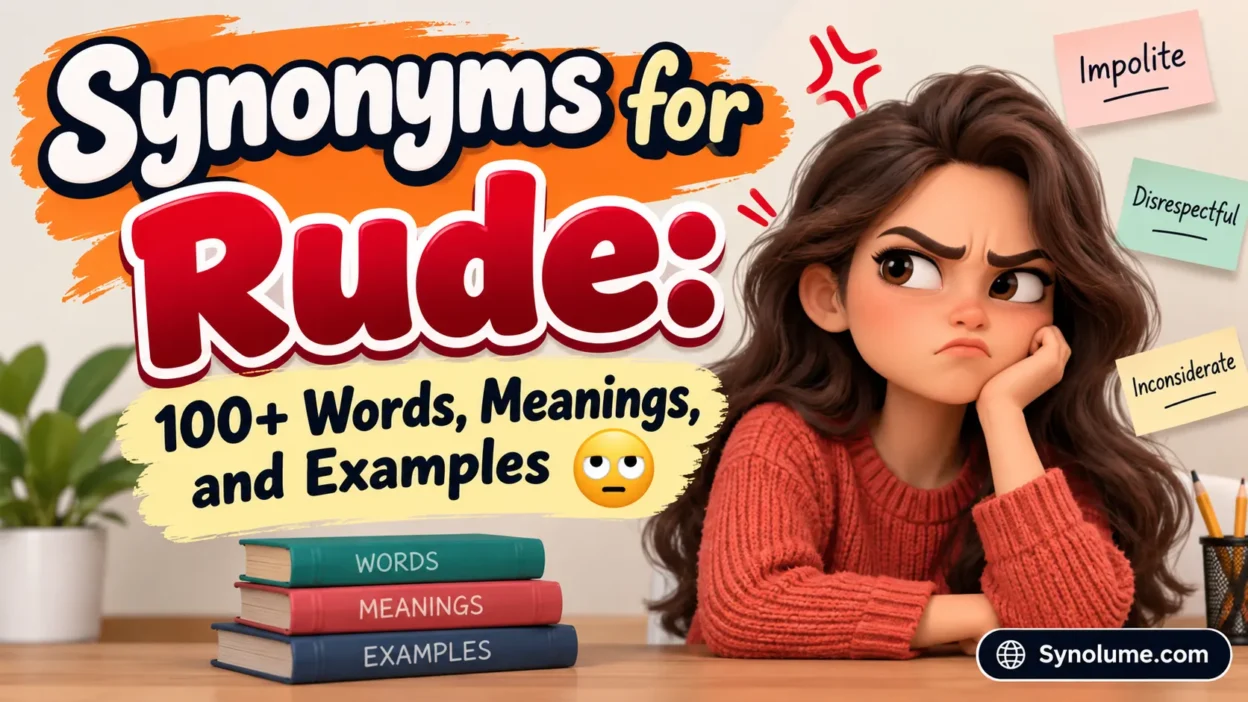
Looking for the best synonyms for rude? Whether you are describing someone who has bad manners, makes offensive comments, speaks disrespectfully, or behaves without considering other people’s feelings, choosing the right word can make your writing more accurate and expressive.
Common synonyms for rude include impolite, disrespectful, discourteous, ill-mannered, insolent, abrasive, blunt, tactless, offensive, and uncivil. However, these words have different meanings. Someone who is blunt may speak honestly without softening their words, while someone who is disrespectful deliberately ignores another person’s feelings or authority.
In this guide, you will discover more than 100 synonyms and related expressions for rude, with clear definitions, example sentences, formal and informal alternatives, and helpful comparison tables. You will also learn how to describe rude behavior without using unnecessarily harsh language.
💬 What Does Rude Mean?
The word rude describes behavior, language, or actions that show a lack of politeness, respect, or consideration for others. A rude person might interrupt conversations, make insulting remarks, ignore basic manners, or speak in a way that makes someone uncomfortable.
For example, interrupting someone repeatedly can seem rude because it prevents them from expressing their thoughts. Making a personal comment about someone’s appearance may also be considered rude if the remark is unwanted or hurtful.
The word can describe different levels of behavior. A person who forgets to say thank you may be considered impolite, while someone who deliberately insults another person may be described as offensive or abusive.
Rude can also refer to inappropriate language, gestures, jokes, or comments. In other contexts, it may describe something sudden and unpleasant, as in the expression a rude awakening. The most suitable synonym depends on the meaning you want to communicate.
✨ Quick Answer: What Are the Best Synonyms for Rude?
The best synonyms for rude include impolite, disrespectful, discourteous, ill-mannered, insolent, uncivil, abrasive, tactless, offensive, and boorish.
Here are some useful alternatives for different situations:
| Synonym | Meaning | Example |
|---|---|---|
| Impolite | Not showing good manners | It was impolite to interrupt her. |
| Disrespectful | Showing a lack of respect | His disrespectful comments upset the team. |
| Discourteous | Not considerate or polite | The reply sounded discourteous. |
| Ill-mannered | Behaving without good manners | The ill-mannered guest interrupted dinner. |
| Insolent | Boldly disrespectful, especially toward authority | The employee gave an insolent response. |
| Abrasive | Harsh or unpleasant in manner | His abrasive style made discussions difficult. |
| Tactless | Insensitive about what to say | That was a tactless question. |
| Offensive | Causing upset or insult | The joke was offensive to several guests. |
| Blunt | Direct, sometimes without tact | Her blunt answer surprised everyone. |
| Boorish | Rough and lacking social manners | His boorish behavior embarrassed his friends. |
Use impolite for ordinary breaches of etiquette, disrespectful for a lack of regard, and tactless for comments that hurt or embarrass people because they lack sensitivity.
📚 100+ Synonyms and Related Words for Rude
The following list brings together common synonyms, stronger descriptions, informal alternatives, and words associated with different kinds of rude behavior. Not every word is interchangeable with rude, so consider the definitions before using one.
Common synonyms for rude
- Impolite
- Disrespectful
- Discourteous
- Uncivil
- Ill-mannered
- Bad-mannered
- Unmannerly
- Uncourteous
- Uncivilized
- Unpleasant
- Unkind
- Unconsiderate
- Inconsiderate
- Ungracious
- Unfriendly
- Abrupt
- Brusque
- Curt
- Tactless
- Offensive
Stronger words for rude behavior
- Insolent
- Impudent
- Impertinent
- Insulting
- Abusive
- Contemptuous
- Scornful
- Derisive
- Mocking
- Belittling
- Degrading
- Disparaging
- Hostile
- Aggressive
- Belligerent
- Antagonistic
- Boorish
- Churlish
- Uncivilized
- Obnoxious
Words for harsh or unpleasant communication
- Abrasive
- Blunt
- Blunt-spoken
- Harsh
- Sharp
- Caustic
- Cutting
- Snappish
- Snippy
- Sarcastic
- Scathing
- Biting
- Acidic
- Gruff
- Grumpy
- Curt
- Dismissive
- Condescending
- Patronizing
- Derogatory
Words for poor manners or social behavior
- Unrefined
- Uncouth
- Crude
- Vulgar
- Coarse
- Boorish
- Loutish
- Unpolished
- Ill-bred
- Indelicate
- Indecorous
- Unbecoming
- Unseemly
- Uncivil
- Disobliging
- Ungentlemanly
- Ungracious
- Thoughtless
- Self-centered
- inconsiderate
Informal words and expressions
- Cheeky
- Mouthy
- Fresh
- Sassy
- Snarky
- Smart-mouthed
- Backtalking
- Rude-mouthed
- Foul-mouthed
- Pushy
- Bossy
- Nasty
- Mean
- Jerk-like
- Bad-tempered
- Sarcastic
- Outspoken
- Insensitive
- Unapologetic
- Thoughtless
Additional related expressions
- Lacking manners
- Showing no respect
- Speaking out of turn
- Talking down to others
- Being dismissive
- Crossing the line
- Having a sharp tongue
- Making insulting remarks
- Being short with someone
- Showing poor etiquette
Important usage note: This is a broad vocabulary list, not 110 exact synonyms. Words such as outspoken and unapologetic are not inherently rude, while bossy describes controlling behavior and sarcastic describes a particular style of expression. The intended context determines whether they fit.
🤝 Synonyms for Rude That Mean Impolite
If you want a direct replacement for rude in everyday writing, words that describe a lack of politeness are usually the safest choices.
| Word | Meaning | Example sentence |
|---|---|---|
| Impolite | Not following expected manners | It is impolite to interrupt a speaker. |
| Discourteous | Not showing consideration | The customer received a discourteous reply. |
| Uncivil | Not behaving with ordinary courtesy | Their exchange became uncivil. |
| Ill-mannered | Having poor manners | The ill-mannered guest spoke over everyone. |
| Unmannerly | Not showing proper manners | His unmannerly conduct annoyed the host. |
| Uncourteous | Lacking courtesy | The message sounded uncourteous. |
| Uncivilized | Lacking expected social refinement; often a strong judgment | The critic called the conduct uncivilized. |
| Ungracious | Not showing warmth or gratitude | Her ungracious response surprised us. |
| Inconsiderate | Failing to think about others | It was inconsiderate to arrive late without calling. |
| Unfriendly | Not warm or welcoming | The receptionist seemed unfriendly. |
These alternatives are useful in essays, professional writing, reviews, and everyday communication. Impolite is a close general synonym, while discourteous often sounds more formal.
For example, “The manager was rude during the meeting” could become “The manager was discourteous during the meeting.” The second sentence sounds more formal without changing the basic meaning.
😠 Synonyms for Rude When Someone Is Disrespectful
Some behavior goes beyond poor manners. When a person dismisses someone else’s authority, ignores their feelings, or treats them as unimportant, words describing disrespect may be more precise.
- Disrespectful: Showing little regard for another person.
- Insolent: Boldly disrespectful, often toward someone in authority.
- Impertinent: Showing inappropriate boldness or familiarity.
- Impudent: Boldly lacking proper respect.
- Contemptuous: Showing that someone is considered unworthy of respect.
- Dismissive: Treating someone’s thoughts or concerns as unimportant.
- Condescending: Speaking as if someone is less intelligent or capable.
- Patronizing: Acting as though another person needs to be talked down to.
- Insulting: Expressing disrespect through hurtful words or actions.
- Scornful: Showing strong disdain or contempt.
Examples in sentences
- His disrespectful reply offended the teacher.
- The employee made an insolent remark to the supervisor.
- Her dismissive attitude discouraged the new team member.
- The speaker sounded condescending when answering questions.
- The insulting comment damaged their friendship.
- His contemptuous expression made the conversation uncomfortable.
Use disrespectful when the main issue is a lack of respect. Choose insolent or impudent for bold disrespect, and condescending when someone talks down to others.
🗣️ Synonyms for Rude Speech and Harsh Comments
Rude speech can take many forms. Someone may be too direct, use insulting language, make sarcastic remarks, or respond in a sharp tone. These differences matter when describing a conversation.
| Word | What it suggests | Example |
|---|---|---|
| Abrasive | Harsh and difficult to deal with | His abrasive tone upset the group. |
| Brusque | Brief and abrupt, sometimes unfriendly | She gave a brusque reply. |
| Curt | Very short and seemingly unfriendly | He sent a curt message. |
| Blunt | Direct without much softening | Her blunt feedback caught him off guard. |
| Tactless | Lacking sensitivity | That was a tactless comment about his job. |
| Sarcastic | Using irony to mock or criticize | His sarcastic remark made the room go quiet. |
| Caustic | Bitterly cutting or critical | The review contained caustic criticism. |
| Snippy | Irritably sharp in speech | She sounded snippy during the call. |
| Scathing | Extremely critical or severe | He delivered a scathing response. |
| Derogatory | Expressing disrespect or a low opinion | The article used derogatory language. |
| Insulting | Likely to offend or hurt | The remark was insulting. |
| Dismissive | Brushing off another person’s point | His dismissive response ended the discussion. |
Is blunt the same as rude?
Not necessarily. A blunt person communicates directly and may not soften criticism. A rude person violates expectations of politeness or respect. Bluntness can be useful when it is honest and constructive, but it may sound rude when it ignores another person’s feelings.
Compare these examples:
- Blunt: “This paragraph needs more evidence.”
- Rude: “This paragraph is terrible, and you clearly did not try.”
The first statement is direct feedback. The second adds a personal attack.
🏢 Formal Synonyms for Rude
In academic, professional, or business writing, formal synonyms can help you describe conduct precisely without sounding overly emotional.
| Formal synonym | Meaning | Example |
|---|---|---|
| Discourteous | Lacking courtesy | The response was discourteous. |
| Disrespectful | Showing insufficient respect | The report described disrespectful conduct. |
| Impolite | Not polite | It may be impolite to interrupt a presentation. |
| Uncivil | Lacking courtesy or civility | The discussion became uncivil. |
| Impertinent | Inappropriately bold or intrusive | The question was considered impertinent. |
| Insolent | Boldly disrespectful | The supervisor objected to the insolent remark. |
| Indelicate | Lacking tact or sensitivity | The speaker raised an indelicate subject. |
| Indecorous | Not appropriate for the situation | The comment was indecorous for a formal event. |
| Unprofessional | Not meeting workplace standards | His unprofessional conduct concerned the manager. |
| Abrasive | Harsh or difficult in manner | Her abrasive communication style caused friction. |
| Derogatory | Expressing disrespect or disparagement | The memo included derogatory language. |
| Disparaging | Expressing a low opinion of someone | He made disparaging comments about a colleague. |
Writing tip: Use the word that describes the specific behavior. Unprofessional is suitable for workplace conduct, indelicate for an insensitive subject, and discourteous for a lack of courtesy.
A sentence such as “The client was rude” may be too general for a formal report. “The client repeatedly interrupted staff and made disparaging remarks” gives readers a clearer picture of what happened.
😎 Informal Synonyms for Rude
Informal words can be useful in dialogue, casual articles, character descriptions, and everyday conversation. However, some are more common in particular regions or carry a playful tone.
- Cheeky: Slightly rude or bold, sometimes in an amusing way.
- Mouthy: Talking back or speaking aggressively.
- Fresh: Informally disrespectful, especially in some American English contexts.
- Snarky: Making sarcastic or cutting remarks.
- Smart-mouthed: Answering in a cheeky or disrespectful way.
- Sassy: Bold or cheeky; not always negative.
- Nasty: Mean, unpleasant, or hurtful.
- Snippy: Speaking in an irritated, sharp way.
- Pushy: Pressuring others or ignoring their boundaries.
- Bossy: Telling others what to do too often.
- Foul-mouthed: Frequently using offensive language.
- Bad-tempered: Easily irritated or angry.
- A jerk: An informal label for someone behaving badly.
- A smart aleck: Someone who makes clever, cheeky, or disrespectful remarks.
- A loudmouth: Someone who speaks loudly or too freely, sometimes offensively.
Informal examples
- “That was a snarky comment.”
- “Don’t be so mouthy with your coach.”
- “He made a cheeky remark and smiled.”
- “Her reply sounded snippy.”
- “The customer was pushy about getting an immediate answer.”
- “That guy acted like a jerk.”
These expressions are not all equally harsh. Cheeky can be playful, while foul-mouthed specifically describes language and a jerk is a direct insult. Choose an expression that matches your intended tone.
💔 Synonyms for Rude and Mean Behavior
Rude and mean are related, but they do not mean exactly the same thing. Rudeness often involves manners or respect, while meanness usually suggests unkindness or a desire to hurt someone.
| Word | Main meaning | Example |
|---|---|---|
| Mean | Unkind or hurtful | It was mean to mock his mistake. |
| Cruel | Causing pain without sufficient concern | The cruel comment upset her. |
| Nasty | Very unpleasant or unkind | He made a nasty remark. |
| Hurtful | Causing emotional pain | Her words were hurtful. |
| Malicious | Intended to cause harm | The message appeared malicious. |
| Spiteful | Motivated by a desire to hurt or annoy | He made a spiteful comment. |
| Insulting | Expressing disrespect | The joke was insulting. |
| Hostile | Showing opposition or aggression | The conversation turned hostile. |
| Unkind | Not considerate or caring | That was an unkind response. |
| Bullying | Repeatedly intimidating or harming someone | The school addressed bullying behavior. |
For example, someone might be rude by interrupting a conversation without intending to hurt anyone. Someone who deliberately mocks a person’s insecurity may be both rude and mean.
This distinction helps you describe behavior fairly instead of treating every uncomfortable interaction as equally harmful.
🌸 Polite Alternatives to the Word Rude
Sometimes you need to explain that behavior was inappropriate without sounding aggressive or judgmental. A softer phrase can be more effective in workplace emails, customer service, and sensitive conversations.
| Instead of saying | Consider saying | Example |
|---|---|---|
| You are rude. | That came across as impolite. | That comment came across as impolite. |
| Your reply was rude. | Your reply sounded abrupt. | Your reply sounded abrupt over email. |
| He is disrespectful. | He could show more consideration. | He could show more consideration during meetings. |
| That was a rude question. | That question felt too personal. | That question felt too personal for the situation. |
| She was mean. | Her comment was hurtful. | Her comment was hurtful, even if that was not her intention. |
| He is rude to customers. | His communication could be more courteous. | His communication could be more courteous with customers. |
| That behavior was unacceptable. | That behavior was inappropriate for the setting. | That behavior was inappropriate for a formal meeting. |
These alternatives focus on the behavior rather than attacking the person’s character. This approach can help keep a conversation productive while still making your concerns clear.
🔍 Rude vs. Impolite vs. Disrespectful vs. Insolent
These words are close in meaning, but each carries a different emphasis.
| Word | Key distinction | Typical situation |
|---|---|---|
| Rude | General lack of politeness or consideration | Interrupting someone |
| Impolite | Failure to follow expected manners | Forgetting to thank a host |
| Disrespectful | Showing a lack of respect | Mocking someone’s opinion |
| Insolent | Bold or defiant disrespect | Speaking defiantly to an authority figure |
| Tactless | Failing to consider feelings or social sensitivity | Asking an embarrassing personal question |
| Abrasive | Harsh or unpleasant manner | Giving feedback in an aggressive tone |
| Offensive | Causing insult or upset | Making an inappropriate joke |
| Discourteous | Lacking courtesy or consideration | Ignoring a guest’s reasonable request |
Which word should you choose?
Use rude when you need a general description. Choose impolite when the issue is manners, and disrespectful when the behavior shows disregard for someone.
Use insolent for a particularly bold form of disrespect, especially toward a person in authority. Tactless is better when someone says something insensitive without necessarily intending to insult anyone.
These distinctions make your vocabulary more precise and help you avoid exaggerating the situation.
⚖️ Antonyms of Rude
Antonyms are words with the opposite meaning. The best opposite of rude is usually a word associated with politeness, respect, or consideration.
| Antonym | Meaning | Example |
|---|---|---|
| Polite | Showing good manners | She was polite to every guest. |
| Courteous | Showing consideration and courtesy | The staff were courteous and helpful. |
| Respectful | Showing regard for others | He remained respectful during the disagreement. |
| Civil | Calm and reasonably polite | They kept the conversation civil. |
| Considerate | Thinking about other people’s needs | It was considerate to call ahead. |
| Well-mannered | Behaving with good manners | The children were well-mannered. |
| Gracious | Kind, courteous, and pleasant | She gave a gracious response. |
| Tactful | Sensitive in handling delicate matters | He offered tactful feedback. |
| Diplomatic | Managing difficult situations carefully | The manager gave a diplomatic answer. |
| Thoughtful | Showing care for others | That was a thoughtful gesture. |
| Respectful | Demonstrating esteem or regard | Her respectful tone eased the tension. |
| Amiable | Friendly and pleasant | The host was amiable and welcoming. |
For example, “He was rude to the receptionist” can be contrasted with “He was courteous to the receptionist.” In professional settings, courteous, respectful, and diplomatic are especially useful alternatives.
✍️ Synonyms for Rude in Example Sentences
The easiest way to learn synonyms is to see how they work in real sentences.
| Original sentence | Alternative sentence |
|---|---|
| He was rude to the waiter. | He was discourteous to the waiter. |
| Her comment was rude. | Her comment was tactless. |
| The student gave a rude answer. | The student gave an insolent answer. |
| His behavior was rude. | His behavior was ill-mannered. |
| She made a rude joke. | She made an offensive joke. |
| His tone was rude. | His tone was abrasive. |
| The reply sounded rude. | The reply sounded curt. |
| He was rude to his coworkers. | He was disrespectful toward his coworkers. |
| That was a rude thing to say. | That was an unkind thing to say. |
| The guest acted rudely. | The guest behaved boorishly. |
| Her question was rude. | Her question was impertinent. |
| His remark was rude and insulting. | His remark was derogatory and insulting. |
| The customer became rude. | The customer became hostile. |
| He spoke rudely to the teacher. | He spoke disrespectfully to the teacher. |
| Her answer was rude and direct. | Her answer was blunt and tactless. |
Remember that changing a synonym can also change the meaning. A curt reply is short and abrupt; an insolent reply is boldly disrespectful. Choose the alternative that accurately describes what happened.
🎯 How to Choose the Right Synonym for Rude
Choosing the right word is easier when you identify the behavior you want to describe.
1. Identify the problem. Is the person ignoring manners, showing disrespect, insulting someone, or speaking too directly? Each situation has a different set of useful synonyms.
2. Consider the intention. Tactless often describes poor judgment or a lack of sensitivity. Malicious suggests an intention to cause harm.
3. Think about the severity. Impolite is relatively neutral, while abusive describes much more serious behavior. Avoid using an extreme word for a minor misunderstanding.
4. Match the audience. In professional writing, discourteous or unprofessional may fit better than mouthy or a jerk.
5. Use specific descriptions when possible. Instead of labeling someone rude, explain the action: “He interrupted three times and dismissed the other person’s suggestion.”
6. Check whether the synonym is truly interchangeable. Blunt can describe direct speech without implying bad intentions, and outspoken can be positive. Neither automatically means rude.
Precise word choice makes your writing clearer and helps readers understand the behavior rather than simply accepting a label.
❓ Frequently Asked Questions About Synonyms for Rude
1. What is the best synonym for rude?
The best synonym depends on the situation. Impolite is a close general alternative, disrespectful emphasizes a lack of respect, discourteous sounds more formal, and tactless describes insensitive speech or behavior.
2. What is a more sophisticated word for rude?
Words such as discourteous, uncivil, impertinent, insolent, and indecorous can work in more formal writing. Choose discourteous for a lack of courtesy and indecorous for behavior inappropriate to a particular setting.
3. What is a polite way to say someone is rude?
You could say, “That comment came across as impolite,” “The response sounded abrupt,” or “I felt that the remark was inconsiderate.” These phrases explain the concern without directly attacking someone’s character.
4. What is a stronger word for rude?
Depending on the behavior, stronger words include insolent, abusive, contemptuous, hostile, and offensive. They carry different meanings, so use them only when they accurately describe the situation.
5. What is a synonym for rude that starts with I?
Common options include impolite, insulting, insolent, impertinent, impudent, and inconsiderate. These words describe different aspects of rudeness, from poor manners to bold disrespect.
6. What is another word for a rude person?
Depending on the context, you might say an ill-mannered person, a discourteous person, a disrespectful person, or informally, a jerk. The more specific expressions are generally more useful when you want to describe behavior accurately.
7. Is blunt a synonym for rude?
Sometimes, but not always. Blunt means direct and not softened by careful wording. It can sound rude if the speaker ignores another person’s feelings, but blunt communication can also be honest and constructive.
8. What is the difference between rude and disrespectful?
Rude is a broad word for behavior that lacks politeness or consideration. Disrespectful specifically emphasizes a lack of regard for another person, their feelings, their position, or their beliefs.
9. What is the difference between rude and mean?
Rudeness usually concerns manners or respect, while meanness involves unkind or hurtful behavior. A person can be rude without intending harm, but deliberately humiliating someone is both rude and mean.
10. What is an informal synonym for rude?
Informal alternatives include cheeky, mouthy, snarky, snippy, fresh, and smart-mouthed. Some can be playful, while others are strongly critical. Their tone also varies by region.
11. What is the opposite of rude?
Common antonyms include polite, courteous, respectful, considerate, civil, tactful, and gracious. Choose the word that reflects the quality you want to emphasize.
12. What is a synonym for rude language?
Depending on the type of language, use offensive, insulting, vulgar, profane, abusive, or derogatory. These terms are not identical: vulgar often relates to crude language, while derogatory describes language that expresses a low opinion of someone.
✅ Final Thoughts on Synonyms for Rude
There are many useful synonyms for rude, but the best choice depends on the kind of behavior you want to describe. Impolite works for poor manners, disrespectful emphasizes a lack of regard, tactless describes insensitive comments, and insolent suggests bold disrespect.
For professional writing, choose precise alternatives such as discourteous, uncivil, or unprofessional. For casual conversations, words such as cheeky, snarky, and mouthy may sound more natural.
Most importantly, remember that not every direct, quiet, or unfriendly response is necessarily rude. By considering the context, tone, and intention, you can choose a word that communicates your meaning clearly and fairly.

Miles Ellington enjoys exploring the subtle differences that can completely change how a word or phrase is understood. At Differology, he turns confusing language questions into straightforward explanations, covering word comparisons, vocabulary, grammar, usage, and everyday English.
With a practical and reader-focused approach, Miles uses real-world examples and clear comparisons to help readers choose the right word, understand its meaning, and communicate more precisely.