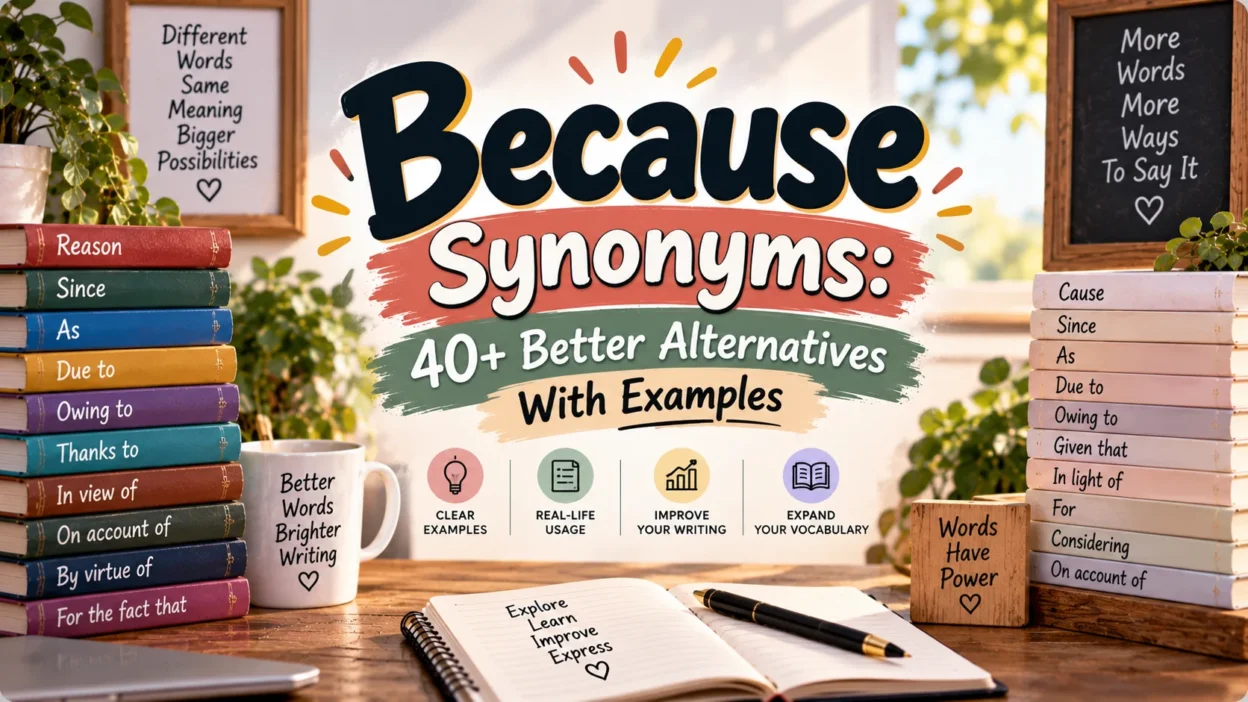
The word because is one of the most common ways to explain a reason or cause in English. It makes sentences clear and natural, but repeating it too often can make your writing feel predictable.
Fortunately, English offers many alternatives and related expressions. Depending on the sentence, you can use since, as, due to, because of, owing to, given that, considering that, or on account of. However, these expressions do not all work in exactly the same grammatical way.
For example, since and as can introduce a clause, while because of must be followed by a noun or noun phrase. Understanding this difference helps you choose an alternative that sounds natural rather than simply replacing one word with another.
Quick Guide to Because Alternatives
| Alternative | Best Used For | Example |
|---|---|---|
| Since | Giving a known reason | Since it was late, we left. |
| As | Providing a reason | As she was busy, she declined. |
| Due to | Formal cause | The event was delayed due to rain. |
| Because of | Direct cause before a noun | We stayed home because of the rain. |
| Owing to | Formal explanation | The flight was canceled owing to fog. |
| Given that | Reason based on a known fact | Given that prices rose, we changed plans. |
| Considering that | Reason based on circumstances | Considering that he was tired, he left early. |
| On account of | Formal cause | The match was postponed on account of rain. |
The right choice depends on both meaning and grammar.
What Does Because Mean?
Because introduces a reason or explanation for something.
Examples:
- We stayed home because it was raining.
- She smiled because she received good news.
- He missed the bus because he woke up late.
- They canceled the trip because the weather was dangerous.
The word normally connects a main clause with a reason clause.
A simple pattern is:
Result + because + reason
For example:
The match was canceled because it was raining.
Because vs Because of
One of the most important distinctions is between because and because of.
Because + Clause
Use because before a clause containing a subject and verb.
Example:
The game was canceled because it was raining.
The phrase it was raining contains a subject and verb.
Because of + Noun
Use because of before a noun or noun phrase.
Example:
The game was canceled because of the rain.
Here, the rain is a noun phrase.
Compare:
- We stayed home because it was raining.
- We stayed home because of the rain.
Both express the same basic reason, but their grammatical structures differ.
Since as a Synonym for Because
Since can introduce a reason, especially when the reason is already known or relatively obvious.
Examples:
- Since you are here, we can start the meeting.
- Since it was getting late, we went home.
- Since everyone agreed, we moved forward.
When Since Works Best
Since often sounds smoother than because when the reason is background information rather than the main point.
Compare:
Because it was late, we left.
Since it was late, we left.
Both are correct. Since can make the sentence feel slightly less direct.
As as an Alternative to Because
As can also introduce a reason.
Examples:
- As the road was closed, we took another route.
- As she felt sick, she stayed home.
- As the store was closed, we returned later.
As is common in formal and written English.
However, because usually makes the cause more direct and obvious.
Compare:
Because the weather was bad, the flight was delayed.
As the weather was bad, the flight was delayed.
Both work, but because places stronger emphasis on the reason.
Due To as an Alternative
Due to is a common formal expression for explaining a cause.
Examples:
- The flight was delayed due to bad weather.
- The road closed due to flooding.
- The event was postponed due to technical problems.
Notice the structure:
due to + noun/noun phrase
You would normally write:
The event was canceled due to rain.
rather than:
The event was canceled due to it was raining.
For a clause, use because, since, or another conjunction instead.
Owing To
Owing to has a similar meaning to due to and often appears in formal writing.
Examples:
- The train was delayed owing to heavy snow.
- The match was postponed owing to poor weather.
- Production slowed owing to supply problems.
It can sound more formal than because of.
Because of
Because of is one of the most natural alternatives when you want to place a noun after the expression.
Examples:
- We stayed inside because of the storm.
- The flight was delayed because of fog.
- She missed the meeting because of traffic.
Compare:
Because it was raining, we stayed inside.
Because of the rain, we stayed inside.
Both sentences explain the same cause using different grammatical structures.
Given That
Given that introduces a reason based on a known fact or circumstance.
Examples:
- Given that the deadline is tomorrow, we need to work quickly.
- Given that he has experience, he should lead the project.
- Given that prices have increased, customers may spend less.
This expression works especially well in professional, academic, and analytical writing.
Considering That
Considering that means taking a particular fact or circumstance into account.
Examples:
- Considering that she was tired, she performed well.
- Considering that the project was difficult, the results were impressive.
- Considering that we had limited time, we achieved a lot.
It often highlights a surprising result or an important circumstance.
On Account Of
On account of means because of and usually sounds formal.
Examples:
- The event was canceled on account of bad weather.
- The company closed the office on account of the holiday.
- The match was postponed on account of heavy rain.
In everyday conversation, because of is usually more natural.
Thanks To
Thanks to explains a cause that usually produces a positive result.
Examples:
- Thanks to your help, we finished the project.
- Thanks to modern technology, communication is easier.
- Thanks to the team’s effort, the event was successful.
It can sometimes be used sarcastically for a negative result, but its normal meaning is positive.
Compare:
We finished early thanks to your help.
This suggests that your help caused the positive outcome.
As a Result Of
As a result of focuses on the cause of an outcome.
Examples:
- The road closed as a result of heavy flooding.
- Sales increased as a result of the new campaign.
- He missed the flight as a result of traffic delays.
It is especially useful when discussing cause and effect in formal writing.
By Reason Of
By reason of is a formal expression meaning because of or due to.
Example:
The contract was terminated by reason of a serious breach.
This phrase is more formal and less common in everyday English.
For
In some formal or literary contexts, for can introduce a reason.
Example:
She remained silent, for she did not know what to say.
This use is grammatically correct but sounds old-fashioned or literary in modern everyday English.
For normal communication, because is usually clearer.
Because Synonyms by Writing Style
Different situations call for different alternatives.
Casual English
Use:
- Because
- Since
- As
- Because of
- Thanks to
Example:
I stayed home because I was tired.
Professional English
Use:
- Because
- Since
- Due to
- Given that
- As a result of
- Owing to
- Considering that
Example:
The meeting was postponed due to scheduling conflicts.
Academic English
Useful choices include:
- Because
- Since
- Given that
- Considering that
- As a result of
- Due to
- Owing to
Example:
The results changed because of variations in temperature.
Formal or Legal Writing
You may encounter:
- Due to
- Owing to
- On account of
- By reason of
- Given that
- As a result of
Example:
The agreement was terminated on account of noncompliance.
Because Alternatives for Different Situations
| Situation | Natural Choice |
|---|---|
| Simple reason | Because |
| Known reason | Since |
| Formal reason | Due to |
| Reason before a noun | Because of |
| Formal cause | Owing to |
| Known circumstance | Given that |
| Considering a fact | Considering that |
| Positive cause | Thanks to |
| Cause of an outcome | As a result of |
| Very formal writing | On account of |
Because vs Since
Both can introduce reasons, but they have slightly different emphasis.
Because usually puts more attention on the reason.
Since can present the reason as background information.
Examples:
Because I was tired, I went home.
Since I was tired, I went home.
Both sentences are correct. Because is generally more direct.
Because vs As
Because clearly identifies the cause.
As can sound slightly more formal or less emphatic.
Examples:
Because the store was closed, we left.
As the store was closed, we left.
Both are grammatically correct.
When there is any possibility of confusion, because can be the clearer choice.
Because vs Due To
These expressions often appear in different grammatical structures.
Because + clause
The flight was delayed because the weather was bad.
Due to + noun phrase
The flight was delayed due to bad weather.
A simple way to remember the difference is:
because + subject + verb
due to + noun
Because vs Because of
This distinction is similar.
Because + clause
She stayed home because she was sick.
Because of + noun
She stayed home because of her illness.
Do not treat because and because of as completely interchangeable.
Because vs Thanks To
These expressions have different emotional implications.
Because is neutral.
The event succeeded because the team worked hard.
Thanks to usually suggests appreciation.
The event succeeded thanks to the team’s hard work.
Use thanks to when you want to give credit for a positive result.
40+ Alternatives to Because
Here is a useful collection of alternatives and related expressions:
- Since
- As
- Because of
- Due to
- Owing to
- Given that
- Considering that
- On account of
- Thanks to
- As a result of
- By reason of
- In view of
- In light of
- As a consequence of
- On the grounds of
- For the reason that
- Seeing that
- Seeing as
- Insofar as
- Now that
- Given
- In consideration of
- As a consequence
- Resulting from
- Stemming from
- Arising from
- Because of the fact that
- Due to the fact that
- On the basis that
- In response to
- In light of the fact that
- As it happens
- By virtue of
- In consequence of
- On the strength of
- For
- Through
- From
- As a consequence of
- As a result
Not every expression is a direct grammatical replacement for because. Some work with clauses, while others require nouns or noun phrases.
Common Mistakes With Because Synonyms
Using Due To Before a Full Clause
Incorrect:
Due to it was raining, we stayed home.
Better:
Because it was raining, we stayed home.
Or:
We stayed home due to the rain.
Using Because of Before a Clause
Incorrect:
We left because of it was late.
Better:
We left because it was late.
Or:
We left because of the late hour.
Using Thanks To for Every Cause
Thanks to usually suggests a positive result or appreciation.
For a neutral or negative cause, because of is often better.
Overusing Formal Expressions
Using owing to, by reason of, and on account of repeatedly can make simple writing sound unnecessarily formal.
Sometimes plain because is the strongest choice.
How to Choose the Right Alternative
Think about the structure first.
Need a full clause after the expression?
Use:
- Because
- Since
- As
- Given that
- Considering that
Need a noun or noun phrase?
Use:
- Because of
- Due to
- Owing to
- Thanks to
- On account of
- As a result of
Writing formally?
Consider:
- Due to
- Owing to
- Given that
- As a result of
- In light of
Writing casually?
Stick with:
- Because
- Since
- As
- Because of
- Thanks to
This makes your choice both grammatically correct and natural.
Frequently Asked Questions
What is the best synonym for because?
Common alternatives include since, as, due to, because of, owing to, given that, and considering that. The correct choice depends on sentence structure and tone.
What is a simple word for because?
Since and as are two simple alternatives when you need a conjunction.
What is a formal synonym for because?
Due to, owing to, given that, on account of, and as a result of can work in formal writing, depending on the grammatical structure.
Is since the same as because?
Since can mean because when it introduces a reason. However, since can also refer to time, so context sometimes matters.
Is as a synonym for because?
Yes. As can introduce a reason, especially in formal or written English.
What is the difference between because and because of?
Because normally introduces a clause, while because of is followed by a noun or noun phrase.
Can I use due to instead of because?
Sometimes. Due to normally comes before a noun or noun phrase, while because can introduce a complete clause.
Is thanks to a synonym for because?
It can express a cause, but it usually suggests that the cause produced a positive result or deserves credit.
What can I use instead of because in an essay?
Depending on the sentence, you can use since, as, given that, due to, owing to, or as a result of.
What is the difference between because and since?
Because usually gives a direct reason. Since often presents the reason as background information that the reader may already accept.
Final Thoughts
There are many useful because synonyms, but they do not all work in the same way. Since and as can introduce a reason clause, while because of, due to, and owing to normally introduce a noun or noun phrase. Expressions such as given that and considering that are useful when a reason depends on a particular fact or circumstance.
For everyday writing, you rarely need complicated alternatives. Because, since, as, and because of will cover most situations. In formal or academic writing, more specific expressions such as due to, optimal? no—actually due to, owing to, given that, and as a result of can help you vary your sentence structure.
The goal is not to remove because from your writing. It is to choose the expression that fits your meaning, grammar, and tone naturally.

Miles Ellington enjoys exploring the subtle differences that can completely change how a word or phrase is understood. At Differology, he turns confusing language questions into straightforward explanations, covering word comparisons, vocabulary, grammar, usage, and everyday English.
With a practical and reader-focused approach, Miles uses real-world examples and clear comparisons to help readers choose the right word, understand its meaning, and communicate more precisely.