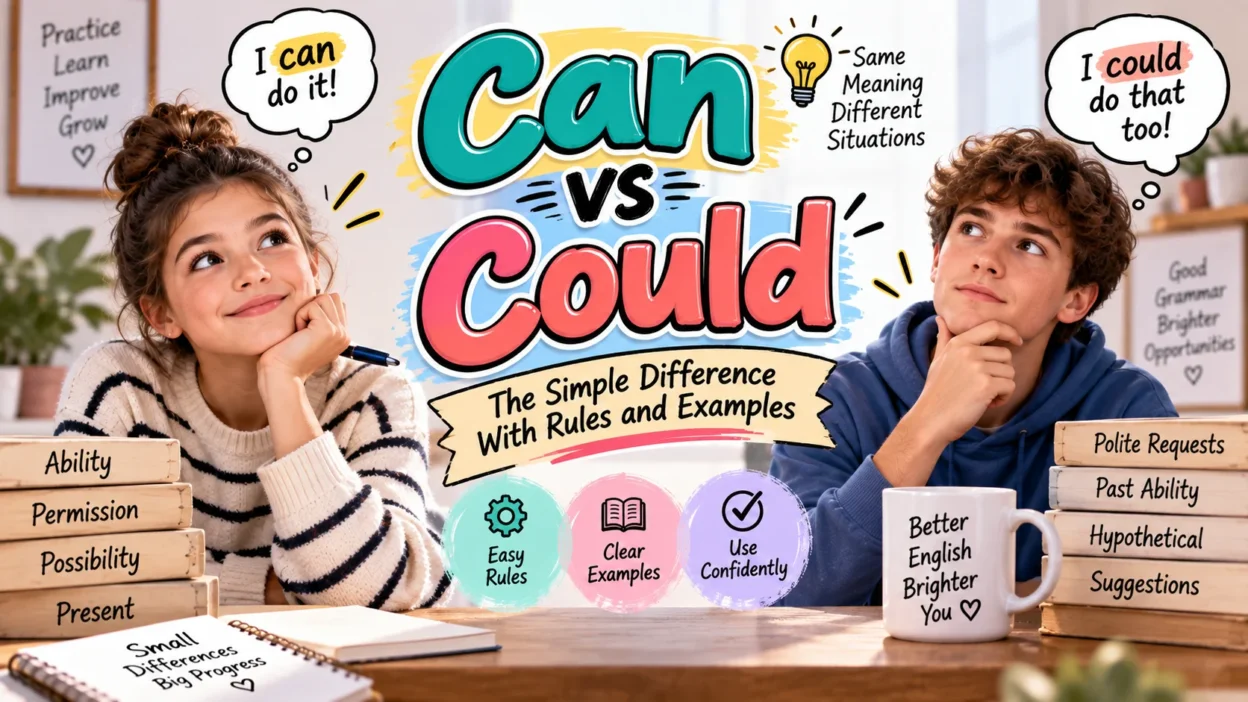
Can vs could is a common English grammar confusion because both words are modal verbs and can express ability, possibility, permission, and requests. However, they are not always interchangeable.
The easiest way to remember the basic difference is that can usually refers to present ability or a more direct possibility, while could often refers to past ability, a less certain possibility, or a more polite request.
For example:
- I can swim. → Present ability.
- I could swim when I was five. → Past ability.
- Can you help me? → Direct request.
- Could you help me? → More polite request.
The difference becomes more interesting when can and could are used for possibility, permission, suggestions, and hypothetical situations. Understanding these patterns will help you use both words naturally in conversations, essays, emails, and professional writing.
Quick Answer
Can is commonly used for present ability, permission, possibility, and direct requests. Could is commonly used for past ability, polite requests, possibilities, suggestions, and hypothetical situations. For example, I can drive describes current ability, while I could drive at age sixteen describes past ability.
Can vs Could at a Glance
| Can | Could |
|---|---|
| Present ability | Past ability |
| Direct requests | More polite requests |
| Present possibility | Possible or less certain situations |
| Informal permission | Polite or formal permission |
| Direct offers | Suggestions |
| General capability | Hypothetical situations |
Simple Rule
Can = ability or possibility now
Could = past ability, possibility, politeness, or hypothetical situation
However, context matters, so this rule does not cover every use.
What Does Can Mean?
Can is a modal verb used to express ability, possibility, permission, and requests.
Can for Present Ability
Use can when someone has the ability to do something now.
Examples:
- I can swim.
- She can speak Spanish.
- He can drive.
- We can solve this problem.
- They can play the guitar.
Here, can describes an ability that exists in the present.
Can for Permission
Can can also be used to ask for or give permission, especially in everyday English.
Examples:
- Can I use your phone?
- Can I leave early today?
- You can sit here.
- You can borrow my book.
Although some traditional grammar advice recommends may for formal permission, can is extremely common in modern English.
Can for Possibility
Can can describe something that is generally possible.
Examples:
- It can get very cold here in winter.
- Driving at night can be dangerous.
- Mistakes can happen.
- This road can become crowded during rush hour.
This use often describes a general possibility rather than a prediction about one specific event.
Can for Requests
Can is frequently used for direct, everyday requests.
Examples:
- Can you help me?
- Can you open the door?
- Can you send me the file?
- Can you wait a moment?
These requests are natural and common in conversation.
What Does Could Mean?
Could is the past form of can in some uses, but it also has several meanings that do not simply indicate past time.
Could for Past Ability
Use could to describe a general ability that someone had in the past.
Examples:
- When I was younger, I could run very fast.
- She could speak French when she lived in Paris.
- He could swim by the age of six.
- We could see the mountains from our house.
Here, could refers to an ability that existed in the past.
Could for Polite Requests
Could is often used to make a request sound more polite or less direct.
Examples:
- Could you help me?
- Could you send me the report?
- Could you open the window?
- Could I ask you a question?
Compare:
Can you help me?
This is perfectly polite in ordinary conversation.
Could you help me?
This sounds slightly more polite or less direct.
Could for Possibility
Could can describe something that is possible but not certain.
Examples:
- It could rain tonight.
- We could be late.
- This could be the answer.
- She could win the competition.
The speaker is suggesting a possibility rather than stating that something is definitely going to happen.
Could for Suggestions
Could can introduce a possible action or suggestion.
Examples:
- We could go to the park.
- You could try restarting the computer.
- We could meet tomorrow.
- She could ask her teacher for help.
Here, could means something like one possible option is…
Can vs Could for Ability
This is one of the easiest differences to understand.
Present Ability → Can
- I can drive.
- She can cook.
- He can speak German.
- They can solve the problem.
Past Ability → Could
- I could drive when I was seventeen.
- She could cook when she was young.
- He could speak German as a child.
- They could solve difficult problems when they worked together.
The basic pattern is:
Now → can
Past → could
Can vs Could for Requests
Both can and could can be used to ask someone to do something.
Can
Can you help me?
This is direct and completely natural.
Could
Could you help me?
This is slightly more polite or indirect.
Other examples:
- Can you close the door?
- Could you close the door?
- Can you send me the document?
- Could you send me the document?
Neither is necessarily rude. Could simply creates a softer tone.
Can vs Could for Permission
Both can and could can appear when asking permission, but could is generally more polite or formal in tone.
Can I…?
- Can I use your laptop?
- Can I leave now?
- Can I sit here?
Could I…?
- Could I use your laptop?
- Could I leave a little early?
- Could I speak with you?
Could I often sounds more respectful or tentative.
Can vs Could for Possibility
This distinction is important.
Can for General Possibility
Use can when something is generally possible.
Examples:
- Winters can be very cold here.
- Too much sugar can cause health problems.
- The road can become dangerous after heavy rain.
These statements describe something that is possible in general.
Could for Specific Possibility
Use could when discussing something that might happen in a particular situation.
Examples:
- It could rain tonight.
- She could arrive late.
- We could miss the train.
- This could cause a problem.
The speaker is presenting a possibility rather than a general fact.
Can vs Could Examples
Compare these sentences:
I can help you.
This expresses present ability or willingness.
I could help you.
This can suggest a possible option or a more tentative offer.
Another example:
She can come tomorrow.
This suggests that she is able or available to come.
She could come tomorrow.
This suggests that coming tomorrow is one possibility, but it may not be certain.
Can vs Could for Offers
Can often sounds more direct when making an offer.
- I can help you with that.
- We can drive you home.
- I can send you the information.
Could can make an offer sound more tentative:
- I could help you with that.
- We could drive you home.
- I could send you the information.
The difference is subtle and depends heavily on context.
Can vs Could for Suggestions
Could is particularly common when offering suggestions.
Examples:
- You could try a different approach.
- We could meet after work.
- You could ask your manager.
- They could start earlier.
Can can sometimes be used too:
- We can meet tomorrow.
But this usually sounds more like stating an available option than making a tentative suggestion.
Can vs Could in Conditional Sentences
Could is commonly used in hypothetical or conditional situations.
Examples:
- If I had more time, I could help you.
- If we left now, we could catch the train.
- If she practiced more, she could improve.
- If they lowered the price, more people could buy it.
Here, could describes a possible result under a condition.
Can vs Could With If
Compare:
If you work hard, you can succeed.
This suggests that success is realistically possible through effort.
If you worked harder, you could succeed.
This sounds more hypothetical or conditional.
Another example:
If we leave now, we can catch the bus.
The speaker believes catching the bus is realistically possible.
If we left now, we could catch the bus.
The sentence presents catching the bus as a possibility.
Can vs Could in Negative Sentences
The negative forms are:
- Cannot / can’t
- Could not / couldn’t
Can’t
Can’t usually means someone is unable to do something or something is not possible.
Examples:
- I can’t swim.
- She can’t come today.
- We can’t open the door.
- That can’t be correct.
Couldn’t
Couldn’t can describe past inability or a present situation that seems impossible.
Examples:
- I couldn’t swim when I was five.
- She couldn’t attend the meeting yesterday.
- We couldn’t find the address.
- That couldn’t be the right answer.
Can vs Could for Past Events
Could is often used for general past ability.
Example:
- When I was younger, I could run five miles easily.
However, when describing one specific successful action in the past, English often uses was/were able to rather than could.
For example:
- I was able to finish the project yesterday.
This is often more natural than:
- I could finish the project yesterday.
However, could is common when describing general ability:
- When I was younger, I could finish difficult projects quickly.
This distinction can help advanced learners write more naturally.
Can vs Could in Professional Writing
Both words are common in professional communication.
Can for Clear, Direct Statements
- We can complete the project by Friday.
- I can send the report this afternoon.
- Our team can provide additional information.
Could for Polite or Tentative Language
- We could schedule a meeting next week.
- Could you please review the document?
- This change could improve performance.
- We could consider another option.
Could is useful when you want to avoid sounding too forceful or overly certain.
Common Mistakes With Can and Could
Mistake 1: Using Can for Past Ability
Incorrect:
When I was a child, I can swim.
Correct:
When I was a child, I could swim.
Mistake 2: Thinking Could Always Means Past
Could does not always refer to the past.
For example:
It could rain tomorrow.
Here, could refers to a future possibility.
Mistake 3: Thinking Could Is Always More Polite
Could often sounds more polite than can, but both can be perfectly polite.
- Can you help me?
- Could you help me?
The second is softer, but the first is not automatically rude.
Mistake 4: Using Could When You Mean Certain Ability
If you are talking about a clear present ability, can is usually the natural choice.
- I can speak English.
Using could would normally change the meaning toward past ability or a tentative possibility.
Can vs Could: Easy Memory Trick
Remember these simple patterns:
Can = now
I can swim.
Could = past
I could swim when I was six.
Could = polite
Could you help me?
Can = general possibility
It can get very cold here.
Once you recognize the context, choosing between can and could becomes much easier.
Can vs Could Comparison Table
| Situation | Can | Could |
|---|---|---|
| Present ability | I can drive. | — |
| Past ability | — | I could drive at 17. |
| Direct request | Can you help? | — |
| Polite request | — | Could you help? |
| Present/general possibility | It can happen. | — |
| Specific possibility | — | It could happen. |
| Permission | Can I leave? | Could I leave? |
| Suggestion | — | We could go tomorrow. |
| Hypothetical situation | — | I could help if I had time. |
Frequently Asked Questions
What is the main difference between can and could?
Can commonly expresses present ability, permission, or general possibility. Could commonly expresses past ability, polite requests, possibilities, suggestions, or hypothetical situations.
Is could the past tense of can?
Could is traditionally considered the past form of can in some uses, especially when talking about past ability. However, could also has present and future uses, such as Could you help me? and It could rain tomorrow.
Is can more direct than could?
Usually, yes. Can you help me? is direct and natural, while Could you help me? sounds slightly softer and more polite.
Can I use could for present ability?
Usually not when you mean a definite ability that exists now. Say I can swim for present ability. I could swim normally refers to past ability or a conditional possibility.
Can could refer to the future?
Yes. For example:
It could rain tomorrow.
Here, could expresses a future possibility.
Is “Can I” grammatically correct for permission?
Yes. Can I…? is extremely common in modern English for asking permission. Could I…? is also correct and generally sounds more polite or tentative.
Which is more polite: can or could?
Could generally sounds more polite or less direct, especially in requests.
Can you help me?
Could you help me?
Both are correct, but the second is softer.
Should I use can or could in an essay?
Use the word that matches your meaning. Can is useful for present ability and general possibility, while could is useful for hypothetical possibilities, tentative claims, and past ability.
Final Thoughts
Understanding can vs could becomes much easier when you focus on the context. Use can for present ability, everyday permission, direct requests, and general possibilities. Use could for past ability, polite requests, suggestions, hypothetical situations, and possibilities that are less certain.
Remember the simplest pattern: can often points to what is possible or possible now, while could often adds distance—past time, uncertainty, politeness, or a hypothetical situation.
For example, I can help you expresses present ability or willingness, while I could help you can suggest a possible option. Likewise, Can you help me? is direct, whereas Could you help me? sounds a little more polite.

Miles Ellington enjoys exploring the subtle differences that can completely change how a word or phrase is understood. At Differology, he turns confusing language questions into straightforward explanations, covering word comparisons, vocabulary, grammar, usage, and everyday English.
With a practical and reader-focused approach, Miles uses real-world examples and clear comparisons to help readers choose the right word, understand its meaning, and communicate more precisely.