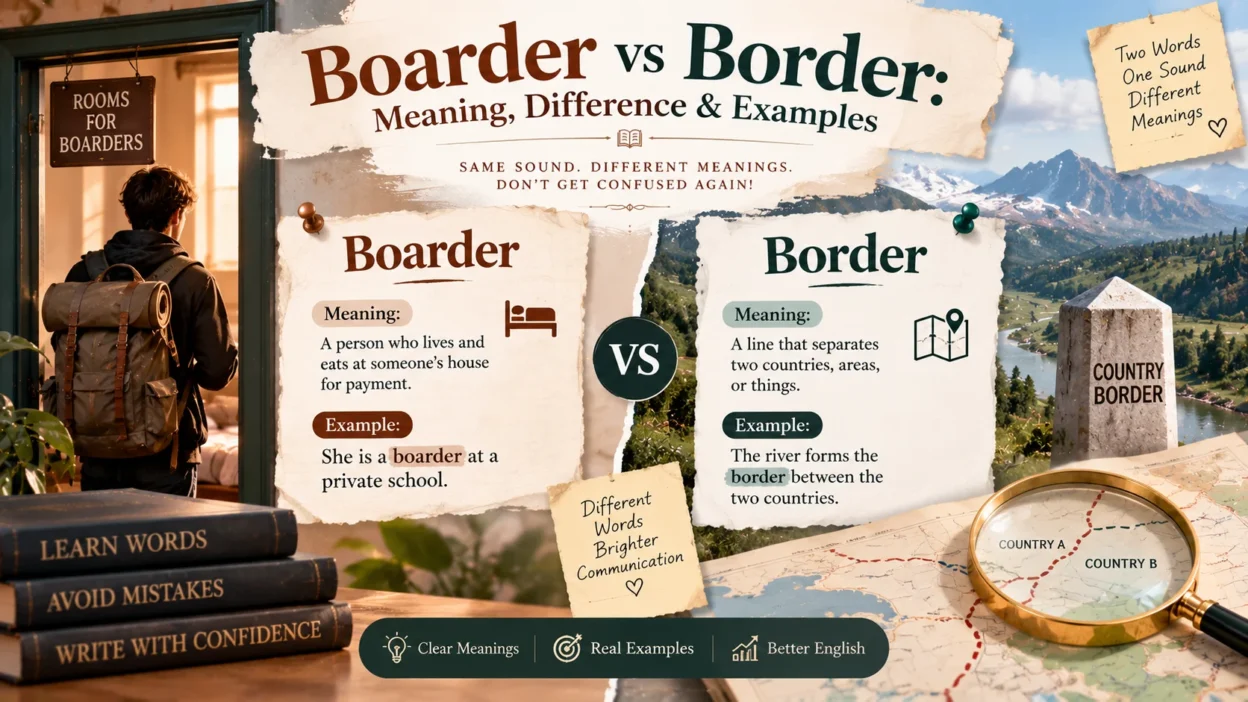
Boarder vs border is a common English word confusion because the two words look and sound very similar. The only spelling difference is the extra a in boarder, but their meanings are completely different.
Boarder usually refers to a person who receives meals and a place to stay in exchange for payment. It can also describe someone who participates in a sport such as snowboarding or skateboarding.
Border, on the other hand, refers to an edge, boundary, or dividing line between places, areas, or things.
For example:
- The student is a boarder at the school.
- Mexico shares a border with the United States.
Understanding the connection between board and boundary makes these words much easier to remember.
Boarder vs Border at a Glance
| Word | Meaning | Common Use | Example |
|---|---|---|---|
| Boarder | A person who receives lodging, usually with meals | Schools, homes, accommodation | The boarder paid for a room and meals. |
| Border | An edge, boundary, or dividing line | Countries, areas, objects | The river forms a natural border. |
Easy Rule
Boarder = a person who boards or stays somewhere
Border = an edge or boundary
The extra a in boarder can help you remember that it relates to board.
What Does Boarder Mean?
A boarder is generally a person who pays for and receives accommodation, often along with meals.
The word comes from board, which has historically been connected with meals or food provided as part of accommodation.
Examples:
- The family took in a boarder.
- The school provides rooms for its boarders.
- Each boarder receives breakfast and dinner.
- The house has space for two boarders.
Boarder in Schools
You may hear boarder when talking about students who live at a boarding school.
For example:
- She is a boarder at a private school.
- The school has both day students and boarders.
- The boarders live in dormitories during the school term.
In this context, a boarder is a student who lives at the school rather than returning home every day.
What Does Border Mean?
A border is a boundary or dividing line between two places, regions, countries, areas, or things.
Examples:
- The river forms the border between the two countries.
- We crossed the border at noon.
- The house is close to the state border.
- The two countries share a long border.
Border can refer to both physical and figurative boundaries.
Border Between Countries
This is one of the most common uses.
Examples:
- Canada and the United States share a border.
- They traveled across the border.
- The soldiers guarded the border.
- We stopped at the border crossing.
Border Around an Object
Border can also mean a decorative edge around something.
Examples:
- The picture has a black border.
- Add a thin border around the table.
- The garden has a stone border.
- The page has a decorative border.
Here, border has nothing to do with countries or geography. It simply means an edge or surrounding line.
Boarder vs Border: Different Parts of Speech
Both words can function as nouns, but their meanings remain distinct.
Boarder as a Noun
A boarder is a person.
The boarder rented a room in the house.
Border as a Noun
A border is an edge or boundary.
The river marks the border.
Border can also function as a verb.
The two regions border each other.
This means that the regions share a boundary.
Boarder vs Border in Sentences
| Boarder | Border |
|---|---|
| The boarder rented a room. | The country shares a border with its neighbor. |
| The school has 200 boarders. | We crossed the border yesterday. |
| The family welcomed a new boarder. | The river forms the border. |
| Every boarder receives meals. | The garden has a wooden border. |
| The student became a boarder. | The two states border each other. |
The meaning changes completely depending on which spelling you choose.
Boarder vs Border in School Context
School-related writing can make this distinction especially important.
Boarder
A boarder lives at a boarding school.
Example:
Emma is a boarder at the school.
Border
A border has nothing to do with whether a student lives at school.
Example:
The school is near the border between two states.
A useful way to remember this is:
Boarder = person who boards
Border = boundary
Boarder in Sports
Boarder can also describe someone who participates in a sport involving a board.
For example:
- snowboarder → sometimes shortened to boarder
- skateboarder → sometimes referred to as a boarder
- wakeboarder → someone who rides a wakeboard
Examples:
- The professional boarder performed an impressive trick.
- The snowboarding competition attracted talented boarders.
- Several boarders practiced on the ramp.
This meaning is less common than the accommodation-related meaning, but you may encounter it in sports writing.
Border as a Verb
Unlike boarder, border can also work as a verb.
It means to share a boundary with something.
Examples:
- Canada borders the United States.
- The property borders a large lake.
- The two states border each other.
- The village borders the forest.
The verb form makes the difference even clearer:
Boarder → person
Border → boundary or share a boundary
Common Mistakes With Boarder and Border
Mistake 1: Using Boarder for a Country Boundary
Incorrect:
The soldiers protected the country’s boarder.
Correct:
The soldiers protected the country’s border.
A country’s boundary is its border.
Mistake 2: Using Border for a Student Who Lives at School
Incorrect:
She is a border at the boarding school.
Correct:
She is a boarder at the boarding school.
A student who lives at school is a boarder.
Mistake 3: Confusing Boarder With Boarding
These words are related but not identical.
- Boarding school = a school where some students live.
- Boarder = a student who lives there.
- Border = a boundary.
Mistake 4: Thinking the Words Have the Same Meaning Because They Sound Similar
Boarder and border sound very similar in many accents, but their meanings are completely different.
Spelling and context matter.
A Simple Memory Trick
Use the A test.
Boarder has an A
Think:
Boarder → board
A boarder is a person who boards somewhere or rides a board.
Border has no A
Think:
Border → boundary
A border is an edge or dividing line.
So remember:
Boarder = person
Border = boundary
Boarder vs Border: Quick Practice
Choose the correct word in each sentence:
- We crossed the country’s ___ yesterday.
- The school has more than 100 ___.
- The river marks the ___ between the two regions.
- She became a ___ at the boarding school.
- The picture has a decorative ___.
- The competition attracted several professional ___.
Answers
- border
- boarders
- border
- boarder
- border
- boarders
The key is to look at the meaning rather than just the pronunciation.
Boarder vs Border in Everyday English
Here are a few practical examples:
Talking About Accommodation
The homeowner rented a room to a boarder.
The person receives accommodation, usually under an arrangement that includes meals or lodging.
Talking About Geography
We drove toward the border.
The word refers to a boundary between places.
Talking About Decoration
The invitation has a gold border.
Here, border means an edge around the design.
Talking About School
The boarders stay on campus during the school year.
The students live at the school.
Pronunciation of Boarder and Border
The two words have very similar pronunciations.
Boarder
Generally pronounced like:
BOR-der
Border
Generally pronounced like:
BOR-der
In many varieties of English, they are homophones, meaning they sound the same even though they have different spellings and meanings.
That is one major reason learners confuse them.
Related Words
Understanding related words can make the distinction easier.
Board
A board can mean a flat piece of material, but the verb board can also mean to get onto a vehicle or stay somewhere with meals.
Examples:
- We boarded the train.
- The students board at the school.
Boarding
Boarding can describe staying somewhere with accommodation or getting onto a vehicle.
Examples:
- She attends a boarding school.
- Boarding begins at 7:30.
Borderline
Borderline means close to a particular limit or condition.
Example:
His behavior was borderline inappropriate.
It comes from the idea of a boundary or limit and relates to border, not boarder.
Frequently Asked Questions
What is the difference between boarder and border?
A boarder is a person who receives accommodation, often with meals, or someone who rides a board in certain sports. A border is an edge or boundary between places or things.
Is a student a boarder or border?
A student who lives at a boarding school is a boarder.
Is it country boarder or country border?
The correct phrase is country border.
A border is a boundary between countries.
What is a boarder in a house?
A boarder is a person who rents or receives a room and usually receives meals as part of the arrangement.
Can boarder refer to a sports participant?
Yes. In some contexts, boarder can refer to someone who participates in a board sport, such as snowboarding or skateboarding.
Are boarder and border pronounced the same?
In many English accents, yes. They can be homophones, even though their spellings and meanings differ.
What is an easy way to remember boarder and border?
Remember boarder = person and border = boundary. The extra a in boarder can remind you of board.
Can border be a verb?
Yes. Border can mean to share a boundary.
For example:
The two countries border each other.
Final Thoughts
The difference between boarder vs border is easy to remember once you connect each word with its core meaning. Boarder refers to a person, such as a student who lives at a boarding school or someone who rides a board in certain sports. Border refers to a boundary, edge, or dividing line.
The two words can sound identical in many accents, which explains why spelling mistakes are common. When you mean a person, think boarder. When you mean a boundary or edge, choose border.
A quick memory trick can help: boarder has board in it, while border describes a boundary. Keeping that distinction in mind will help you choose the correct word in school, travel, geography, accommodation, and everyday writing.

Miles Ellington enjoys exploring the subtle differences that can completely change how a word or phrase is understood. At Differology, he turns confusing language questions into straightforward explanations, covering word comparisons, vocabulary, grammar, usage, and everyday English.
With a practical and reader-focused approach, Miles uses real-world examples and clear comparisons to help readers choose the right word, understand its meaning, and communicate more precisely.