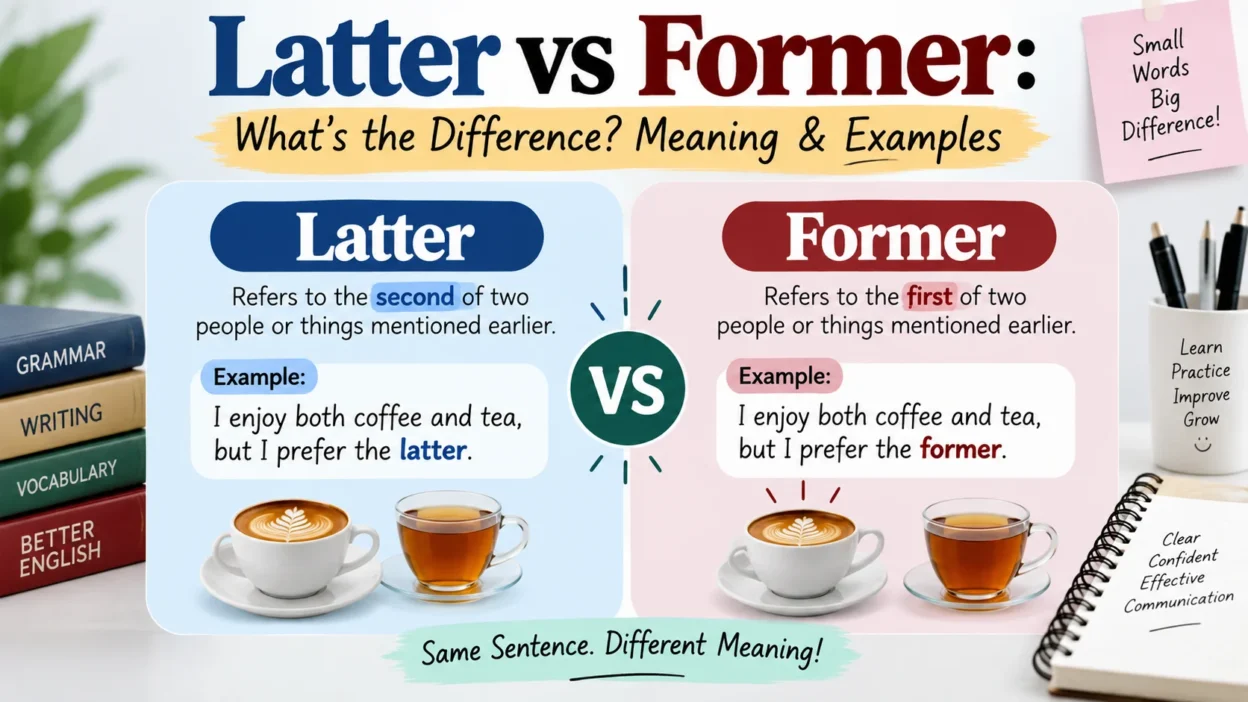
Latter vs former is a common English comparison that can confuse writers and learners because both words refer to something mentioned earlier in a sentence or passage. The good news is that the difference is simple once you understand their direction: former refers to the first of two people or things, while latter refers to the second.
For example, if someone says, I enjoy both coffee and tea, but I prefer the latter, the word latter refers to tea because tea appears second. If they say, I prefer the former, they mean coffee because coffee appears first. This small distinction becomes especially useful in essays, formal writing, reports, academic work, and everyday English.
Latter vs Former at a Glance 🔍
The easiest way to understand the difference is to remember their positions.
| Word | Refers To | Position | Example |
|---|---|---|---|
| Former | First of two | Earlier | Cats and dogs are popular; the former are independent. |
| Latter | Second of two | Later | Cats and dogs are popular; the latter are loyal. |
The Simple Rule
When two people or things appear in a sentence:
- Former = first
- Latter = second
Think of the words as pointing backward to two previously mentioned choices.
Quick Example
Sarah and Emma attended the meeting. The former presented the report, while the latter answered questions.
- Former = Sarah
- Latter = Emma
This is the basic rule you can apply in most situations.
What Does Former Mean? 📘
Former means the first of two people or things previously mentioned.
It can also have another meaning: something that was true in the past but is no longer true.
Former as the First of Two
Consider this sentence:
Summer and winter are very different seasons. The former is warmer.
Here, former refers to summer because summer appears first.
More examples:
- Dogs and cats are popular pets; the former are often highly trainable.
- English and Spanish are widely spoken languages; the former is used in this article.
- John and Michael applied for the position; the former had more experience.
- Books and movies offer different experiences; the former can provide greater detail.
Former Meaning in the Past
Former can also mean previous or earlier.
For example:
- She is a former teacher.
- He is a former employee.
- The former president attended the event.
- We visited the former factory.
- She spoke with her former manager.
In these examples, former does not mean the first of two things. It means something or someone held a particular position or status in the past.
What Does Latter Mean? 📖
Latter refers to the second of two people or things mentioned earlier.
For example:
Tea and coffee are both popular beverages, but I prefer the latter.
The word latter refers to coffee because coffee appears second.
More examples:
- Cats and dogs are common pets; the latter often require more outdoor exercise.
- Summer and autumn are beautiful seasons; the latter brings cooler temperatures.
- Fiction and nonfiction appeal to different readers; the latter focuses on factual information.
- Football and basketball attract millions of fans; the latter uses a hoop and backboard.
Latter Refers to the Later Choice
A useful way to think about latter is:
Later = latter
The second item comes later in the sentence, so it is the latter.
The Main Difference Between Latter and Former ⚖️
The difference becomes easy when you focus on order.
| Feature | Former | Latter |
|---|---|---|
| Meaning | First of two | Second of two |
| Position | Earlier | Later |
| Memory clue | First | Later |
| Common pairing | Former and latter | Former and latter |
| Example | Apple and orange; former = apple | Apple and orange; latter = orange |
Compare These Two Sentences
Pizza and pasta are popular foods. The former is often eaten with toppings.
Former = pizza.
Pizza and pasta are popular foods. The latter is often served with sauce.
Latter = pasta.
The words do not change the order. They simply point back to the two previously mentioned items.
Former vs Latter Examples ✏️
Examples are one of the fastest ways to master this distinction.
Example 1: Food
I ordered pizza and pasta. The former arrived first.
- Former = pizza
- Latter = pasta
Example 2: Travel
We considered driving and taking the train. The latter was cheaper.
- Former = driving
- Latter = taking the train
Example 3: Education
Students can study online or attend classes in person. The latter option provides face-to-face interaction.
- Former = online study
- Latter = attending classes in person
Example 4: Technology
Laptops and tablets are useful devices. The former usually offers a physical keyboard.
- Former = laptops
- Latter = tablets
Example 5: People
Maria and Jennifer applied for the position. The latter had several years of relevant experience.
- Former = Maria
- Latter = Jennifer
Former and Latter in One Sentence 🔄
The two words often appear together.
Common Pattern
A and B. The former…, while the latter…
For example:
The company offers online and in-person training. The former is more flexible, while the latter provides direct interaction.
Here:
- Former = online training
- Latter = in-person training
Another example:
Tom and David joined the project. The former handles design, while the latter manages development.
- Former = Tom
- Latter = David
Why Writers Use Both
Using former and latter prevents writers from repeating the same nouns.
Instead of writing:
Online learning is flexible, while in-person learning provides more direct interaction.
You can write:
Online learning is flexible, while the latter provides more direct interaction.
However, clarity should always come before brevity.
Former vs Latter in Formal Writing 🎓
These words appear frequently in academic and professional writing because they allow writers to refer back to two previously mentioned subjects efficiently.
Academic Example
Researchers compared qualitative and quantitative methods. The former focuses on descriptive information, while the latter emphasizes numerical data.
This structure is clear because exactly two methods appear immediately before the reference.
Business Example
The company considered expanding its website and launching a mobile application. The latter option required a larger initial investment.
Report Example
The survey examined customer satisfaction and product quality. The former received higher ratings than the latter.
In formal writing, these words can make sentences concise, but writers should avoid using them when the reference could become confusing.
Former vs Latter in Everyday English 💬
Although both words are correct in everyday English, casual speakers often prefer simpler expressions.
Instead of:
I like tea and coffee, but I prefer the latter.
A casual speaker might say:
I like tea and coffee, but I prefer coffee.
Both are grammatically correct.
Formal vs Casual Style
| Formal | More Direct |
|---|---|
| I prefer the latter. | I prefer the second one. |
| The former is cheaper. | The first one is cheaper. |
| The latter approach works better. | The second approach works better. |
| The former employee returned. | The employee who worked here before returned. |
The choice depends on your audience and the amount of clarity needed.
The Best Memory Trick for Former vs Latter 🧠
The simplest memory trick is:
Former = First
Both words start with a strong F connection:
Former → First
Latter = Later
The words almost give you the answer:
Latter → Later
So remember:
Former = First
Latter = Later
If two items appear in this order:
A → B
Then:
Former = A
Latter = B
That simple pattern solves most former-versus-latter questions.
Former vs Latter vs Later 🔤
One common source of confusion is the similarity between latter and later.
| Word | Meaning |
|---|---|
| Former | First of two or previous |
| Latter | Second of two |
| Later | At a subsequent time |
Latter
Latter deals with order in a pair.
Example:
I prefer tea and coffee; I like the latter.
Latter = coffee.
Later
Later deals with time.
Example:
I will call you later.
Here, later means at a future time.
Easy Distinction
Latter = second in a pair
Later = afterward in time
Former vs Previous
Former and previous can overlap, but they do not always mean the same thing.
| Word | Typical Meaning |
|---|---|
| Former | Previous or first of two |
| Previous | Earlier in time, order, or sequence |
Examples
She is a former employee.
This means she worked for the company in the past.
She attended the previous meeting.
This means she attended the meeting immediately before the current one.
Another important difference is that former can identify the first of two choices:
Tea and coffee were available. I chose the former.
You cannot naturally replace former with previous here.
Former vs Latter vs First and Second
In many situations, first and second are clearer alternatives.
| Expression | Meaning |
|---|---|
| The former | First of two |
| The latter | Second of two |
| The first | First item |
| The second | Second item |
For example:
The former was more expensive, while the latter was easier to use.
This is equivalent to:
The first option was more expensive, while the second option was easier to use.
Which Is Clearer?
If your readers might forget the order, use first and second. They are often easier to understand immediately.
Common Mistakes With Former and Latter 🚫
Mistake 1: Reversing Them
Incorrect understanding:
Former = second
Latter = first
The correct rule is:
Former = first
Latter = second
Mistake 2: Using Latter for More Than Two Items
Traditionally, former and latter work best when you have exactly two clearly identified items.
For example:
Apples, oranges, and bananas are popular fruits. The latter is sweet.
This creates ambiguity because three items appear.
A clearer sentence would be:
Apples, oranges, and bananas are popular fruits. Bananas are sweet.
Mistake 3: Using Them With Unclear References
Consider:
John discussed the project with Mike after meeting Sarah and David. The latter was helpful.
Which person does latter refer to? The sentence can create uncertainty.
Use the person’s name instead when the reference is unclear.
Mistake 4: Confusing Latter With Later
Remember:
- Latter = second of two
- Later = afterward
Mistake 5: Assuming Former Always Means First
Former has two major uses.
It can mean:
- The first of two
- Previous or no longer current
Context determines the meaning.
When Should You Use Former? ✅
Use former when:
- You need to refer to the first of two items.
- You want to avoid repeating a noun.
- You are writing formally.
- You are describing someone’s previous status or position.
- You are comparing two options.
Examples
- The former option is more affordable.
- She is a former employee.
- The former president visited the city.
- Between the two plans, I prefer the former.
- Cats and dogs are popular; the former are often more independent.
When Should You Use Latter? ✅
Use latter when:
- You need to refer to the second of two items.
- The two items were clearly mentioned.
- You want a concise formal reference.
- You are comparing two alternatives.
Examples
- Between tea and coffee, I prefer the latter.
- The company considered two plans, and the latter was more practical.
- John and David attended; the latter spoke first.
- Fiction and nonfiction have different purposes; the latter relies on factual information.
Former and Latter in Professional Communication 💼
Professional writing often involves comparing two options, approaches, products, or strategies.
For example:
The team considered reducing costs and increasing revenue. The latter approach may require additional investment.
This works because the reader can easily identify the two options.
However, professional writers should prioritize clarity over formality. If a sentence contains several possible references, repeating the noun may make the meaning clearer.
Good Professional Example
The company can improve customer service through employee training or automation. The former requires more staff time, while the latter requires greater upfront investment.
This structure clearly identifies both options.
Former and Latter in Essays 📝
Students often encounter these words in essays and academic assignments.
Example
Social media and traditional newspapers both influence public communication. The former offers immediate interaction, while the latter has a longer-established format.
The structure is useful because the reader can easily connect each word with the correct subject.
Writing Tip
Do not use former and latter simply to sound sophisticated. Use them when they genuinely improve the sentence.
Clear writing is more important than complicated vocabulary.
Former and Latter With People 👥
You can use these words to distinguish between two people.
Alex and Jordan applied for the scholarship. The former had stronger academic results, while the latter had more volunteer experience.
Here:
- Former = Alex
- Latter = Jordan
However, names are often clearer than pronouns when a paragraph contains many people.
Former and Latter With Choices 🔀
The words work particularly well when discussing alternatives.
Example
You can travel by bus or train. The former is cheaper, while the latter is faster.
- Former = bus
- Latter = train
Another example:
You can work from home or from the office. The former offers greater flexibility, while the latter may encourage more collaboration.
This pattern appears frequently in essays, reports, comparisons, and professional writing.
Pronunciation of Former and Latter 🗣️
Pronunciation can also help you recognize these words.
| Word | Approximate Pronunciation | Meaning |
|---|---|---|
| Former | FOR-mer | First of two / previous |
| Latter | LAT-er | Second of two |
| Later | LAY-ter | At a future time |
The spelling of latter and later looks similar, but the vowel sound differs.
Pronunciation Tip
Think:
Latter → LAT-ter
Later → LAY-ter
This distinction can help prevent confusion when speaking and writing.
Latter vs Former in Common Sentence Patterns 📚
Here are some useful structures you can remember.
Pattern 1
A and B. The former…
Meaning: A
Pattern 2
A and B. The latter…
Meaning: B
Pattern 3
A and B. The former…, while the latter…
Meaning:
- Former = A
- Latter = B
Example
The company offers basic and premium plans. The former is affordable, while the latter includes additional features.
This is one of the most useful patterns to learn.
Practice: Choose Former or Latter 🎯
Test yourself with these sentences.
Question 1
Cats and dogs are common pets. The _____ are often easier to train.
Answer: latter, if the intended reference is dogs.
Question 2
Tea and coffee are popular drinks. I prefer the _____.
The answer depends on which drink you mean. If you mean tea, choose former. If you mean coffee, choose latter.
Question 3
Online classes and classroom lessons both have benefits. The _____ provide greater flexibility.
If online classes are intended, the answer is former.
Question 4
Books and movies tell stories differently. The _____ can provide more detailed descriptions.
If books are intended, the answer is former.
Question 5
Summer and autumn are beautiful seasons. The _____ brings cooler weather.
The answer is latter because autumn comes second.
Quick Former vs Latter Reference Card 📌
| If You Mean… | Use |
|---|---|
| The first of two | Former |
| The second of two | Latter |
| Something from the past | Former |
| Something that happens afterward | Later |
| First option | Former |
| Second option | Latter |
The One-Line Rule
Former = first; latter = second.
If you remember only one thing from this article, remember that sentence.
Frequently Asked Questions About Latter vs Former
What is the difference between former and latter?
Former refers to the first of two people or things mentioned, while latter refers to the second.
Does former mean first?
When comparing two previously mentioned items, yes. Former refers to the first item.
Does latter mean last?
In a two-item comparison, latter refers to the second item. It is often understood as the later or second-mentioned choice.
Can former mean previous?
Yes. Former can describe someone or something that held a position or status in the past, such as a former employee or former president.
What is the easiest way to remember former and latter?
Remember: Former = first and Latter = later/second.
Can I use former and latter for three things?
It is best to use these terms for exactly two clearly identified items. With three or more items, repeating the noun usually provides better clarity.
Is latter the same as later?
No. Latter means the second of two previously mentioned items. Later refers to a subsequent time.
Is former more formal than first?
Former can sound more formal, especially in academic and professional writing. However, first is often clearer and more direct.
Can former and latter refer to people?
Yes. For example, if you mention Sarah and Emma, former refers to Sarah and latter refers to Emma.
Should I use former and latter in everyday conversation?
You can, but simple words such as first and second often sound more natural in casual conversation.
Final Comparison: Latter vs Former
| Category | Former | Latter |
|---|---|---|
| Basic meaning | First of two | Second of two |
| Position | Earlier | Later |
| Can describe the past? | Yes | No |
| Refers to two items? | Yes | Yes |
| Common phrase | The former | The latter |
| Main memory clue | First | Later |
| Example | Tea and coffee; tea = former | Tea and coffee; coffee = latter |
Conclusion
Understanding latter vs former becomes easy once you focus on order. When two people, objects, ideas, or choices appear in a sentence, former points to the first one and latter points to the second one.
Remember the simple formula:
Former = first
Latter = second
Also keep in mind that former has another common meaning: previous or no longer current. Meanwhile, latter should not be confused with later, which refers to time.
When clarity matters most, do not hesitate to use first and second instead. Good writing is not about using the most formal word; it is about making your meaning easy for the reader to understand.

Miles Ellington enjoys exploring the subtle differences that can completely change how a word or phrase is understood. At Differology, he turns confusing language questions into straightforward explanations, covering word comparisons, vocabulary, grammar, usage, and everyday English.
With a practical and reader-focused approach, Miles uses real-world examples and clear comparisons to help readers choose the right word, understand its meaning, and communicate more precisely.