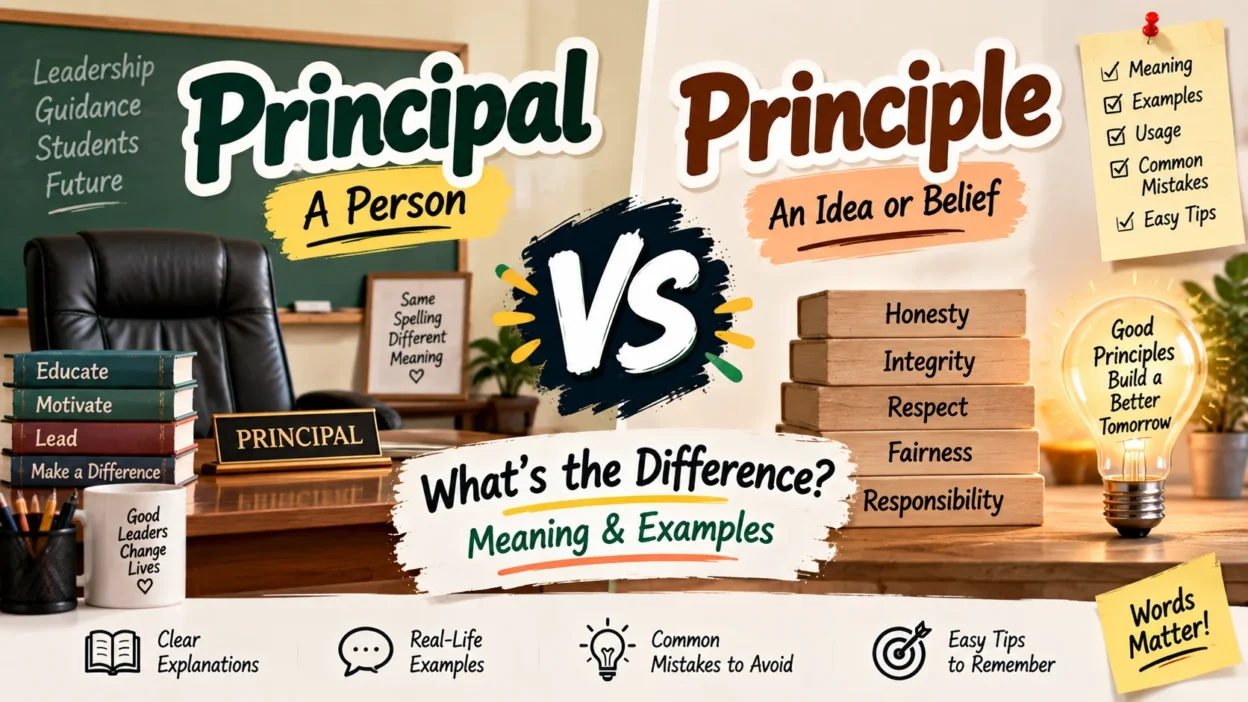
Principal vs principle is one of the most common English word confusions because the two words sound almost identical but have completely different meanings. If you have ever wondered whether to write “the school principal” or “the school principle,” the correct choice is principal.
The word principal can describe a person who holds an important position, especially the head of a school, or something that is most important. In contrast, principle refers to a rule, belief, moral standard, or basic idea that guides behavior or explains how something works.
Understanding the difference between principal and principle becomes much easier once you remember their meanings and a simple memory trick. In this guide, we’ll explain principal vs principle, their definitions, pronunciation, spelling, grammar, examples, common mistakes, and easy ways to remember which word to use.
📚 Principal vs Principle: Quick Difference
The easiest way to understand principal vs principle is to remember that principal is commonly connected with a person or something important, while principle is connected with a rule, belief, or guiding idea.
- Principal = a person in charge or something most important
- Principle = a rule, belief, standard, or fundamental idea
- School principal = the head of a school
- Principal amount = the original amount of money borrowed or invested
- Main principal = something considered most important
- Moral principle = a belief about right and wrong
- Scientific principle = a basic idea or law explaining how something works
- Business principle = a guiding rule used in business
- Personal principle = a belief that guides someone’s choices
A useful shortcut is: The principal is your pal. The word principal has an “a,” just like pal, which can help you remember that a principal can be a person.
🧑🏫 What Does Principal Mean?
Principal is a noun or adjective with several meanings. As a noun, it often refers to the person who leads a school. It can also mean the original amount of money involved in a loan or investment.
As an adjective, principal means first in importance, main, or chief. This makes principal meaning broader than simply “school administrator.”
Examples include:
- The principal welcomed the students.
- Our school principal announced the new schedule.
- The principal called the parents.
- The principal amount of the loan was $20,000.
- The building is the company’s principal office.
- Safety is the principal concern.
- The principal reason for the change was cost.
- Education is the principal goal of the program.
So, if you are asking what does principal mean, think of either a person in charge or something that is most important.
📖 What Does Principle Mean?
Principle is a noun that refers to a fundamental rule, belief, standard, or idea. It is often used when talking about morality, behavior, science, politics, business, or general concepts.
For example, someone might refuse to lie because honesty is one of their personal principles. A scientific principle can describe a fundamental idea that explains how something works.
Examples include:
- Honesty is an important principle.
- She refused to compromise her principles.
- The machine operates according to a simple scientific principle.
- Equality is a basic principle of the organization.
- He made the decision based on his personal principles.
- The company follows ethical principles.
- We should understand the basic principles before applying the method.
If you’re wondering what does principle mean, remember: it is generally a rule, belief, standard, or fundamental idea.
🔤 Principal Meaning vs Principle Meaning
The difference between principal meaning and principle meaning becomes clear when you compare their roles in a sentence.
Principal can mean:
- Head of a school
- Person in a leading position
- Main or most important
- Original amount of money in a loan or investment
Principle can mean:
- Moral rule
- Personal belief
- Guiding standard
- Fundamental scientific idea
- Basic concept or rule
For example:
- The principal spoke at the assembly.
- Honesty is an important principle.
- The principal reason was financial.
- The machine works according to a scientific principle.
The words are pronounced similarly, but their meanings are different.
🏫 Principal vs Principle in School
The principal vs principle in school distinction is especially important because this is where many spelling mistakes occur. The person who leads a school is the principal, not the principle.
Correct:
The school principal spoke to the students.
Incorrect:
The school principle spoke to the students.
However, schools also teach principles. For example:
The teacher explained the principles of good citizenship.
A simple way to remember this is that the principal is a person, while a principle is an idea or rule.
💰 Principal vs Principle in Finance
In finance, principal has a specific meaning. The principal amount is the original amount of money borrowed or invested, before considering interest or other charges.
For example, if you borrow $10,000, your initial $10,000 is the principal. Interest may then be calculated based on that amount.
Examples:
- I paid down the principal on my mortgage.
- The loan has a principal of $15,000.
- Her monthly payment includes interest and principal.
- The investment returned the original principal.
The word principle does not have this financial meaning. You would not normally say “loan principle” when referring to the original amount borrowed.
⚖️ Principal vs Principle in a Sentence
Seeing principal vs principle in a sentence can make the distinction easier to remember.
Principal:
- The school principal met with the teachers.
- This is the principal reason for the delay.
- We made a payment toward the loan principal.
Principle:
- Fairness is an important principle.
- She lives according to her principles.
- The experiment demonstrates a basic scientific principle.
Notice that principal points toward a person, importance, or money, while principle points toward an idea, rule, or belief.
✍️ Principal vs Principle Examples
Here are more principal vs principle examples to help you see how each word works naturally.
- The principal announced the school closure.
- Respect is a basic principle.
- The principal objective is to improve safety.
- He refused to break his moral principles.
- We paid the loan principal early.
- The scientist explained the principle behind the experiment.
- The principal investigator presented the results.
- She follows strong ethical principles.
- The principal office is on the first floor.
- The organization operates according to several important principles.
🧠 Principal vs Principle Memory Trick
One of the easiest ways to remember principal vs principle is the phrase:
“The principal is your pal.”
Both principal and pal contain the letter a.
This can help you remember that a school principal is a person.
Another way to remember it:
- Principal → person, primary, or principal amount
- Principle → philosophy, rule, or belief
You can also think of principle as something you believe. Moral principles often describe the beliefs and standards that guide your decisions.
🔊 Principal vs Principle Pronunciation
Another reason principal vs principle causes confusion is pronunciation. In standard American English, both words are commonly pronounced very similarly:
- Principal: /ˈprɪnsəpəl/
- Principle: /ˈprɪnsəpəl/
Because they sound alike or nearly alike, context and spelling are especially important.
This makes them examples of homophones or near-homophones, depending on the dialect and linguistic analysis. The key difference is not usually pronunciation but meaning and spelling.
📝 Principal as a Noun
When principal is used as a noun, it can refer to a person or an amount of money.
Examples:
- The principal addressed the students.
- The bank calculated the remaining principal.
- The principal approved the request.
- We reduced the loan principal.
- The school principal organized the meeting.
The exact meaning depends on context.
⭐ Principal as an Adjective
Principal can also function as an adjective meaning main, chief, or most important.
Examples:
- The principal reason was cost.
- Our principal objective is safety.
- The company’s principal office is downtown.
- Water is the principal ingredient.
- The principal concern was timing.
In these sentences, principal does not refer to a school administrator.
📜 Principle as a Noun
Unlike principal, the word principle is generally used as a noun. It refers to a rule, belief, standard, or fundamental concept.
Examples:
- She values the principle of honesty.
- The principle applies to many situations.
- They agreed on the basic principles.
- He acted according to his principles.
- The scientific principle is easy to understand.
You can use principles when referring to multiple beliefs, rules, or foundational ideas.
🚫 Common Principal vs Principle Mistakes
The most common principal vs principle mistakes happen when writers remember the sound but forget the meaning.
Mistake 1: School leader
Incorrect:
- The school principle called a meeting.
Correct:
- The school principal called a meeting.
Mistake 2: Moral belief
Incorrect:
- Honesty is an important principal.
Correct:
- Honesty is an important principle.
Mistake 3: Loan amount
Incorrect:
- I paid down the loan principle.
Correct:
- I paid down the loan principal.
Mistake 4: Main reason
Correct:
- The principal reason was lack of time.
Here, principal means “main” or “most important.”
🔎 Principal or Principle: Which One Should You Use?
When deciding between principal or principle, ask yourself what you’re talking about.
Use principal if you mean:
- A school leader
- A person in a leading position
- The main or most important thing
- The original amount of a loan or investment
Use principle if you mean:
- A belief
- A moral rule
- A guiding standard
- A scientific concept
- A fundamental rule or idea
For example:
Who leads the school? → The principal.
What guides someone’s behavior? → A principle.
What is the original loan amount? → The principal.
What is a basic scientific idea? → A principle.
🎯 Principal vs Principle Quick Comparison
| Word | Meaning | Example |
|---|---|---|
| Principal | School leader | The principal greeted the students. |
| Principal | Main or most important | Safety is the principal concern. |
| Principal | Original loan/investment amount | I paid the principal. |
| Principle | Rule or belief | Honesty is a principle. |
| Principle | Moral standard | She follows strong principles. |
| Principle | Fundamental idea | The machine follows a basic principle. |
💡 Easy Way to Remember Principal vs Principle
If you’re still confused about principal vs principle, use this quick memory formula:
Principal = Person, Primary, Principal Money
Principle = Rule, Belief, Idea
The phrase “The principal is your pal” is particularly useful for remembering the school meaning.
If the word describes a person, the main thing, or money borrowed/invested, choose principal. If it describes a belief, rule, or fundamental idea, choose principle.
❓ FAQs About Principal vs Principle
Is it school principal or school principle?
The correct phrase is school principal. A principal is the person who leads a school.
What is the difference between principal and principle?
Principal can mean a school leader, something most important, or the original amount of money in a loan or investment. Principle means a rule, belief, standard, or fundamental idea.
Is principal a person or a thing?
It can be either. A principal can be a person, such as a school principal, or it can describe something important or refer to the original amount of money in finance.
Is principle always a belief?
Not always. A principle can be a moral belief or rule, but it can also mean a fundamental idea or law in science, mathematics, business, or another field.
How can I remember principal vs principle?
Use the mnemonic “The principal is your pal.” The “a” in principal matches the “a” in pal and can remind you that a principal can be a person.
Is it loan principal or loan principle?
The correct phrase is loan principal. It refers to the original amount of money borrowed, excluding interest.
Is it moral principle or moral principal?
The correct phrase is moral principle because it refers to a belief or rule about right and wrong.
Can principal be an adjective?
Yes. Principal can be an adjective meaning main, chief, or most important, as in “the principal reason.”
Can principle be plural?
Yes. The plural form is principles, as in “personal principles” or “ethical principles.”
Are principal and principle pronounced the same?
They are commonly pronounced alike or very similarly in English, which is why the words are frequently confused in writing.
🏁 Conclusion
Understanding principal vs principle is much easier when you connect each word with its core meaning. Principal can refer to a school leader, something that is most important, or the original amount of money involved in a loan or investment. Principle, on the other hand, refers to a rule, belief, moral standard, or fundamental idea.
When you’re unsure, remember: the principal is your pal, while a principle is something you may believe in or follow. With this simple distinction, you’ll be able to choose the correct word confidently in school writing, business communication, academic work, and everyday English.

Miles Ellington enjoys exploring the subtle differences that can completely change how a word or phrase is understood. At Differology, he turns confusing language questions into straightforward explanations, covering word comparisons, vocabulary, grammar, usage, and everyday English.
With a practical and reader-focused approach, Miles uses real-world examples and clear comparisons to help readers choose the right word, understand its meaning, and communicate more precisely.