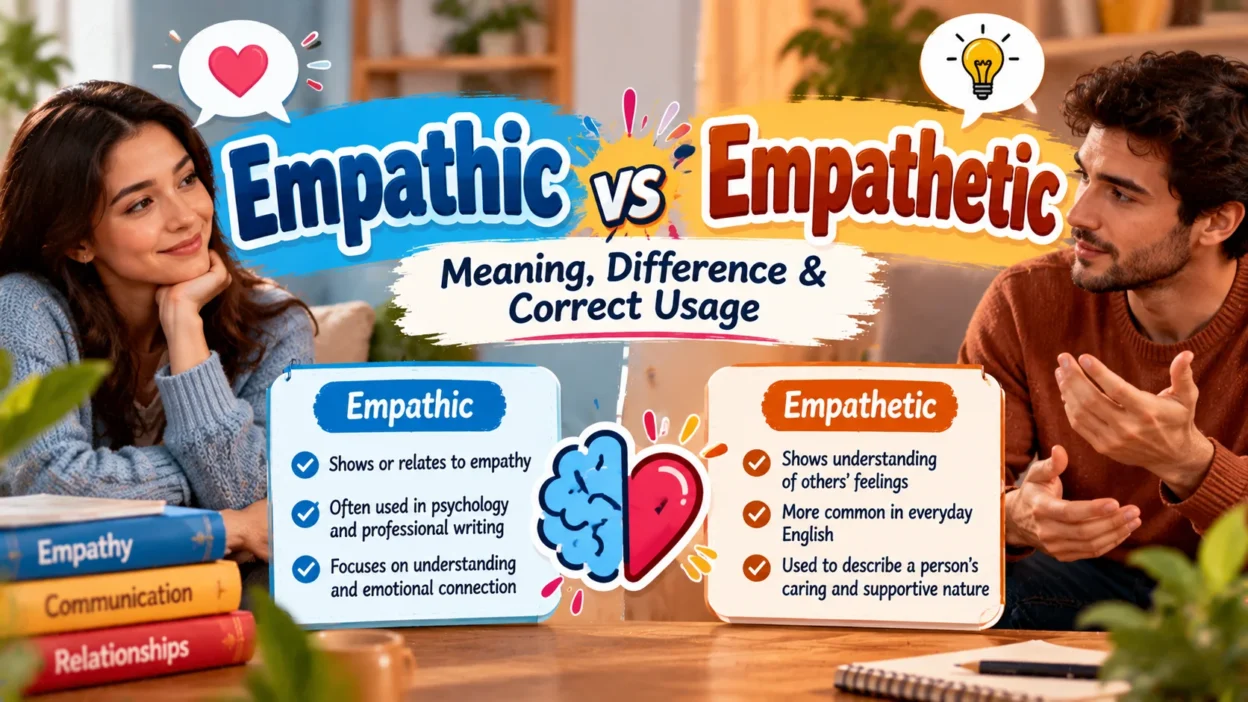
Empathic vs empathetic can be confusing because both words describe the ability to understand and connect with another person’s feelings. In most modern English, they are so similar that people often use them interchangeably.
The main difference lies in usage, style, and nuance rather than basic meaning. Both words describe someone who understands another person’s emotional experience and responds with sensitivity. However, empathetic is more common in everyday English, while empathic often appears in psychology, counseling, professional writing, and discussions about empathy.
Understanding this distinction can help you choose the word that sounds most natural for your sentence.
🔎 Empathic vs Empathetic at a Glance
Both adjectives come from the noun empathy, but English speakers tend to use them in slightly different ways.
| Word | Basic Meaning | Common Usage | Example |
|---|---|---|---|
| Empathic | Showing or relating to empathy | Psychology, counseling, formal writing | The therapist used an empathic approach. |
| Empathetic | Showing an ability to understand another person’s feelings | Everyday and professional English | She was very empathetic toward her friend. |
Neither word is inherently incorrect. The choice usually depends on context, tone, and personal or professional style.
A simple rule is:
Empathetic = more common in general English
Empathic = often preferred in specialized or formal contexts
❤️ What Does Empathetic Mean?
Empathetic describes someone who can understand another person’s feelings, emotions, or perspective and respond with appropriate sensitivity.
For example:
- She is an empathetic friend.
- The manager took an empathetic approach with the employee.
- He was empathetic when his colleague discussed a difficult situation.
- An empathetic response can make people feel heard.
The word often emphasizes a person’s ability to recognize and respond to another person’s emotional experience.
Being empathetic does not necessarily mean experiencing exactly the same emotion. Instead, it means making an effort to understand what another person may be feeling.
Common Uses of Empathetic
| Context | Example |
|---|---|
| Friendship | She is an empathetic friend. |
| Workplace | An empathetic manager listens carefully. |
| Relationships | An empathetic partner considers both perspectives. |
| Education | An empathetic teacher understands student concerns. |
| Healthcare | Patients often appreciate empathetic communication. |
🧠 What Does Empathic Mean?
Empathic has essentially the same core meaning. It describes something or someone that demonstrates empathy or involves understanding another person’s emotional experience.
For example:
- The counselor used an empathic listening technique.
- Her empathic response helped the patient feel understood.
- The study examined empathic communication.
- He showed an empathic understanding of the situation.
You may encounter empathic more frequently in psychology, counseling, psychotherapy, academic writing, and professional discussions about interpersonal communication.
However, this does not mean that empathic is limited to technical writing. Native speakers use it in general English as well.
⚖️ What Is the Difference Between Empathic and Empathetic?
The difference is subtle because the two adjectives overlap heavily in meaning.
Empathetic tends to sound more natural in everyday conversation. Empathic can sound slightly more concise, formal, or specialized.
Compare these examples:
Everyday style:
She is an empathetic person who listens to everyone.
Professional style:
The counselor demonstrated an empathic approach during the session.
Both sentences communicate the idea of understanding another person’s feelings.
| Feature | Empathic | Empathetic |
|---|---|---|
| Core meaning | Understanding another’s feelings | Understanding another’s feelings |
| Grammar | Adjective | Adjective |
| Everyday use | Common | Very common |
| Professional use | Common | Common |
| Psychology | Common | Common |
| Tone | Often concise/formal | Often natural/general |
| Correct spelling | Yes | Yes |
📚 Are Empathic and Empathetic Synonyms?
Yes. In most contexts, empathic and empathetic function as synonyms.
If you replace one with the other, the meaning usually remains intact.
For example:
She gave an empathic response.
and
She gave an empathetic response.
Both sentences describe a response that demonstrates understanding and sensitivity toward another person’s feelings.
The difference is primarily one of preference and style, not a strict difference in definition.
🗣️ Which Word Is More Common?
Empathetic is generally the more familiar choice in everyday English.
You are likely to hear it when people discuss:
- Relationships
- Friendships
- Parenting
- Leadership
- Customer service
- Communication
- Emotional intelligence
- Personal development
Empathic also appears in these contexts, but it has a somewhat stronger association with psychology, counseling, and professional communication.
That makes empathetic a safe choice when you want a word that sounds natural to a broad audience.
💼 Empathic vs Empathetic in Professional Writing
Both words work well in professional communication, but the surrounding sentence can influence which one sounds better.
For general workplace communication, empathetic often feels straightforward and accessible.
Example:
An empathetic manager listens to employees and considers their concerns.
In professional or academic discussions about therapeutic communication, empathic can sound more specialized.
Example:
The counselor developed an empathic connection with the client.
Neither sentence requires the other adjective. The choice depends on the writer’s preferred style.
Professional Contexts
| Context | Natural Choice |
|---|---|
| General workplace | Empathetic |
| Leadership | Empathetic |
| Customer service | Empathetic |
| Counseling | Empathic or empathetic |
| Psychology | Empathic or empathetic |
| Academic writing | Either, depending on style |
| Casual conversation | Empathetic |
🩺 Empathic vs Empathetic in Psychology
Both terms appear in psychological and counseling contexts.
Empathy involves understanding another person’s emotional experience or perspective. Professionals may use empathic to describe communication, listening, understanding, or therapeutic interaction.
For example:
The therapist maintained an empathic attitude throughout the conversation.
You may also see:
The therapist responded in an empathetic way.
Both forms can communicate the same general idea.
One important distinction is that empathy itself does not necessarily mean agreement. A person can understand someone’s feelings without agreeing with their decisions or behavior.
💬 Empathetic vs Sympathetic
These words are related, but they do not mean exactly the same thing.
Empathy involves understanding or sharing another person’s emotional perspective.
Sympathy generally involves feeling concern, compassion, or sorrow for someone experiencing difficulty.
Consider this example:
A friend loses their job.
A sympathetic response might be:
I am sorry you’re going through this.
An empathetic response might focus more closely on understanding the person’s emotional experience:
I can understand why this situation feels stressful and uncertain.
Both responses can be kind. They simply emphasize different forms of emotional connection.
| Empathy | Sympathy |
|---|---|
| Focuses on understanding another person’s experience | Focuses on concern for another person |
| Tries to see a situation from another perspective | Recognizes that someone is suffering |
| Can involve emotional connection | Often involves compassion |
| Example: I understand why this hurts | Example: I am sorry this happened |
🌱 Empathetic vs Compassionate
Empathetic and compassionate also overlap, but they emphasize different qualities.
An empathetic person tries to understand another person’s feelings.
A compassionate person feels concern for someone’s difficulties and may want to help.
For example:
The nurse was empathetic toward the patient’s fears.
This emphasizes emotional understanding.
The nurse was compassionate toward the patient.
This emphasizes care and concern.
A person can be both empathetic and compassionate.
✍️ Examples of Empathic in Sentences
Here are several natural examples using empathic:
- The counselor used an empathic approach.
- Her empathic response encouraged him to continue talking.
- The therapist demonstrated empathic listening.
- His empathic understanding helped resolve the conflict.
- The teacher created an empathic classroom environment.
- The doctor communicated with an empathic tone.
- The manager showed an empathic understanding of the employee’s concerns.
- The conversation required careful and empathic listening.
In these examples, empathic describes communication, understanding, listening, or an approach that demonstrates empathy.
💗 Examples of Empathetic in Sentences
Here are examples using empathetic:
- She is an empathetic friend.
- He gave an empathetic response.
- The manager was empathetic toward the employee.
- An empathetic teacher can recognize when students need support.
- She became more empathetic after hearing his story.
- The doctor took an empathetic approach.
- He tried to be empathetic instead of judgmental.
- Her empathetic nature made people comfortable sharing their concerns.
These examples show why empathetic works particularly well in everyday English.
🚫 Common Mistakes
One common mistake is assuming that one spelling is correct and the other is wrong.
For example:
Incorrect assumption: Empathic is wrong.
That is not true.
Empathic is a legitimate English adjective.
Another misconception is that empathetic always means the person personally feels exactly the same emotion as someone else. Empathy can involve understanding another person’s perspective without experiencing identical feelings.
Better Understanding
Instead of thinking:
Empathetic = feeling exactly what someone else feels
Think:
Empathetic = understanding and responding to another person’s emotional experience.
This distinction makes the word easier to use accurately.
🔤 Empathy, Empathetic and Empathic
All three words belong to the same vocabulary family.
| Word | Part of Speech | Meaning |
|---|---|---|
| Empathy | Noun | Ability to understand another person’s feelings or perspective |
| Empathetic | Adjective | Showing or having empathy |
| Empathic | Adjective | Showing or relating to empathy |
Examples:
Noun:
Empathy can improve communication.
Adjective:
She is an empathetic leader.
Adjective:
The counselor used an empathic listening style.
🧩 How to Choose the Right Word
If you are unsure which adjective to use, ask yourself what kind of writing you are doing.
For ordinary conversation, personal writing, social media, or general content, empathetic is often the easiest and most familiar choice.
For psychology, counseling, research, or formal discussions about empathy, empathic may fit naturally.
However, there is no strict rule requiring one word for one situation.
Simple Decision Guide
Use empathetic when:
- You want the most familiar everyday adjective.
- You are describing a person’s personality.
- You are writing for a general audience.
- You want natural conversational wording.
Use empathic when:
- You are discussing empathy in a professional context.
- You are writing about counseling or psychology.
- You are describing empathic listening or communication.
- You prefer a concise formal adjective.
📊 Quick Comparison
| Question | Empathic | Empathetic |
|---|---|---|
| Is it a real word? | Yes | Yes |
| Is it an adjective? | Yes | Yes |
| Does it relate to empathy? | Yes | Yes |
| Can it describe a person? | Yes | Yes |
| Can it describe communication? | Yes | Yes |
| Can it describe listening? | Yes | Yes |
| Common in psychology? | Yes | Yes |
| Common in everyday English? | Yes | Yes |
| Usually more familiar to general readers? | Less often | Yes |
❓ Frequently Asked Questions
Is empathic or empathetic correct?
Both are correct. They are adjectives related to empathy and often carry the same meaning.
Is empathic the same as empathetic?
In most contexts, yes. Both describe someone or something that demonstrates or involves empathy.
Which is more common, empathic or empathetic?
Empathetic is generally more familiar and common in everyday English, while empathic frequently appears in professional, psychological, and academic contexts.
Is empathic a real word?
Yes. Empathic is a standard English adjective.
Is empathetic a real word?
Yes. Empathetic is also a standard English adjective.
Which word should I use in everyday conversation?
Empathetic is usually the most natural choice for general conversation.
Can you describe a person as empathic?
Yes. For example:
She is an empathic and thoughtful counselor.
You can also say:
She is an empathetic and thoughtful counselor.
What is the difference between empathetic and sympathetic?
Empathetic generally emphasizes understanding another person’s feelings or perspective, while sympathetic emphasizes concern or compassion for someone experiencing difficulty.
Is empathetic the same as emotional?
No. An empathetic person can understand another person’s feelings without becoming overwhelmed by those emotions.
What is the noun form of empathetic?
The related noun is empathy.
For example:
Empathy helps people communicate with greater understanding.
🏁 Final Verdict
The choice between empathic vs empathetic is not a matter of one being correct and the other being incorrect. Both are legitimate adjectives that relate to empathy, and they often communicate the same idea.
For everyday English, empathetic is generally the more familiar and natural choice. Empathic can sound more concise or specialized and appears frequently in psychology, counseling, and professional discussions.
When you need a simple rule, remember:
Empathetic = common, natural, and widely used
Empathic = concise, professional, and often specialized
Both can be correct, so choose the one that best fits your audience and writing style.

Miles Ellington enjoys exploring the subtle differences that can completely change how a word or phrase is understood. At Differology, he turns confusing language questions into straightforward explanations, covering word comparisons, vocabulary, grammar, usage, and everyday English.
With a practical and reader-focused approach, Miles uses real-world examples and clear comparisons to help readers choose the right word, understand its meaning, and communicate more precisely.