
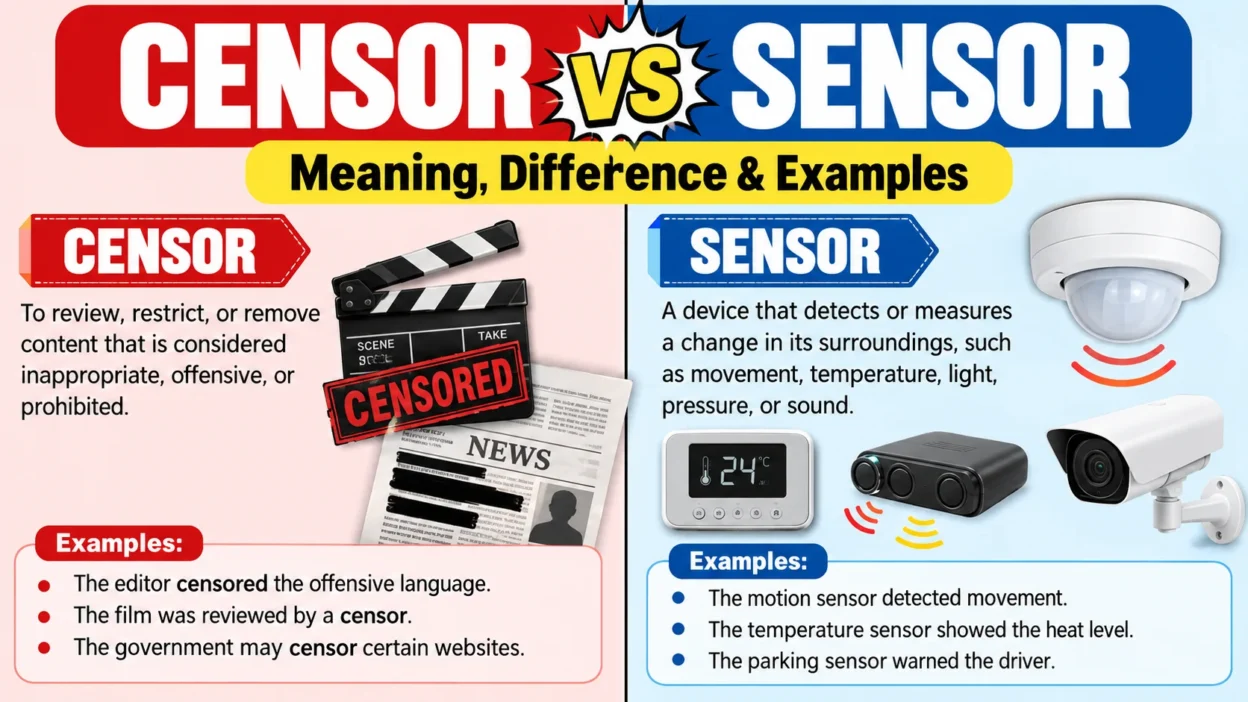
Censor vs sensor is a common English word comparison because these two words sound similar but have completely different meanings. Censor relates to reviewing, restricting, or removing content, while sensor refers to a device that detects changes in its surroundings. Confusing these words can lead to spelling mistakes and unclear sentences.
The easiest way to remember the difference is to connect censor with censorship and sensor with sensing. A censor may remove inappropriate language from a movie, while a sensor may detect movement, temperature, light, or pressure. Understanding their definitions, grammar, and everyday uses will help you choose the correct word.
🔍 Censor vs Sensor: Quick Difference
The main difference between censor and sensor is their purpose. One involves controlling information or expression, while the other involves detecting or measuring something.
| Word | Meaning | Part of Speech | Example |
|---|---|---|---|
| Censor | To review, restrict, or remove content | Verb | The editor censored the offensive language. |
| Censor | A person who reviews content for restrictions | Noun | The censor reviewed the movie. |
| Sensor | A device that detects or measures something | Noun | The sensor detected movement. |
Quick rule: Use censor when someone restricts content. Use sensor when a device detects or measures something.
📖 What Does Censor Mean?
The word censor means to examine information, speech, images, or other content and remove or restrict material considered inappropriate, offensive, sensitive, or prohibited. Censorship can occur in movies, television programs, books, news reports, websites, and social media.
As a noun, a censor is a person or authority responsible for reviewing content. As a verb, censor describes the act of restricting or removing that content.
Examples:
- The television network censored the offensive language.
- The school censored parts of the controversial publication.
- The film censor reviewed the movie before its release.
- The editor decided to censor sensitive information.
- Some platforms censor content that violates their rules.
The word can also appear in discussions about freedom of speech, media regulation, privacy, and public communication.
Censor as a Noun
When censor functions as a noun, it refers to a person who examines material and decides whether it should be restricted.
Examples:
- The censor approved the documentary.
- A government censor reviewed the newspaper.
- The film was examined by a censor before release.
Censor as a Verb
When censor functions as a verb, it describes the action of restricting or removing content.
Examples:
- The producers censored the explicit scene.
- The website censored the prohibited material.
- The broadcaster censored several words from the interview.
📡 What Does Sensor Mean?
A sensor is a device that detects or measures a physical condition or change. Sensors are widely used in electronics, vehicles, smartphones, medical equipment, security systems, industrial machinery, and smart-home technology.
A sensor may detect movement, temperature, light, pressure, sound, moisture, or proximity. It can send information to another system so that the system can display a measurement, issue an alert, or perform an action.
Examples:
- The motion sensor turned on the lights.
- The temperature sensor detected overheating.
- A parking sensor warned the driver about an obstacle.
- The phone uses a sensor to adjust screen brightness.
- The smoke sensor triggered an alarm.
Unlike a censor, a sensor does not review content for appropriateness. Its primary role is to detect or measure something.
Common Types of Sensors
Different sensors perform different tasks depending on the technology and environment.
| Sensor Type | What It Detects | Common Use |
|---|---|---|
| Motion sensor | Movement | Security lights |
| Temperature sensor | Heat or temperature | Thermostats |
| Light sensor | Light intensity | Automatic screen brightness |
| Pressure sensor | Pressure | Industrial equipment |
| Proximity sensor | Nearby objects | Smartphones |
| Smoke sensor | Smoke particles | Fire alarms |
| Humidity sensor | Moisture in the air | Weather monitoring |
| Touch sensor | Touch or contact | Touchscreens |
⚖️ Censor vs Sensor: Key Differences
Although the words sound similar, their meanings, grammatical roles, and contexts are different.
| Feature | Censor | Sensor |
|---|---|---|
| Main meaning | Restrict or remove content | Detect or measure changes |
| Common role | Noun and verb | Noun |
| Associated concept | Censorship | Sensing |
| Typical subject | Editor, authority, broadcaster | Device, machine, electronic system |
| Common context | Media, books, speech, information | Technology, vehicles, electronics |
| Example | They censored the scene. | The sensor detected heat. |
Remember that censor can describe both a person and an action, whereas sensor generally refers to a physical or electronic detecting device.
✍️ Censor vs Sensor in Example Sentences
Seeing the words in complete sentences makes their difference easier to understand. Pay attention to whether the sentence describes restricting information or detecting a physical condition.
Examples Using Censor
- The editor chose to censor the inappropriate comments.
- The broadcaster censored the offensive language.
- A censor reviewed the film before it reached theaters.
- The company refused to censor legitimate customer feedback.
- The documentary discussed censorship in the media.
- The platform may censor posts that violate its policies.
- The newspaper was accused of censoring important information.
- The producer decided to censor one scene from the movie.
Examples Using Sensor
- The sensor detected movement near the entrance.
- My phone uses a light sensor to adjust its display.
- The temperature sensor showed that the engine was overheating.
- The car’s parking sensor warned me about the wall.
- A smoke sensor can alert people to a possible fire.
- The washing machine uses sensors to monitor its operation.
- The security system includes a motion sensor.
- The humidity sensor measures moisture in the air.
🧠 How to Remember Censor vs Sensor
A simple memory trick can help you choose the right spelling without repeatedly checking a dictionary.
Censor = censorship. Both words begin with c, and both relate to reviewing, restricting, or removing content.
Sensor = sensing. A sensor helps a device sense or detect something in its surroundings.
Try these quick associations:
- Censor a movie.
- Censor offensive language.
- Sensor detects motion.
- Sensor measures temperature.
If your sentence involves editing or restricting information, choose censor. If it involves a detecting device, choose sensor.
🚫 Common Censor and Sensor Mistakes
Writers sometimes confuse these words because their pronunciation is similar. The best way to avoid mistakes is to identify the meaning required by the sentence.
| Incorrect Sentence | Correct Sentence | Why |
|---|---|---|
| The motion censor detected movement. | The motion sensor detected movement. | A device detects movement. |
| The editor sensored the scene. | The editor censored the scene. | The editor restricted content. |
| The temperature censor stopped working. | The temperature sensor stopped working. | The device measures temperature. |
| The network sensored the dialogue. | The network censored the dialogue. | The network removed content. |
| The smoke censor triggered the alarm. | The smoke sensor triggered the alarm. | The device detects smoke. |
A useful proofreading habit is to ask whether the sentence describes content control or physical detection. That distinction usually makes the correct spelling obvious.
📰 Censor vs Sensor in Media and Technology
These words often appear in different professional fields, which makes their meanings easier to separate.
In media, journalism, publishing, and entertainment, censor usually relates to content restrictions. A broadcaster might censor offensive language, an editor might censor sensitive details, or a film authority might review a movie before public release.
In technology, engineering, and electronics, sensor refers to a device that gathers information about its surroundings. A smartphone may use a proximity sensor, a car may use parking sensors, and a factory may use pressure sensors to monitor equipment.
For example:
- Media: The channel censored the scene before broadcasting it.
- Technology: The sensor detected a change in temperature.
- Publishing: The editor refused to censor the author’s argument.
- Automotive: The parking sensor alerted the driver to an obstacle.
The surrounding words usually reveal which meaning the writer intends.
🔤 Censor, Sensor, and Censorship: Related Words
Learning related vocabulary can help you remember the distinction and expand your English vocabulary.
| Word | Meaning | Example |
|---|---|---|
| Censor | Restrict or remove content | The editor censored the passage. |
| Censored | Restricted or removed | The censored scene was shorter. |
| Censoring | The act of restricting content | The article discussed censoring online posts. |
| Censorship | The practice of restricting expression or information | The debate focused on censorship. |
| Sensor | A device that detects or measures something | The sensor detected movement. |
| Sensory | Related to the senses | The exhibit provided a sensory experience. |
| Sensing | Detecting or becoming aware of something | The device is sensing a temperature change. |
Notice that censorship is related to censor, while sensory and sensing are related in meaning to sensor. These word families provide useful spelling clues.
💬 Censor vs Sensor in Everyday English
You may encounter both words in daily conversations, news articles, product descriptions, and technical instructions.
Here are some common situations:
- Movies: A studio may censor explicit scenes.
- Social media: A platform may censor prohibited content under its policies.
- Cars: A sensor may detect nearby vehicles or obstacles.
- Smartphones: A sensor may detect when the phone is close to your face.
- Home security: A sensor may detect movement or smoke.
- Books: A publisher may censor certain passages.
- Factories: A sensor may monitor temperature or pressure.
- News: Journalists may discuss whether a report was censored.
When the context is clear, you can quickly determine which word fits.
🌎 Is Censor or Sensor More Common?
Both words are established English vocabulary, but their frequency depends on the subject being discussed.
Censor often appears in writing about media, politics, publishing, freedom of expression, and content moderation. Sensor is common in technical writing, product descriptions, science, engineering, healthcare, and everyday discussions of electronic devices.
For example, a news article about restrictions on speech might use censor several times, while a smartphone review may frequently mention sensor. Neither spelling is a variation of the other; each has its own meaning.
📝 Censor vs Sensor Practice Quiz
Test your understanding by choosing the correct word for each sentence. The answers are provided below so you can check your progress.
- The security _____ detected movement near the door.
- The television network decided to _____ the offensive language.
- A temperature _____ monitors the engine.
- The newspaper was accused of trying to _____ the report.
- The parking _____ alerted the driver to an obstacle.
- The film _____ reviewed the movie.
- A light _____ adjusts the screen brightness.
- The editor refused to _____ the author’s criticism.
Answers:
- Sensor
- Censor
- Sensor
- Censor
- Sensor
- Censor
- Sensor
- Censor
If you answered all eight correctly, you understand the main difference between these commonly confused words.
❓ Frequently Asked Questions About Censor vs Sensor
What is the difference between censor and sensor?
Censor means to review, restrict, or remove content. Sensor is a device that detects or measures something, such as movement, light, heat, or pressure.
Is a motion censor or motion sensor correct?
Motion sensor is correct. It is a device that detects movement and may activate lights, alarms, or other systems.
Is it censor or sensor in a movie?
Use censor when discussing the removal or restriction of scenes, dialogue, or other movie content. For example, the studio censored the scene.
Is it temperature censor or temperature sensor?
Temperature sensor is correct because the device measures temperature.
What does censor mean in simple words?
To censor something means to remove, block, or restrict content considered inappropriate, sensitive, or prohibited. A censor can also be a person who reviews such material.
What does sensor mean in simple words?
A sensor is a device that detects or measures something in its surroundings, such as heat, movement, light, pressure, or smoke.
Are censor and sensor pronounced the same?
In many English accents, censor and sensor are pronounced the same or very similarly. This makes them homophones for many speakers, even though their meanings and spellings differ.
What is the easiest trick for remembering censor vs sensor?
Remember censor = censorship and sensor = sensing. A censor restricts content, while a sensor detects something.
Final Thoughts
Understanding censor vs sensor is simple once you connect each word with its purpose. A censor reviews or restricts information, while a sensor detects or measures changes in the physical world. Although their pronunciation is similar, their meanings and uses are very different.
Remember the connection between censor and censorship when writing about movies, books, media, or online content. When discussing electronics, cars, security systems, or measurements, use sensor. With this simple distinction and a little practice, you can avoid one of the most common spelling mix-ups in English.sor, censor and sensor examples, censor vs sensor sentences, commonly confused words.

Miles Ellington enjoys exploring the subtle differences that can completely change how a word or phrase is understood. At Differology, he turns confusing language questions into straightforward explanations, covering word comparisons, vocabulary, grammar, usage, and everyday English.
With a practical and reader-focused approach, Miles uses real-world examples and clear comparisons to help readers choose the right word, understand its meaning, and communicate more precisely.