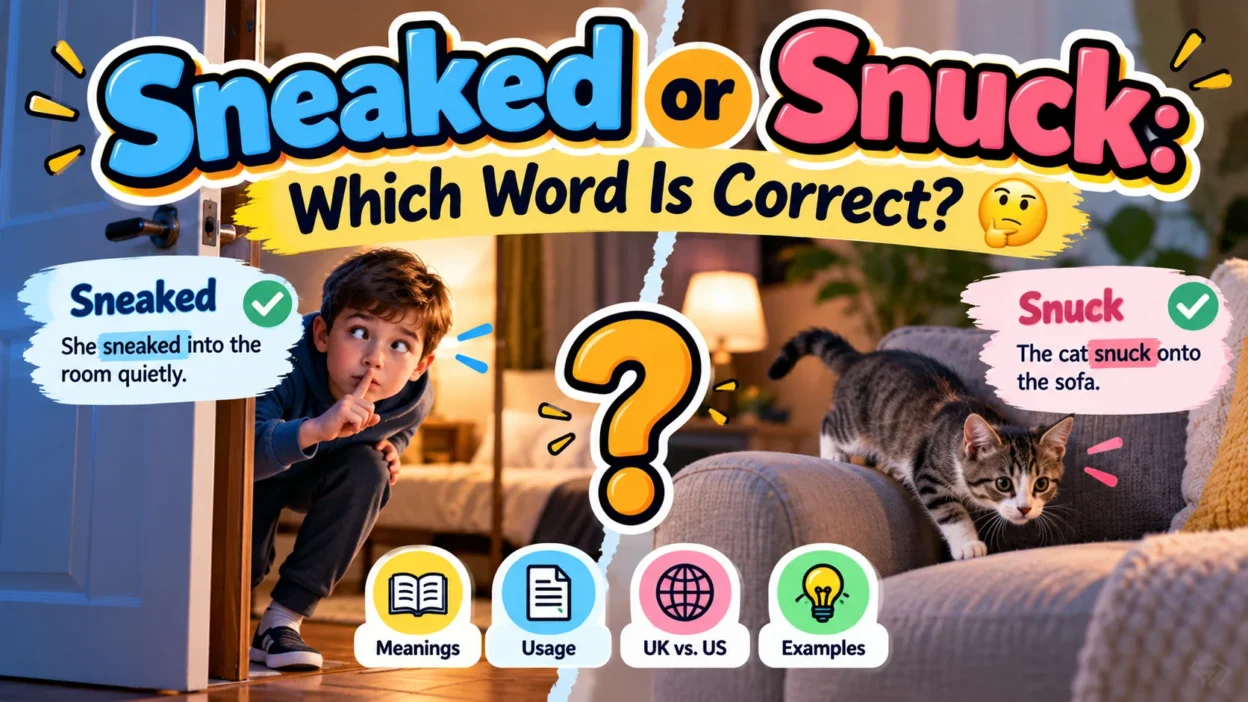
Have you ever wondered whether to write sneaked or snuck? Both words describe moving quietly, secretly, or without attracting attention, but their usage can confuse English learners and native speakers alike. You might hear someone say, I sneaked into the room, while another person says, I snuck into the room.
The good news is that both sneaked and snuck are correct forms of the past tense of sneak. However, they differ slightly in regional preference, tone, and frequency. Sneaked follows the regular English verb pattern, while snuck developed as an irregular form and has become especially common in American English.
In this guide, you will learn the meaning of both words, how to use them in sentences, whether one is more grammatically correct, and which form works best in American and British English.
📖 Sneaked or Snuck: Which One Is Correct?
Both sneaked and snuck are correct past-tense forms of the verb sneak. You can use either word when describing someone who moved quietly or secretly.
For example, both of these sentences are grammatically acceptable:
- The cat sneaked into the kitchen.
- The cat snuck into the kitchen.
Both sentences describe the same action. The main difference is that snuck is especially common in American English, while sneaked remains widely accepted in both American and British English.
| Word | Grammatical form | Usage |
|---|---|---|
| Sneak | Base form | Present tense |
| Sneaked | Regular past tense | Standard and widely accepted |
| Snuck | Irregular past tense | Common, especially in American English |
| Sneaking | Present participle | Used in continuous forms |
Quick answer: Use either sneaked or snuck. If you prefer the traditional regular form, choose sneaked. If you want a natural, conversational American English style, snuck is an excellent choice.
🔤 What Does Sneaked Mean?
Sneaked is the regular past-tense and past-participle form of sneak. The verb means to move quietly, secretly, or cautiously to avoid being noticed.
For example, someone might sneak out of a house after everyone falls asleep or sneak a snack into a movie theater.
The word often suggests secrecy, but it does not always imply wrongdoing. Someone might sneak into a room to surprise a friend or quietly leave a sleeping baby undisturbed.
Examples include:
- She sneaked out of the house quietly.
- The children sneaked extra cookies from the kitchen.
- He sneaked a quick look at the answer.
- They sneaked into the garden after dark.
- I have sneaked away from noisy gatherings before.
In each example, sneaked describes an action performed quietly or without drawing attention.
🕵️ What Does Snuck Mean?
Snuck is an irregular past-tense and past-participle form of sneak. It carries the same basic meaning as sneaked but often sounds more conversational, particularly in American English.
For example:
He snuck into the room without making a sound.
This sentence means that he entered the room quietly to avoid being noticed.
People commonly use snuck in everyday conversation, stories, informal writing, and dialogue.
Examples include:
- She snuck out before the meeting ended.
- The dog snuck onto the sofa.
- He snuck a piece of cake before dinner.
- We snuck into the theater just before the movie started.
- I snuck a peek at the surprise gift.
The word is fully established in modern English, so you do not need to treat it as a grammatical error.
⚖️ Sneaked vs. Snuck: What’s the Difference?
The main difference between sneaked and snuck is their grammatical formation and typical usage.
Sneaked follows the regular pattern of adding -ed to a verb. Snuck is an irregular form that developed through usage and became widely accepted.
Both express the same action, so your choice usually depends on tone, regional preference, and personal style.
| Feature | Sneaked | Snuck |
|---|---|---|
| Meaning | Moved secretly or quietly | Moved secretly or quietly |
| Verb type | Regular past-tense form | Irregular past-tense form |
| American English | Common | Very common |
| British English | Widely accepted | Understood, but traditionally less preferred |
| Formal writing | Appropriate | Also acceptable in modern standard English |
| Conversational tone | Natural | Often sounds especially conversational |
There is no universal rule that makes one form correct and the other incorrect. Both are accepted in contemporary English.
🇺🇸 Sneaked or Snuck in American English
In American English, snuck is especially common in everyday speech and informal writing. Many American speakers naturally use it when describing secretive or quiet actions.
For example:
- He snuck out after everyone went to bed.
- She snuck a chocolate bar into her bag.
- The children snuck downstairs to open their presents.
Sneaked is also correct in American English, especially when a writer prefers the regular verb form or wants to maintain consistency throughout a piece of writing.
For a conversational American blog post, either option works. Choose the form that sounds natural and use it consistently.
🇬🇧 Sneaked or Snuck in British English
Sneaked has traditionally been more common in British English, particularly in formal and edited writing. However, snuck is also understood and appears in modern British usage.
For example:
- He sneaked into the garden.
- She sneaked a glance at the letter.
These sentences sound natural in British English.
British speakers may also use snuck, particularly in informal conversation or under the influence of American media. The distinction is a matter of preference and frequency rather than a strict grammatical boundary.
✍️ How to Use Sneaked in a Sentence
Sneaked works well in everyday conversations, professional writing, school assignments, and storytelling.
Here are ten examples:
- The boy sneaked into the kitchen to get a cookie.
- She sneaked out of the office a few minutes early.
- The cat sneaked past the sleeping dog.
- He sneaked a quick look at his phone.
- They sneaked into the backyard after sunset.
- I sneaked away before the party became too crowded.
- The children sneaked downstairs on Christmas morning.
- She sneaked a note into his backpack.
- The actor sneaked through the back entrance.
- We sneaked a few extra minutes of sleep before breakfast.
Each sentence uses sneaked to describe an action performed discreetly.
📝 How to Use Snuck in a Sentence
Snuck works in the same situations as sneaked. It is particularly natural in conversational American English and informal storytelling.
Here are ten examples:
- He snuck out of the house without waking anyone.
- She snuck a snack into the movie theater.
- The puppy snuck into the bedroom.
- They snuck behind the stage to watch the performers.
- I snuck a peek at the birthday present.
- The children snuck extra candy before dinner.
- He snuck into the meeting a little late.
- She snuck a note across the classroom.
- We snuck away before the rain started.
- The cat snuck under the table to hide.
These examples show that snuck is not limited to one specific situation or meaning.
🧩 Sneaked or Snuck in Different Tenses
Although sneaked and snuck are alternative past-tense forms, other verb forms follow the standard pattern for sneak.
| Tense or form | Example |
|---|---|
| Present | I sneak into the kitchen. |
| Simple past | I sneaked into the kitchen. |
| Alternative simple past | I snuck into the kitchen. |
| Present continuous | I am sneaking into the kitchen. |
| Past continuous | I was sneaking into the kitchen. |
| Present perfect | I have sneaked into the kitchen. |
| Alternative present perfect | I have snuck into the kitchen. |
| Future | I will sneak into the kitchen. |
Both have sneaked and have snuck are accepted. The best choice depends on your preferred variety of English and the style of your writing.
🚫 Common Mistakes With Sneaked and Snuck
Even though both words are correct, writers sometimes confuse their forms or use them inconsistently.
Mistake 1: Assuming snuck is always incorrect
Incorrect assumption: Snuck is not a real English word.
Correct understanding: Snuck is an accepted irregular past-tense form of sneak.
Mistake 2: Assuming sneaked is old-fashioned or wrong
Sneaked remains correct and widely used. It is not a spelling mistake.
Mistake 3: Writing sneakeded or snucked
The standard forms are sneaked and snuck. Avoid adding extra endings.
Mistake 4: Mixing forms without a reason
Using both forms in the same article is not automatically incorrect, but choosing one consistently can improve readability.
Mistake 5: Confusing sneak with peek
Sneak describes quiet or secretive movement or action. Peek means to look quickly or secretly. You can sneak into a room and peek through a doorway.
🔍 Sneaked vs. Snuck vs. Sneaking
These three forms are related but serve different grammatical purposes.
| Word | Function | Example |
|---|---|---|
| Sneak | Base form | I sneak out early sometimes. |
| Sneaked | Past tense | I sneaked out yesterday. |
| Snuck | Alternative past tense | I snuck out yesterday. |
| Sneaking | Present participle | I am sneaking out now. |
Remember that sneaked and snuck describe completed actions in the past, while sneaking often appears with forms of be or in other grammatical constructions.
💡 Which Word Should You Use?
If you are unsure which form to choose, consider your audience and the tone of your writing.
For American English, snuck is a natural and widely used choice, especially in casual writing and dialogue. Sneaked is equally acceptable when you prefer the regular form.
For British English, sneaked is a traditional and safe option, particularly in formal or edited writing. Snuck is also understood and increasingly familiar.
For schoolwork, professional communication, or a style guide that specifies a preference, follow the relevant instructions. Otherwise, either form is acceptable.
❓ Frequently Asked Questions About Sneaked or Snuck
Is sneaked or snuck grammatically correct?
Both are grammatically correct. Sneaked is the regular past-tense form of sneak, while snuck is an accepted irregular alternative.
Is snuck a real word?
Yes. Snuck is a recognized English word and a widely used past-tense and past-participle form of sneak.
Which is more common in American English, sneaked or snuck?
Snuck is especially common in American English, particularly in conversation and informal writing. Sneaked is also correct and widely understood.
Which form is preferred in British English?
Sneaked has traditionally been more common in British English, although snuck is also used and understood.
Can I use snuck in formal writing?
Yes. Snuck is accepted in modern standard English, but you should follow your organization’s style guide if it specifies a preference. Sneaked can be a suitable choice when you want the regular form.
Is sneaked the past tense of sneak?
Yes. Sneaked is the regular simple past tense of sneak. Snuck is an alternative irregular form.
Is snuck the past participle of sneak?
Yes. Snuck can function as both the simple past tense and the past participle. For example, He snuck away and He has snuck away are both accepted.
What is the difference between sneaked and sneakily?
Sneaked is a verb form describing a past action. Sneakily is an adverb that describes how someone performs an action.
Are sneaked and snuck interchangeable?
In most situations, yes. Both describe moving or acting secretly or quietly. The main difference involves regional preference, tone, and style.
What is the present tense of snuck?
The base verb is sneak. Snuck is a past-tense form, not a separate verb with its own present tense.
🌟 Final Thoughts on Sneaked or Snuck
The choice between sneaked and snuck is simpler than it may seem. Both are correct past-tense forms of sneak, and both describe moving quietly, secretly, or without attracting attention.
Sneaked follows the regular -ed pattern and has a long history of standard use. Snuck is an established irregular form that is particularly common in American English.
For most modern writing, you can use either word confidently. Choose the form that suits your audience, maintain consistency, and remember that neither spelling is inherently wrong.

Miles Ellington enjoys exploring the subtle differences that can completely change how a word or phrase is understood. At Differology, he turns confusing language questions into straightforward explanations, covering word comparisons, vocabulary, grammar, usage, and everyday English.
With a practical and reader-focused approach, Miles uses real-world examples and clear comparisons to help readers choose the right word, understand its meaning, and communicate more precisely.