
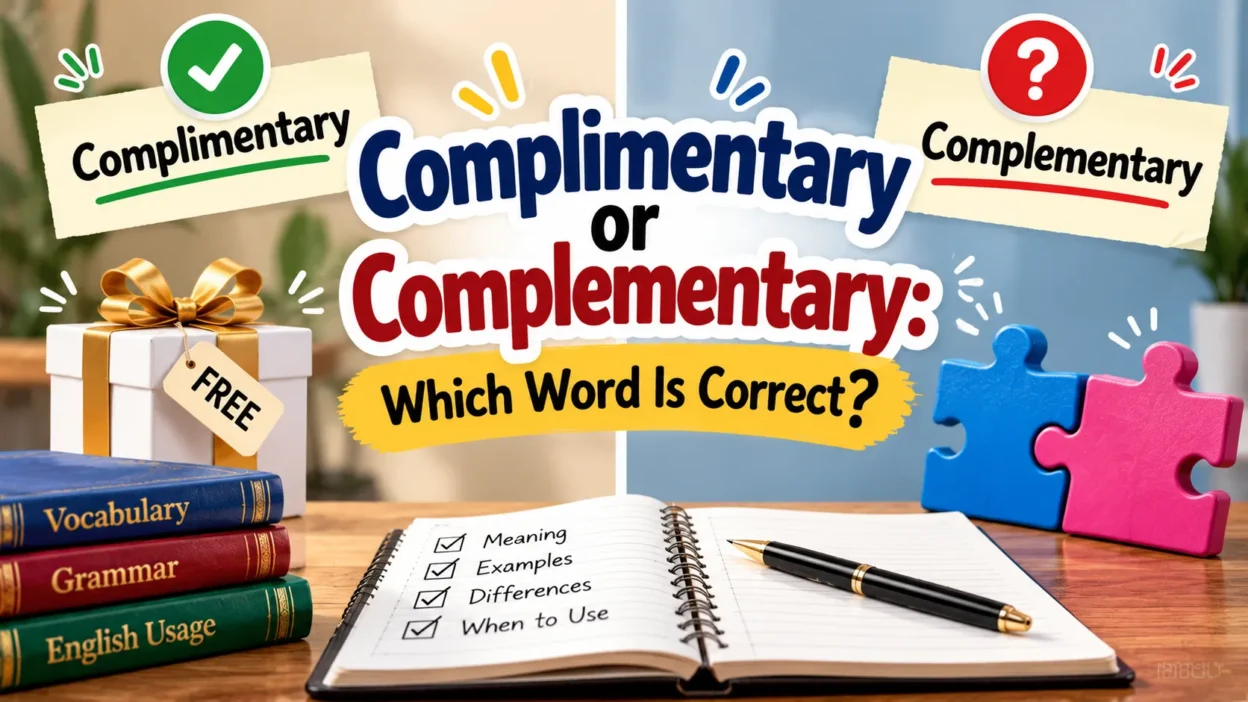
Have you ever wondered whether to write complimentary or complementary? These two words look almost identical and sound very similar, but they have different meanings. Choosing the wrong word can change the message you want to communicate, especially in emails, business writing, product descriptions, and everyday conversations.
The word complimentary usually means free of charge or expressing praise. For example, a hotel might offer complimentary breakfast, or someone might give you a complimentary comment about your work. On the other hand, complementary describes things that complete, improve, or work well with each other. For instance, two colors can create a complementary combination, or two skills can complement each other.
Both spellings are correct, but you cannot use them interchangeably. The right choice depends on your intended meaning. This guide explains the difference between complimentary and complementary, provides practical sentence examples, highlights common mistakes, and shares simple tricks to help you remember the correct spelling.
📖 Complimentary vs. Complementary: What’s the Difference?
The main difference between complimentary and complementary lies in their meanings. Although they share most of their letters, each word serves a distinct purpose in English.
Complimentary usually describes something given for free or something that expresses praise, admiration, or approval. You will often see it in hotels, restaurants, customer service, marketing, and everyday conversations.
Complementary describes two or more things that complete, enhance, or work well with one another. People frequently use it when discussing colors, clothing, skills, ideas, personalities, and design.
| Word | Meaning | Example |
|---|---|---|
| Complimentary | Free of charge | The hotel offers complimentary breakfast. |
| Complimentary | Expressing praise | She made a complimentary remark about his presentation. |
| Complementary | Working well together | The colors create a complementary combination. |
| Complementary | Completing or enhancing something | Their skills are complementary. |
Quick rule: Use complimentary when you mean free or praising someone. Use complementary when you mean matching, completing, or enhancing something.
🎁 What Does Complimentary Mean?
The word complimentary has two common meanings. It can describe something that someone provides for free, or it can refer to words that express praise and admiration.
In business and hospitality, companies often use complimentary to describe services or products that customers receive without an additional charge. A hotel might provide complimentary coffee, a restaurant might offer complimentary dessert, and an airline might include complimentary refreshments on a flight.
In everyday communication, complimentary describes a positive remark about someone’s appearance, personality, behavior, or achievements.
Complimentary Meaning: Free of Charge
When a business offers something complimentary, customers do not pay an extra fee for that particular item or service. The offer may come with certain conditions, so it does not necessarily mean that every part of the overall service costs nothing.
Examples include:
- Complimentary breakfast at a hotel.
- Complimentary drinks at a special event.
- Complimentary Wi-Fi at an airport lounge.
- Complimentary samples at a store.
- Complimentary parking for restaurant customers.
- Complimentary refreshments during a conference.
- Complimentary toiletries in a hotel room.
- Complimentary tickets offered as part of a promotion.
Complimentary Meaning: Expressing Praise
The word can also describe a remark that shows appreciation, approval, or admiration.
For example, if someone tells you that your presentation was clear and engaging, they have made a complimentary remark. Similarly, a manager might offer complimentary feedback after an employee completes a successful project.
Examples include:
- She made a complimentary comment about his writing.
- The teacher gave her a complimentary review of the assignment.
- He received complimentary feedback from his manager.
- Her complimentary remarks made the new employee feel welcome.
- The customer left a complimentary review of the service.
The context makes the intended meaning clear. A complimentary breakfast is free, while a complimentary comment expresses praise.
🤝 What Does Complementary Mean?
The word complementary describes things that complete, improve, or enhance each other. Two complementary items do not have to be identical. In fact, their differences can make them work especially well together.
For example, a blue shirt and orange accessories can create a complementary color combination. Similarly, one employee might have strong writing skills while another excels at research. Their complementary abilities can help a team produce better results.
People use this word in fashion, design, education, business, relationships, and many other fields.
Common Uses of Complementary
- Complementary colors: Colors that create a strong visual contrast when paired.
- Complementary skills: Abilities that work well together.
- Complementary roles: Responsibilities that support one another.
- Complementary products: Products that people commonly use together.
- Complementary personalities: Personal qualities that help two people work well together.
- Complementary treatments: Treatments used alongside another treatment to support care.
Examples of Complementary in Sentences
- The designer chose complementary colors for the living room.
- Their complementary skills helped the business grow.
- The two products offer complementary features.
- Her creativity and his analytical thinking are complementary.
- The teacher used complementary activities to reinforce the lesson.
- These accessories create a complementary look.
- The departments have complementary responsibilities.
- Their different strengths make them complementary partners.
In each example, complementary describes a relationship between things that work together or enhance one another.
🧠 Why Do People Confuse Complimentary and Complementary?
People often confuse these words because their spelling differs by only one letter. Both words also contain the same general sequence of letters, which makes typing errors easy.
Pronunciation adds another challenge. Many English speakers pronounce the two words almost identically, so listening alone may not help you choose the correct spelling.
The words also appear in similar contexts. For example, a business might advertise complimentary services, while another company might sell complementary products. Both terms sound appropriate in a business setting, but they communicate different ideas.
The easiest solution is to connect each word with a related word:
- Complimentary → Compliment: Think about praise or something offered for free.
- Complementary → Complement: Think about something that completes or enhances another thing.
For example, if a colleague praises your presentation, they give you a compliment. If your research and writing skills work well together, they are complementary.
✍️ Complimentary or Complementary: Common Mistakes
Writers sometimes choose the wrong spelling because they remember the general sound but forget the meaning. The following examples show how one letter can change the intended message.
| Incorrect wording | Correct wording | Why? |
|---|---|---|
| The hotel offers complementary breakfast for free. | The hotel offers complimentary breakfast for free. | The breakfast costs nothing extra. |
| She gave me a complementary comment about my work. | She gave me a complimentary comment about my work. | The comment expresses praise. |
| The two colors are complimentary. | The two colors are complementary. | The colors work well together. |
| Their skills are complimentary. | Their skills are complementary. | Their abilities support one another. |
| The restaurant provided complementary drinks at no extra cost. | The restaurant provided complimentary drinks at no extra cost. | The drinks were free. |
| He made a complementary remark about her performance. | He made a complimentary remark about her performance. | He praised her performance. |
| These shoes and this outfit are complimentary. | These shoes and this outfit are complementary. | The items work well together stylistically. |
One important detail: complimentary can mean either free or praising, while complementary relates to completing or enhancing something. Always check the sentence’s intended meaning before choosing the spelling.
🎨 Complementary Colors vs Complimentary Gifts
Color theory provides a useful example of the difference between these words. Complementary colors are colors that sit opposite each other on a traditional color wheel. Common examples include red and green, blue and orange, and yellow and purple.
Designers use complementary colors to create contrast, highlight important details, and make visual compositions more dynamic. The colors do not have to look similar; their contrast helps them work together.
A complimentary gift, however, is a gift that someone provides for free. For example, a store might offer a complimentary gift with a purchase.
Compare these examples:
- The artist used complementary colors to create contrast.
- The hotel gave guests a complimentary welcome gift.
- The designer selected complementary shades for the website.
- The company offered complimentary products to new customers.
Remember that complementary colors enhance each other, while complimentary gifts cost nothing extra.
💼 Complimentary vs. Complementary in Business
Both words appear frequently in professional communication, but they serve different purposes.
Businesses use complimentary when they offer free services, promotional items, or positive feedback. A customer service representative might provide complimentary assistance, while a hotel might advertise complimentary airport transportation.
Businesses use complementary when they describe products, skills, services, or departments that work well together. For example, a company might sell complementary products that customers commonly purchase as a set.
Business Examples
- The company offers complimentary consultations to new customers.
- Our team has complementary skills in marketing and analytics.
- The hotel provides complimentary shuttle service to the airport.
- These software tools offer complementary functions.
- The manager gave complimentary feedback on the employee’s performance.
- The two departments perform complementary roles.
- Customers receive a complimentary sample with their purchase.
- The products serve complementary purposes in a home office.
These examples demonstrate why the distinction matters in marketing materials, emails, proposals, and product descriptions.
💬 Complimentary or Complementary in Everyday Conversations
In everyday English, the correct word depends on whether you want to describe praise, a free item, or a useful combination.
If someone says something kind about your appearance, work, or achievements, you can describe their remark as complimentary. If two people have different qualities that help them work well together, you can describe those qualities as complementary.
The following examples show how each word fits naturally into everyday conversation.
Examples of Complimentary
- “The restaurant gave us complimentary dessert.”
- “She made a complimentary remark about my new haircut.”
- “We received complimentary tickets to the concert.”
- “He wrote a complimentary review of the book.”
- “The hotel provides complimentary coffee every morning.”
Examples of Complementary
- “Your ideas and mine are complementary.”
- “The colors look complementary together.”
- “Our different skills are complementary.”
- “These two apps offer complementary features.”
- “The jacket and trousers create a complementary outfit.”
If you can replace the word with free or praising, choose complimentary. If you can replace it with working well together or enhancing each other, choose complementary.
🔤 Compliment vs Complement: What’s the Difference?
Understanding the nouns and verbs behind these adjectives makes the spelling difference easier to remember.
A compliment is an expression of praise or admiration. For example, “She gave me a compliment about my presentation.”
A complement is something that completes or enhances another thing. For example, “The sauce is a perfect complement to the meal.”
The same distinction applies to the related verbs:
- Compliment: To praise someone. Example: “I complimented her on her presentation.”
- Complement: To complete or enhance something. Example: “The blue curtains complement the room.”
The adjectives follow the same pattern:
- Complimentary: Free or expressing praise.
- Complementary: Completing, enhancing, or working well together.
A helpful memory trick is to look at the spelling. Complimentary contains the word compliment, while complementary contains the word complement.
📝 How to Remember the Correct Spelling
You can remember the difference between complimentary and complementary with a few simple tricks.
1. Think of praise when you see the letter “i.”
The word complimentary connects to compliment, which means praise. You might give someone a complimentary remark or receive complimentary feedback.
2. Think of completion when you see the letter “e.”
The word complementary connects to complement, which means something that completes or enhances another thing. Complementary colors and complementary skills fit this meaning.
3. Use the word “free” as a test.
If you can replace complimentary with free of charge, you probably have the correct word. For example, “The hotel offers free breakfast” communicates the same basic idea as “The hotel offers complimentary breakfast.”
4. Use the phrase “works well together” as another test.
If that phrase captures your meaning, choose complementary. For example, “Their skills work well together” means their skills are complementary.
5. Read the entire sentence before correcting it.
A spelling checker might accept both words because both are valid. Context, rather than spelling alone, determines which one you need.
❓ Frequently Asked Questions About Complimentary or Complementary
1. Is it complimentary or complementary?
Both words are correct, but they have different meanings. Complimentary means free of charge or expressing praise. Complementary means completing, enhancing, or working well with something else.
2. Does complimentary mean free?
Yes. In business and hospitality, complimentary often means free of charge or provided without an additional fee. For example, a hotel might offer complimentary breakfast to its guests.
3. What does complementary mean in simple words?
Complementary means that two or more things complete, improve, or work well with one another. For example, two complementary colors create an appealing visual combination.
4. Is complimentary breakfast correct?
Yes. Complimentary breakfast is the correct phrase when a hotel or another business provides breakfast without an additional charge.
5. Is it complementary colors or complimentary colors?
The correct phrase is complementary colors. These colors create contrast and work together visually, such as blue and orange.
6. What is a complimentary remark?
A complimentary remark expresses praise, admiration, or approval. For example, telling a colleague that their presentation was excellent is a complimentary remark.
7. What is a complementary relationship?
A complementary relationship involves people, qualities, or things that enhance or support one another. For example, two coworkers with different but compatible skills may form a complementary team.
8. How do you use complimentary in a sentence?
You can write, “The hotel offers complimentary Wi-Fi to its guests.” You can also say, “She made a complimentary comment about my work.”
9. How do you use complementary in a sentence?
You can write, “The designer chose complementary colors for the bedroom.” Another example is, “Their complementary skills helped them complete the project.”
10. What is the difference between compliment and complement?
A compliment expresses praise, while a complement completes or enhances something. For example, you compliment a person, but a sauce can complement a meal.
11. Can complimentary mean both free and praising?
Yes. Complimentary can describe a free service or product, as well as a statement that expresses praise. The context tells you which meaning applies.
12. How can I avoid confusing complimentary and complementary?
Remember the related words: compliment means praise, while complement means something that completes or enhances. Use complimentary for free items or praise, and complementary for things that work well together.
✅ Conclusion
The difference between complimentary or complementary depends on what you want to express. Complimentary means free of charge or expressing praise, while complementary describes things that complete, enhance, or work well together.
For example, a hotel might offer complimentary breakfast, while a designer might choose complementary colors. A colleague can give you a complimentary remark, while your skills and experience can complement each other.
The simplest way to remember the distinction is to connect complimentary with compliment and complementary with complement. Once you understand those two related words, choosing the correct spelling becomes much easier.

Miles Ellington enjoys exploring the subtle differences that can completely change how a word or phrase is understood. At Differology, he turns confusing language questions into straightforward explanations, covering word comparisons, vocabulary, grammar, usage, and everyday English.
With a practical and reader-focused approach, Miles uses real-world examples and clear comparisons to help readers choose the right word, understand its meaning, and communicate more precisely.