The English language has many short expressions that can communicate an opinion, reaction, or decision in just a few words. Yay or Nay is one of the most recognizable combinations used to show approval or disagreement with an idea.
The expression appears in casual conversations, social media posts, polls, fashion discussions, food debates, workplace chats, and everyday decision-making. Understanding the meaning of each word also helps you distinguish between yay, yea, yeah, and nay, which can sound similar but have different purposes.
Whether you are learning English, improving your vocabulary, or simply wondering how these expressions are used, this guide explains their meanings, differences, examples, and common contexts.
📖 What Does Yay Mean?
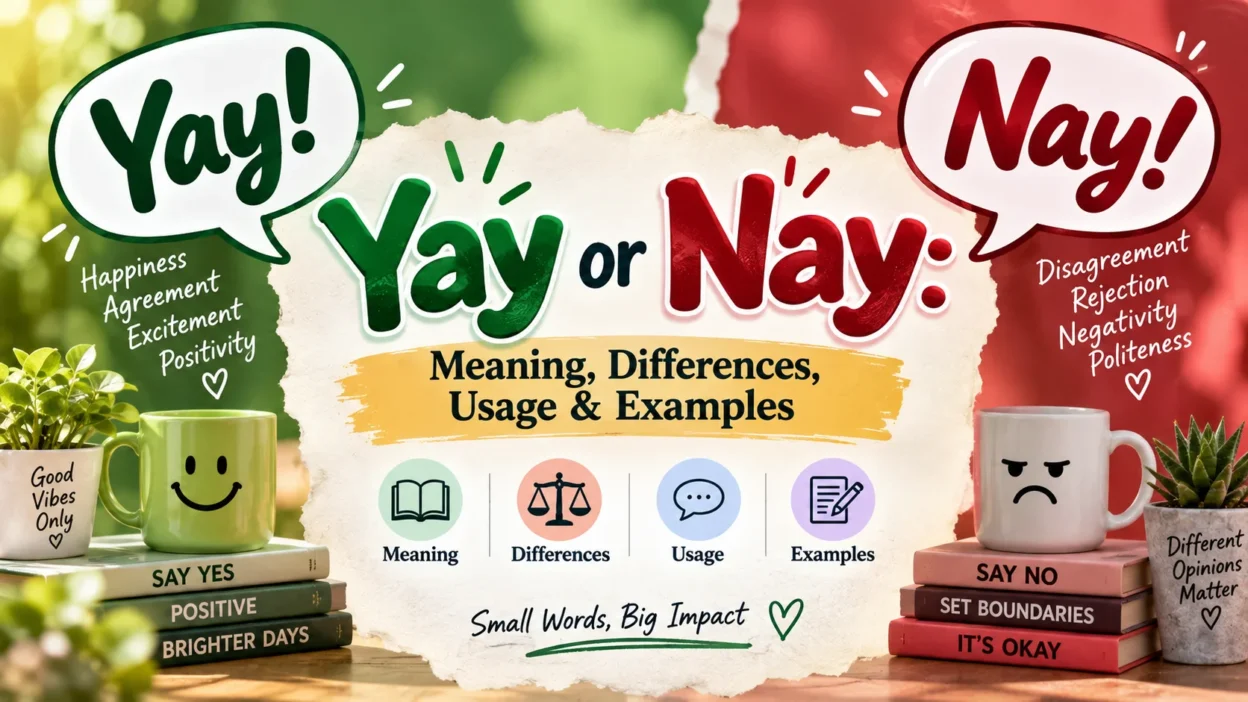
Yay is an informal exclamation that expresses happiness, excitement, enthusiasm, celebration, or approval. It is commonly used when something positive happens or when someone strongly likes an idea.
The word is especially common in spoken English, texting, online conversations, social media, and casual writing.
Common meanings include:
- Happiness
- Excitement
- Celebration
- Approval
- Enthusiasm
- Agreement
- Positive reaction
- Support
Examples:
- Yay, we finally finished the project!
- Yay, the weekend has arrived!
- Yay, you are coming with us!
- Yay, we won the game!
- Yay, my vacation starts tomorrow!
The emotional meaning can vary slightly depending on the situation. Sometimes it simply means yes, while other times it communicates strong excitement.
🚫 What Does Nay Mean?
Nay traditionally means no. It can communicate disagreement, rejection, opposition, refusal, or a negative response.
Unlike the very casual word no, this term can sound formal, old-fashioned, dramatic, or playful depending on the context.
It is especially familiar in formal voting language, historical writing, parliamentary discussions, and humorous expressions.
Common meanings include:
- No
- Opposition
- Disagreement
- Rejection
- Refusal
- Negative response
- Negative vote
- Dissent
Examples:
- I vote nay.
- The proposal received several nays.
- His response was a firm nay.
- The members voted yea and nay.
- She gave the suggestion a nay.
In ordinary modern conversation, no is usually more natural than nay.
⚖️ What Is the Difference Between Yay and Nay?
The basic distinction is straightforward.
Yay represents a positive reaction, approval, excitement, or agreement.
Nay represents a negative reaction, disagreement, rejection, or opposition.
| Expression | Meaning | Typical use |
|---|---|---|
| Yay | Positive response or excitement | Casual conversation |
| Nay | Negative response or opposition | Formal, traditional, or playful contexts |
| Yea | Affirmative response | Formal voting |
| Yeah | Informal yes | Everyday conversation |
The important point is that yay and yea are not interchangeable in every situation. Their meanings overlap only in certain contexts.
💬 What Does the Full Expression Mean?
The phrase Yay or Nay is commonly used when someone wants a quick opinion about something.
It can essentially mean:
- Yes or no?
- Do you approve?
- Do you like it?
- Should we do it?
- Are you in favor?
- Is this a good idea?
- Should we keep it?
For example, someone might ask about a new outfit, restaurant, hairstyle, travel plan, or design and expect a quick positive or negative reaction.
The expression is popular because it makes decision-making feel simple and conversational.
🎉 When Should You Use Yay?
Use yay when the purpose is to show enthusiasm, happiness, celebration, or strong approval.
It works particularly well in informal situations.
Common situations include:
- Celebrating good news
- Reacting to an achievement
- Showing excitement about plans
- Supporting an idea
- Responding positively to an invitation
- Celebrating an event
- Reacting to a surprise
- Showing enthusiasm online
Examples:
- Yay, our team made it to the final!
- Yay, I got the tickets!
- Yay, dinner is ready!
- Yay, everyone can join us!
- Yay, summer vacation is here!
The word usually creates a cheerful and energetic tone.
🗳️ When Should You Use Nay?
Nay is useful when expressing opposition or giving a negative vote, particularly when the situation has a formal or traditional tone.
Examples include:
- I vote nay.
- The motion received five nays.
- The committee recorded several nays.
- He voted nay on the proposal.
- My answer is nay.
In casual conversations, alternatives such as no, not really, or I do not think so usually sound more natural.
Using nay in everyday speech can intentionally create a humorous or dramatic effect.
🆚 Yay, Yea, Yeah, and Nay
These four expressions are often confused because their spellings and sounds are similar.
Understanding their individual roles makes the difference easier to remember.
Yay
Used for excitement, happiness, celebration, or enthusiastic approval.
Example:
- Yay, we are going on vacation!
Yea
Used as an affirmative response, particularly in formal voting.
Example:
- The final vote included twelve yeas.
Yeah
An informal form of yes that is extremely common in everyday conversation.
Example:
- Yeah, I can help with that.
Nay
Used to express no, opposition, rejection, or a negative vote.
Example:
- The motion received three nays.
Easy way to remember them
- Yay = excitement
- Yea = affirmative vote
- Yeah = casual yes
- Nay = no or opposition
📱 Use in Social Media
This expression works especially well on social platforms because users often want quick reactions from their audience.
People may use it when asking followers about:
- Outfits
- Hairstyles
- Shoes
- Food
- Home décor
- Travel destinations
- Tattoos
- New products
- Room designs
- Photos
- Hairstyles
- Captions
- Trends
- Personal style
For example, a social media post may ask whether a new haircut looks good or whether a particular fashion trend should be tried.
The short format encourages people to give an immediate reaction instead of writing a long explanation.
👗 Fashion Examples
Fashion is one of the most natural settings for this type of informal approval question.
Examples:
- Denim jackets this season
- Sneakers with formal outfits
- Oversized sunglasses
- Matching sets
- Vintage clothing
- Monochrome outfits
- Bold accessories
- Wide-leg jeans
- Statement shoes
- Layered necklaces
These questions often create friendly debates because people have different tastes.
🍕 Food and Restaurant Examples
Food preferences also provide plenty of opportunities for positive or negative reactions.
Examples:
- Pineapple on pizza
- Extra cheese
- Spicy noodles
- Sweet and salty popcorn
- Breakfast for dinner
- Ice cream after lunch
- Chocolate and peanut butter
- Hot sauce on everything
- Late-night snacks
- Trying a new restaurant
Because food preferences are personal, these questions are usually intended for fun rather than serious decision-making.
💼 Use in Workplace Communication
The expression can sometimes work in professional environments, especially when the workplace culture is friendly and informal.
Examples include:
- New team lunch location
- Casual Friday outfit
- Office decoration idea
- New meeting time
- Team-building activity
- Weekend event
- New presentation design
However, formal business writing usually benefits from more precise language.
Instead of informal expressions, professional communication may use:
- Approved or rejected
- Accepted or declined
- Supported or opposed
- For or against
- Agree or disagree
- Proceed or do not proceed
Choosing the appropriate expression depends on the audience and purpose.
🧠 Why Is This Expression So Popular?
One reason is simplicity. People often want a quick reaction instead of a detailed explanation.
A short question can immediately communicate that the speaker wants an opinion.
It also creates a playful tone. A simple question about clothing, food, travel, or entertainment can become more engaging when presented as a two-sided choice.
The expression is therefore useful for:
- Quick polls
- Social media questions
- Friendly debates
- Group decisions
- Casual conversations
- Style discussions
- Personal preferences
✍️ Examples in Everyday Sentences
Here are some natural examples:
- New restaurant tonight, yay or nay?
- I am giving this outfit a definite yay.
- That hairstyle gets a nay from me.
- Movie night this evening, yay?
- I vote nay on changing the schedule.
- Coffee before work is always a yay.
- Another meeting today is a definite nay.
- Should we invite everyone?
- The new design received plenty of approval.
- The committee recorded several negative votes.
- Weekend road trip sounds like a yay.
- I am leaning toward no on that idea.
- This color combination gets my approval.
- The proposal received opposition from several members.
- Should we try the new café?
😂 Funny Questions for Friends
The phrase is particularly useful when creating playful questions for friends or followers.
Try these:
- Wearing pajamas all day?
- Pizza for breakfast?
- Dancing while cooking?
- Talking to your pet like a person?
- Sleeping with five pillows?
- Watching one more episode at midnight?
- Ordering dessert before dinner?
- Wearing mismatched socks?
- Naming your Wi-Fi something ridiculous?
- Taking dozens of pictures before choosing one?
- Eating fries with breakfast?
- Singing loudly in the shower?
- Going on a spontaneous road trip?
- Sending memes before saying hello?
- Having pizza three days in a row?
These questions can work well for social media polls, group chats, captions, and conversation starters.
💡 How to Respond to a Positive Choice
There are many ways to communicate approval without simply using one word.
Strong approval:
- Definitely!
- Absolutely!
- Big yes!
- Count me in!
- I love it!
- 100 percent!
- Sounds perfect!
- I am in!
Moderate approval:
- I would say yes.
- Sounds good.
- I like the idea.
- That works for me.
- I am interested.
- I would try it.
These alternatives can make conversations feel more natural and varied.
🙅 How to Respond to a Negative Choice
When you disagree, you can choose from several expressions depending on how direct you want to be.
Strong disagreement:
- Definitely not.
- Absolutely not.
- Hard pass.
- No way.
- Not happening.
- That is a no from me.
Softer disagreement:
- I am not convinced.
- Probably not.
- I would skip it.
- I do not think so.
- I am leaning toward no.
- Maybe another time.
The best choice depends on your relationship with the other person and how strongly you feel.
📝 Alternatives to Yay or Nay
Sometimes a different expression may fit the situation better.
Casual alternatives
- Yes or no?
- Like it or not?
- Good or bad?
- Keep it or skip it?
- In or out?
- Worth it or not?
- Do it or do not?
- Love it or leave it?
Professional alternatives
- Approve or reject
- Accept or decline
- Support or oppose
- Agree or disagree
- For or against
- Proceed or stop
Playful alternatives
- Green light or red light?
- Keep or ditch?
- Hot or not?
- Hit or miss?
- Go or no-go?
- Win or fail?
Each alternative has a slightly different tone, so context matters.
📚 History of Yay and Nay
The two words have different linguistic histories.
Nay is an old English term meaning no. Over time, it became strongly associated with disagreement, opposition, and formal voting.
Yay developed as an expression of enthusiasm and approval. Its role is much more emotional than the formal affirmative sense associated with yea.
This distinction explains why formal voting often uses yea and nay, while casual conversations may use yay to express excitement.
Understanding this difference is useful because spelling alone can sometimes change the meaning.
🔤 Yea vs Yay
The difference between yea and yay is particularly important.
Yea traditionally represents an affirmative response and is strongly associated with formal voting.
Yay expresses happiness, excitement, or enthusiastic approval.
Compare the contexts:
Formal voting:
- The proposal received twenty yeas and five nays.
Casual excitement:
- Yay, we are going to the beach!
The two words may sound similar when spoken, but their written forms have different purposes.
🗳️ Yea and Nay in Voting
In formal voting language, yea and nay are traditionally paired.
A yea represents an affirmative vote.
A nay represents a negative vote.
For example, an official voting record might report:
- 30 yeas
- 12 nays
This is different from casual expressions of excitement or disappointment.
When discussing formal voting, using the correct spelling is important because yay and yea are not always interchangeable.
🎯 A Simple Memory Trick
A quick way to remember the difference is to connect each word with its most common role.
Yay
Think celebration.
Something good happens, and you react with excitement.
Yea
Think voting.
You support a proposal or motion.
Yeah
Think everyday conversation.
It is the informal version of yes.
Nay
Think opposition.
You reject or disagree with something.
This simple method can prevent many common vocabulary mistakes.
❓ Frequently Asked Questions
What does yay mean?
Yay is an informal exclamation expressing happiness, excitement, celebration, enthusiasm, or approval.
What does nay mean?
Nay traditionally means no and can express disagreement, rejection, opposition, or a negative vote.
Is yay the same as yes?
Not exactly. Yay can communicate approval, but it usually adds an emotional sense of excitement or enthusiasm.
Is nay the same as no?
In many contexts, yes. However, nay sounds more formal, traditional, dramatic, or playful than the everyday word no.
What is the difference between yay and yea?
Yay usually expresses excitement or happiness, while yea is traditionally used as an affirmative response, especially in formal voting.
What is the difference between yea and yeah?
Yea is traditionally associated with affirmative voting or formal agreement. Yeah is an informal way of saying yes.
Is nay still used today?
Yes. It appears in formal voting language, historical writing, formal discussions, and playful or humorous speech.
Is yay formal English?
Yay is generally considered informal. It is common in casual speech, texting, social media, and friendly conversations.
Can yay be used professionally?
It can be used in relaxed workplace communication, but formal reports and official documents usually benefit from clearer expressions such as approved, accepted, or supported.
Why do people ask yay or nay?
The expression provides a quick way to ask for an opinion, approval, preference, or decision without requiring a long response.
🌟 Final Thoughts
These short English expressions may seem simple, but their meanings become clearer when you understand the context behind each one.
Yay is mainly associated with excitement, celebration, and positive reactions. Nay communicates rejection, disagreement, or a negative response. Yea has a more formal affirmative role, particularly in voting, while yeah is the familiar informal form of yes.
Knowing these distinctions can make your writing and conversations more precise. Whether you are creating a social media poll, discussing a fashion choice, talking about food, or reading a formal voting record, choosing the right expression helps communicate your intended meaning clearly.

Miles Ellington enjoys exploring the subtle differences that can completely change how a word or phrase is understood. At Differology, he turns confusing language questions into straightforward explanations, covering word comparisons, vocabulary, grammar, usage, and everyday English.
With a practical and reader-focused approach, Miles uses real-world examples and clear comparisons to help readers choose the right word, understand its meaning, and communicate more precisely.