
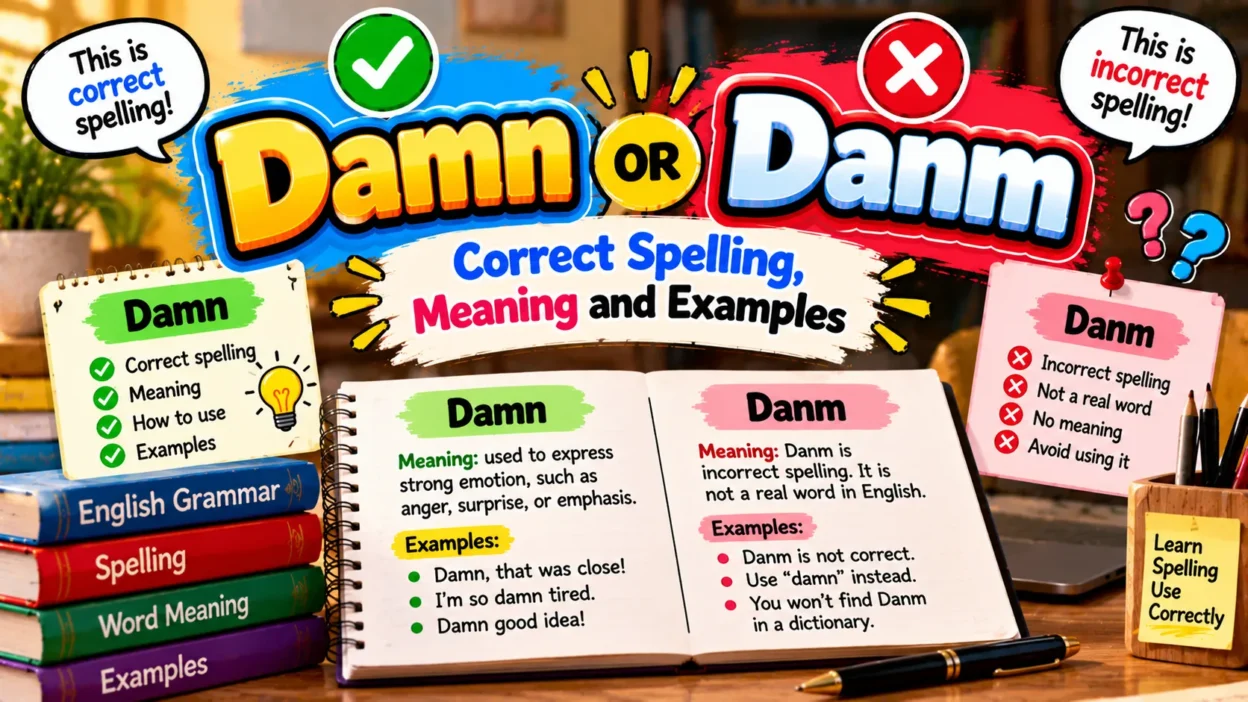
When writing in English, even a small spelling mistake can change the appearance of a sentence. One common example is the confusion between damn or danm. Although these spellings look almost identical, only one is the standard spelling of the familiar English word used to express frustration, surprise, anger, or emphasis.
The correct spelling is damn. The spelling danm is generally a typing error rather than an accepted alternative. You may see it in text messages, social media comments, online conversations, or informal posts, but standard English writing uses damn.
Understanding the correct spelling, meaning, and usage of this word can help you communicate more confidently. This article explains what damn means, why danm is usually incorrect, how to use damn in sentences, and which alternatives are appropriate for different situations.
What Is the Correct Spelling of Damn or Danm? ✍️
The correct spelling is damn, with the letters arranged in the order D-A-M-N. The spelling danm reverses the final two letters and is generally considered a misspelling when referring to the common English word.
Damn is an established English word found in dictionaries and used in both spoken and written language. Danm, on the other hand, is not a standard spelling of that word.
Here is a simple comparison:
| Spelling | Status | Explanation |
|---|---|---|
| Damn | Correct | The standard English word |
| Danm | Usually incorrect | A common typing or spelling mistake |
For example:
- Incorrect: Danm, I forgot my phone!
- Correct: Damn, I forgot my phone!
If you are writing an article, email, caption, or message, use damn when that is the word you intend to express.
What Does Damn Mean? 📖
Damn is a word used to express strong emotions or add emphasis to a statement. Depending on the context, it can communicate frustration, disappointment, surprise, annoyance, or admiration.
The word can function as an exclamation, a verb, or an intensifier. Its meaning depends on how it appears in a sentence.
For example, someone might say “Damn!” after receiving unexpected news. Another person might describe a performance as “damn impressive” to emphasize how good it was.
Common uses include:
- Frustration: “Damn, I missed the bus.”
- Surprise: “Damn, that was unexpected!”
- Admiration: “Damn, your artwork looks amazing.”
- Emphasis: “That was a damn good performance.”
- Disappointment: “Damn, we lost the game.”
Although damn is widely understood, it is generally considered mild profanity. Whether it is appropriate depends on the audience, setting, and purpose of the conversation.
What Does Danm Mean? 🔤
The spelling danm is generally an error made when someone intends to write damn. It does not carry the same established meaning in standard English.
People may accidentally type danm because they are writing quickly, using a small mobile keyboard, or forgetting the correct order of the final letters. In casual online communication, readers may understand the intended word from the context, but that does not make the spelling standard.
Consider these examples:
- Incorrect: Danm, this weather is terrible.
- Correct: Damn, this weather is terrible.
- Incorrect: That was a danm good idea.
- Correct: That was a damn good idea.
- Incorrect: I do not give a danm.
- Correct: I do not give a damn.
There may be unusual contexts in which Danm appears as a name, username, or deliberately stylized term. However, for ordinary English writing, damn is the correct choice.
How to Use Damn Correctly in a Sentence 💬
Damn can be used in several ways, and understanding these uses helps you choose the right expression. It often appears in informal conversations, entertainment, online discussions, and dialogue.
1. To Express Frustration
People often use damn when something goes wrong or does not happen as expected.
Examples:
- Damn, I left my wallet at home.
- Damn! My computer stopped working.
- Damn, I missed the last train.
- Damn, I forgot about the appointment.
2. To Express Surprise
The word can communicate shock or surprise when something unexpected happens.
Examples:
- Damn, I did not see that coming.
- Damn! You finished the project already?
- Damn, that was a close match.
- Well, damn, that is surprising news.
3. To Express Admiration
In informal English, damn can emphasize a compliment or show that something is impressive.
Examples:
- Damn, you look fantastic.
- That was a damn impressive performance.
- Damn, your new car looks beautiful.
- She is a damn talented singer.
4. To Emphasize a Statement
Damn can strengthen an adjective or another part of a sentence.
Examples:
- This is a damn difficult assignment.
- He is damn good at mathematics.
- That was a damn long meeting.
- It is a damn useful tool.
In formal writing, consider replacing damn with a more neutral word, such as very, extremely, or remarkably, when appropriate.
Damn or Danm in Text Messages and Social Media 📱
Spelling mistakes are particularly common in text messages and social media comments because people often type quickly and prioritize speed over accuracy.
You might encounter danm in a comment or message where the writer intended to express surprise, frustration, or admiration. In most cases, the intended word is clear from the surrounding sentence.
For example:
- “Danm, that picture looks good!”
- “Danm, I forgot to reply.”
- “That was a danm good game.”
In standard spelling, these should read:
- “Damn, that picture looks good!”
- “Damn, I forgot to reply.”
- “That was a damn good game.”
When writing social media captions, blog posts, website content, or professional messages, correct spelling makes your writing appear more polished and credible.
Is Damn Considered a Bad Word? 🤔
Damn is generally classified as mild profanity in modern English. Some people use it casually, while others avoid it because they consider it impolite or offensive.
Its suitability depends on the circumstances.
In casual conversations: Friends may use damn to express frustration or surprise without intending to offend anyone.
On social media: The word is common in informal captions, comments, and posts, although audience expectations vary.
In professional communication: It is usually better to avoid damn in business emails, formal reports, and workplace messages unless the context specifically requires it.
In academic writing: Neutral vocabulary is generally more appropriate than profanity.
In family-friendly content: A milder alternative may be preferable.
If you are unsure whether the word is suitable, consider the audience before using it.
What Are Some Polite Alternatives to Damn? 🌿
If you want to express the same emotion without using profanity, several alternatives can work depending on the situation.
| Alternative | Typical use | Example |
|---|---|---|
| Darn | Mild frustration | Darn, I forgot my keys. |
| Oh no | Disappointment | Oh no, we missed the bus. |
| Goodness | Surprise | Goodness, that was unexpected. |
| Wow | Surprise or admiration | Wow, that looks amazing. |
| Frustrating | Annoyance | That is really frustrating. |
| Extremely | Emphasis | The test was extremely difficult. |
| Remarkably | Strong emphasis | She performed remarkably well. |
The best alternative depends on the emotion you want to communicate. For everyday situations, darn is a particularly close and milder substitute for damn.
Why Do People Mistype Damn as Danm? ⌨️
Several factors can lead to this spelling mistake. Although the error is simple, it is easy to make when typing quickly.
Fast typing: People may press letters in the wrong order when sending messages in a hurry.
Mobile keyboards: Small touchscreens can make it harder to enter letters accurately.
Unfamiliarity: Someone who has rarely written the word may not remember its exact spelling.
Autocorrect: Predictive text and autocorrect can occasionally fail to identify the intended word.
Careless proofreading: Informal messages are often sent without checking for mistakes.
To prevent this error, pause briefly before sending a message or use your device’s spelling checker when writing longer content.
Easy Ways to Remember the Correct Spelling 🧠
A simple memory trick can help you avoid confusing damn with danm.
Remember the sequence D-A-M-N. The letter M comes before N.
You can reinforce this pattern with familiar phrases:
- Damn, that was unexpected.
- It was a damn good meal.
- I do not give a damn.
Another helpful technique is to remember a complete sentence instead of memorizing the letters alone. When you repeatedly see the correct word in context, recognizing its spelling becomes easier.
Before publishing an article or sending a message, check whether you have accidentally reversed the M and N.
Common Mistakes to Avoid When Writing Damn ⚠️
Knowing the correct spelling is important, but proper punctuation and sentence structure also make your writing clearer.
Mistake 1: Reversing the final letters
Incorrect: Danm, that is impressive!
Correct: Damn, that is impressive!
Mistake 2: Forgetting punctuation after an exclamation
Less polished: Damn that was surprising.
Clearer: Damn, that was surprising!
Mistake 3: Using profanity in an unsuitable setting
Informal: That was a damn good presentation.
More formal: That was an excellent presentation.
Mistake 4: Assuming every online spelling is correct
A word appearing frequently in comments or messages does not necessarily mean its spelling is standard.
For polished writing, check spelling, punctuation, tone, and audience suitability before publishing.
Frequently Asked Questions About Damn or Danm ❓
Is damn or danm the correct spelling?
Damn is the correct spelling of the standard English word. Danm is generally a misspelling caused by typing the letters in the wrong order.
Is danm an actual English word?
Danm is not the standard spelling of the common word damn. It may appear as a proper name, username, or intentional stylization, but it should not replace damn in ordinary English sentences.
What does damn mean in texting?
In text messages, damn can express surprise, frustration, disappointment, anger, or admiration. For example, “Damn, that looks incredible!” communicates surprise or appreciation.
Can damn be used as a compliment?
Yes. In informal English, damn can intensify a compliment. For example, “That was a damn good performance” expresses strong approval.
Is damn a swear word?
Yes, damn is generally considered mild profanity. Its perceived offensiveness varies according to personal preferences, culture, and context.
What is a polite word to use instead of damn?
Darn is a common, milder alternative. Depending on the context, you can also use wow, oh no, goodness, or extremely.
Why do people write danm instead of damn?
People usually write danm by accident when typing quickly or mixing up the final two letters. The intended word is often clear from the context.
Can I use damn in a professional email?
It is usually best to avoid damn in professional emails because it may sound too informal or inappropriate. Choose a neutral expression, such as very, extremely, or unfortunately, depending on the sentence.
Final Thoughts 🎯
When deciding whether to write damn or danm, remember that damn is the standard English spelling. It is commonly used to express frustration, surprise, admiration, or emphasis, while danm is generally a typing mistake.
The easiest way to remember the correct spelling is to keep the final letters in order: M comes before N. Use damn when it fits the tone and audience, and choose a polite alternative such as darn when a softer expression is more appropriate.
With the correct spelling and a clear understanding of its meaning, you can use the word confidently in everyday conversations, messages, and informal writing.

Miles Ellington enjoys exploring the subtle differences that can completely change how a word or phrase is understood. At Differology, he turns confusing language questions into straightforward explanations, covering word comparisons, vocabulary, grammar, usage, and everyday English.
With a practical and reader-focused approach, Miles uses real-world examples and clear comparisons to help readers choose the right word, understand its meaning, and communicate more precisely.


