
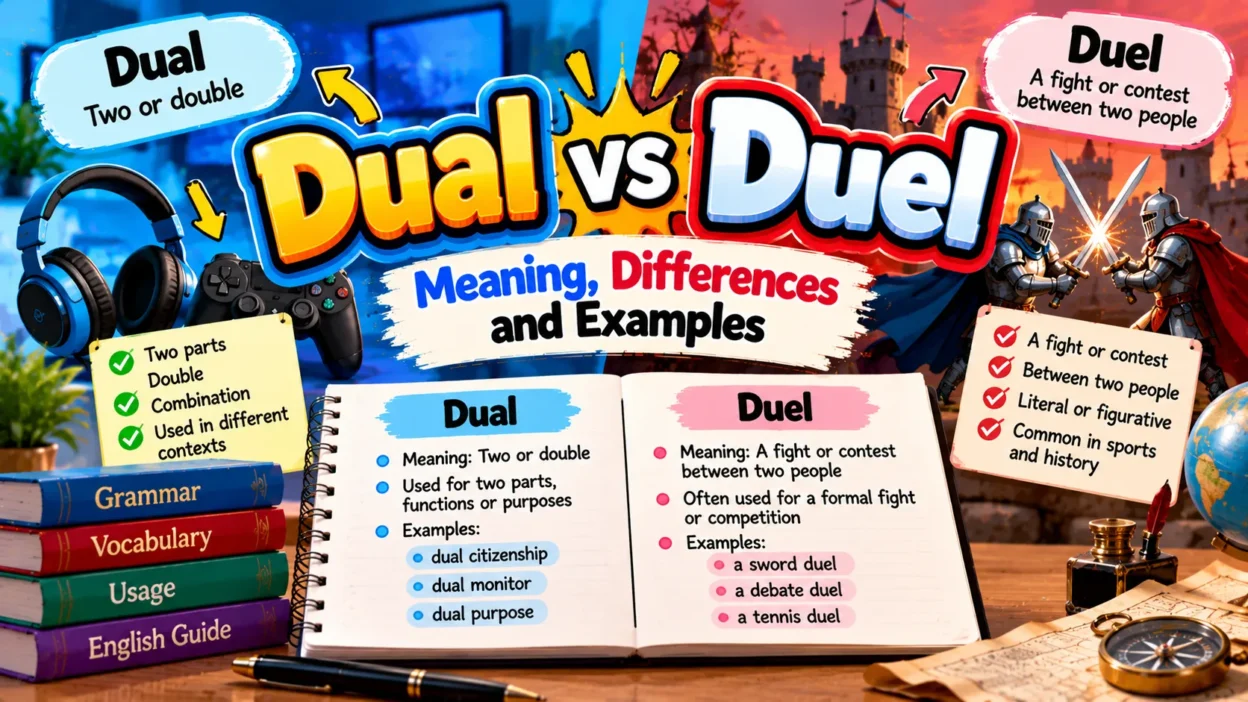
Have you ever wondered whether to use dual or duel in a sentence? These two words look and sound similar, but they have completely different meanings. One describes something that has two parts or serves two purposes, while the other refers to a contest or fight between two opponents. Understanding the difference can help you avoid spelling mistakes and communicate more clearly.
The confusion between dual and duel is common because both words contain the same letters in a slightly different order. However, choosing the correct word depends on the meaning you want to express. In this guide, we will explain the meaning of dual and duel, compare their differences, provide practical examples, and share simple tricks to remember which word to use.
What Does Dual Mean? 🔵
Dual is an adjective that means having two parts, two aspects, two functions, or two purposes. It is commonly used when describing something that combines two features or serves two roles at the same time.
You may encounter the word dual in technology, education, business, transportation, and everyday conversations. For example, a smartphone with two SIM card slots has dual SIM capability, while someone who works two jobs may have dual responsibilities.
Examples of Dual in Sentences
- My new phone supports dual SIM cards.
- She has dual responsibilities at work.
- The building serves a dual purpose as an office and a community center.
- He earned a dual degree in business and economics.
- The car has dual exhaust pipes.
- This camera offers dual recording modes.
- The program provides dual benefits for students.
- They installed a dual-monitor setup in the office.
In each sentence, dual describes two parts, functions, roles, or features. It does not mean a fight or competition.
What Does Duel Mean? ⚔️
Duel is a noun or verb that refers to a contest, fight, or confrontation between two opponents. Traditionally, a duel was a formal fight between two people, often involving weapons, to settle a disagreement or defend honor. Today, the word can also describe a sporting contest, a competitive battle, or a dramatic face-off.
As a noun, duel means the contest itself. As a verb, it means to engage in a duel or compete directly against another person.
Examples of Duel in Sentences
- The two knights fought a duel at sunrise.
- The movie ends with a dramatic duel between the heroes.
- The chess players prepared for a difficult duel.
- The boxers will duel for the championship title.
- The two rivals faced off in a musical duel.
- The novel describes a duel between two powerful warriors.
- The players dueled fiercely for the winning point.
- The final duel determined the fate of the kingdom.
In these examples, duel refers to a fight, contest, or direct competition between opponents.
Dual vs. Duel: Key Differences 📊
Although dual and duel look similar, their meanings, grammatical roles, and uses are different. The easiest way to distinguish them is to remember that dual relates to two parts or purposes, while duel relates to a contest between opponents.
| Feature | Dual | Duel |
|---|---|---|
| Part of speech | Usually an adjective | Noun and verb |
| Meaning | Having two parts or functions | A fight or contest between opponents |
| Main idea | Two features or purposes | Two opposing sides |
| Common contexts | Technology, education, business | History, sports, fiction |
| Example | The laptop has dual screens. | The rivals fought a duel. |
| Memory clue | Dual = two functions | Duel = a battle |
Quick rule: Use dual when describing two features or purposes. Use duel when describing a fight or competition.
Dual vs. Duel Examples in Everyday English 💬
Seeing both words in similar contexts can make their differences easier to understand. The following examples show how a small spelling change can completely change a sentence’s meaning.
Examples Using Dual
- The school offers a dual enrollment program.
- My car has dual airbags.
- She plays a dual role in the production.
- The device supports dual connectivity.
- The company introduced a dual pricing system.
- He has dual citizenship.
- The machine performs a dual function.
- They use dual monitors for their work.
- The course follows a dual learning approach.
- This camera has dual lenses.
Examples Using Duel
- The warriors prepared for a duel.
- The two champions entered a fierce duel.
- The rivals dueled for the trophy.
- The final duel was the most exciting scene.
- The story features a duel between two detectives.
- The competitors dueled for first place.
- The duel lasted only a few minutes.
- The characters settled their dispute through a duel.
- The two musicians engaged in a friendly duel.
- The players dueled until the final whistle.
Notice how dual describes something with two elements, whereas duel describes a confrontation or contest.
When Should You Use Dual? 📝
Use dual when you want to explain that something has two parts, combines two features, or performs two functions. The word is particularly useful in formal writing, technical descriptions, and discussions involving responsibilities or roles.
Here are some common situations where dual is appropriate:
- Technology: Dual cameras, dual SIM phones, and dual monitors.
- Education: Dual degrees, dual enrollment, and dual-language programs.
- Employment: Dual roles, dual responsibilities, and dual positions.
- Transportation: Dual exhaust systems and dual controls.
- Citizenship: Dual citizenship, meaning citizenship in two countries.
- Business: Dual pricing, dual strategies, and dual purposes.
- Daily life: A room with a dual purpose as an office and guest room.
More Examples of Dual
- The employee manages dual roles within the organization.
- This tablet offers dual connectivity options.
- The school introduced a dual-language curriculum.
- Their partnership has a dual benefit for both companies.
- The new system provides dual protection against errors.
Remember that dual is appropriate when the sentence focuses on two aspects, not a battle.
When Should You Use Duel? 🥊
Use duel when referring to a fight, confrontation, or contest involving two opponents. The word can describe historical combat, fictional battles, sporting rivalries, or figurative competitions.
Common situations include:
- History: A traditional duel between two people.
- Fantasy: A sword duel between fictional characters.
- Sports: A duel between two leading athletes.
- Entertainment: A dance duel, rap duel, or musical duel.
- Competition: A direct contest between two rivals.
- Figurative language: A battle of ideas or a duel of words.
More Examples of Duel
- The two swordsmen began their duel.
- The basketball game became a duel between the leading scorers.
- The singers took part in a musical duel.
- The detective and criminal faced each other in a final duel.
- The debate turned into a duel of opposing ideas.
A duel does not always involve weapons. In modern English, it can also describe a close competition or an intense exchange between two opponents.
Dual vs. Duel: Common Phrases and Expressions 📚
Learning common expressions can help you recognize each word in context. Some combinations are especially frequent in everyday writing.
Common Phrases With Dual
- Dual citizenship
- Dual purpose
- Dual role
- Dual degree
- Dual SIM
- Dual monitors
- Dual controls
- Dual function
- Dual responsibility
- Dual identity
Example: She uses her dual citizenship to travel between the two countries.
Common Phrases With Duel
- Sword duel
- Final duel
- Deadly duel
- Musical duel
- Duel between rivals
- Duel for the championship
- Duel of words
- Duel of wits
- Rap duel
- Political duel
Example: The final duel between the rivals kept the audience on the edge of their seats.
These expressions show the central difference: dual describes two aspects, while duel describes a contest.
Is Dual a Noun or an Adjective? 🔎
Dual is primarily used as an adjective. It describes a noun by explaining that something has two parts, roles, or functions.
For example:
- The device has dual cameras.
- She holds dual citizenship.
- They installed dual controls.
In some specialized contexts, dual can also be used as a noun, particularly in mathematics and technical subjects. However, in everyday English, it is most commonly an adjective.
Is Duel a Noun or a Verb? ✍️
Duel can function as both a noun and a verb.
As a noun, it names a contest or fight:
- The duel ended before sunset.
- Their duel attracted a large crowd.
As a verb, it describes the action of fighting or competing:
- The knights dueled in the arena.
- The two athletes dueled for the title.
Its forms include duel, duels, dueled, dueling in American English. British English commonly uses duelled and duelling.
This distinction is useful when deciding how to structure your sentence.
Dual vs. Duel: Common Mistakes to Avoid ⚠️
Because the words are pronounced similarly, writers sometimes confuse them. The mistake can change the intended meaning, so it is important to check the context.
Mistake 1: Using Duel Instead of Dual
Incorrect: My phone has duel cameras.
Correct: My phone has dual cameras.
Why? The sentence describes two camera features, not a fight.
Mistake 2: Using Dual Instead of Duel
Incorrect: The two knights fought a dual.
Correct: The two knights fought a duel.
Why? The sentence describes a fight between opponents.
Mistake 3: Confusing Dual Roles With a Duel
Incorrect: The actor played a duel role in the movie.
Correct: The actor played a dual role in the movie.
Why? The actor performed two roles, so dual is the correct adjective.
Mistake 4: Confusing Competition With Two Functions
Incorrect: The tennis match was a dual between two rivals.
Correct: The tennis match was a duel between two rivals.
Why? The sentence describes a competitive contest.
To avoid these errors, identify what the sentence describes before choosing the word.
Easy Tricks to Remember Dual vs. Duel 🧠
If you regularly mix up these words, a simple memory trick can help you choose the correct spelling.
Remember dual = two. The word dual is associated with two parts, two functions, or two roles. Think of a dual-SIM phone or a dual-purpose room.
Remember duel = battle. A duel is a fight or contest between opponents. Think of two knights facing each other with swords.
You can also use these short reminders:
- Dual features, dual functions, dual roles.
- Duel opponents, duel battles, duel competitions.
- If the sentence describes two things working together, choose dual.
- If the sentence describes two sides competing against each other, choose duel.
The key is to focus on meaning rather than pronunciation.
Dual vs. Duel: Frequently Asked Questions ❓
What is the main difference between dual and duel?
Dual means having two parts, features, or purposes. Duel means a fight, contest, or direct confrontation between opponents. For example, a phone may have dual cameras, while two rivals may engage in a duel.
Is dual the same as duel?
No. They are different words with different meanings. Dual describes two aspects or functions, whereas duel refers to a contest or fight. They are not interchangeable.
What is an example of dual in a sentence?
“My laptop has dual screens.” In this sentence, dual means that the laptop has two screens.
What is an example of duel in a sentence?
“The two knights fought a duel.” Here, duel refers to a fight between two opponents.
Is duel always a physical fight?
No. A duel can be figurative. Expressions such as “a duel of wits” or “a musical duel” describe competition without necessarily involving physical combat.
Can duel be used as a verb?
Yes. Duel can be a verb meaning to fight or compete against another person. For example, “The two players dueled for the championship.”
What does dual purpose mean?
Dual purpose means that something serves two purposes. For example, a sofa bed has a dual purpose because it can be used as both a sofa and a bed.
Why do people confuse dual and duel?
The words have similar spellings and pronunciations, so they are easy to mix up. Remembering their meanings—two functions for dual and a contest for duel—helps prevent errors.
Which word is correct: dual citizenship or duel citizenship?
Dual citizenship is correct. It refers to a person holding citizenship in two countries. Duel citizenship is incorrect in this context.
Which word should I use for a battle between two rivals?
Use duel when describing a battle or contest between two rivals. For example, “The final duel between the rivals decided the winner.”
Final Thoughts on Dual vs. Duel 🎯
The difference between dual and duel is simple once you understand what each word describes. Dual is generally an adjective meaning twofold or having two parts, functions, or purposes. Duel is a noun or verb referring to a fight, confrontation, or competition between opponents.
Remember this easy rule: dual means two features, while duel means a contest. Use dual for phrases such as dual citizenship, dual cameras, and dual roles. Use duel for a sword duel, a final duel, or a duel between rivals.
With these meanings, examples, and memory tricks, you can confidently use the correct word in your writing and avoid a common English spelling mistake.

Miles Ellington enjoys exploring the subtle differences that can completely change how a word or phrase is understood. At Differology, he turns confusing language questions into straightforward explanations, covering word comparisons, vocabulary, grammar, usage, and everyday English.
With a practical and reader-focused approach, Miles uses real-world examples and clear comparisons to help readers choose the right word, understand its meaning, and communicate more precisely.


