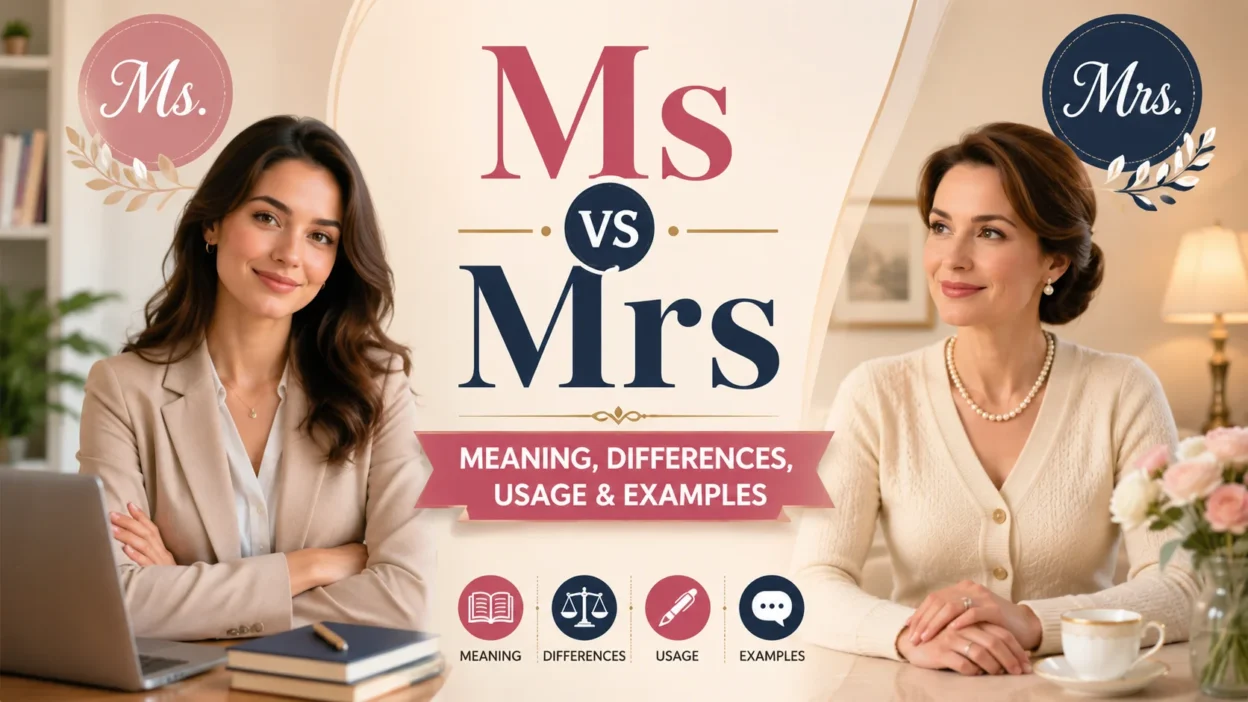
Knowing whether to use Ms or Mrs can be confusing, especially in emails, formal letters, workplace communication, and invitations. Both titles come before a woman’s name, but they do not communicate the same thing.
Ms is a neutral title that does not reveal whether a woman is married. Mrs traditionally identifies a married woman. However, modern English allows women to choose the title they prefer, so you should not assume someone’s title based only on marital status.
The difference becomes easy once you understand what each title means, where people commonly use it, and how personal preference affects the choice.
Ms vs Mrs: The Quick Difference
| Title | Meaning | Marital Status | Example |
|---|---|---|---|
| Ms | Neutral title for a woman | Not specified | Ms. Taylor |
| Mrs | Traditional title for a married woman | Traditionally married | Mrs. Taylor |
| Miss | Traditional title for an unmarried woman or girl | Traditionally unmarried | Miss Taylor |
The simplest rule is:
Ms does not specify marital status, while Mrs traditionally indicates that a woman is married.
What Does Ms Mean?
Ms is a title that you can place before a woman’s name without saying whether she is married.
For example:
- Ms. Sarah Johnson
- Ms. Emily Brown
- Ms. Taylor
- Ms. Wilson
The title works well when marital status has no relevance to the conversation.
Why Do People Use Ms?
Ms gives people a neutral way to address a woman. You do not need to know whether she is married before using it.
For example, if you are contacting a new client, you can write:
Dear Ms. Anderson,
This sounds professional without making assumptions about her personal life.
Ms is especially common in:
- Business emails
- Workplace communication
- Formal letters
- Applications
- School communication
- Official documents
What Does Mrs Mean?
Mrs traditionally refers to a married woman.
Examples include:
- Mrs. Sarah Johnson
- Mrs. Brown
- Mrs. Williams
- Mrs. Carter
Historically, Mrs often appeared with a married woman’s husband’s surname. Modern naming practices are more flexible, though, and a married woman may keep her surname, use her spouse’s surname, or use a hyphenated surname.
For that reason, you should not assume someone’s surname simply because she is married.
Ms vs Mrs in Real-World Situations
The best way to understand the difference is to look at situations where you might actually use these titles.
You Don’t Know Her Marital Status
Suppose you need to email Sarah Wilson for the first time.
A suitable greeting is:
Dear Ms. Wilson,
You do not need to know whether she is married.
You Know She Uses Mrs
If Sarah Wilson introduces herself as Mrs. Wilson, you can write:
Dear Mrs. Wilson,
Following someone’s preferred title is always a good approach.
She Is Married but Uses Ms
A married woman may prefer Ms.
In that case:
Ms. Wilson
is the correct title for her, even though she is married.
The Situation Is Informal
You may not need a title at all.
For example:
Hi Sarah,
In many workplaces and everyday situations, using someone’s first name is completely natural.
When Should You Use Ms?
Use Ms when you want a neutral title or when you do not know which title a woman prefers.
Common situations include:
- You do not know her marital status.
- You do not know her preferred title.
- You are writing a professional email.
- You are contacting a client for the first time.
- Marital status is irrelevant.
- The woman specifically prefers Ms.
Examples:
- Ms. Carter will lead the meeting.
- Please contact Ms. Davis for more information.
- I sent the documents to Ms. Wilson.
- Ms. Brown will review the application.
When Should You Use Mrs?
Use Mrs when a woman identifies herself with that title or you know that she prefers it.
Examples:
- Mrs. Carter will attend the event.
- Please speak with Mrs. Davis.
- We sent the invitation to Mrs. Wilson.
- Dear Mrs. Brown,
Being married alone does not tell you whether someone wants to use Mrs.
Ms vs Mrs in Professional Emails
Emails are one of the most common places where people hesitate between these titles.
If You Don’t Know Her Preference
Use:
Dear Ms. Johnson,
This gives you a neutral and professional form of address.
If She Uses Mrs
Use:
Dear Mrs. Johnson,
- If she signs her emails as Mrs. Johnson, following that choice makes sense.
If She Has Another Professional Title
- If the person uses a professional title such as Dr., use that title when appropriate.
For example:
Dear Dr. Johnson,
You do not need to replace a professional title with Ms or Mrs simply because you know the person’s marital status.
Ms vs Mrs vs Miss
Many people confuse these three titles.
| Title | Traditional Meaning | Marital Status |
|---|---|---|
| Ms | Neutral title for a woman | Not specified |
| Mrs | Title for a married woman | Married |
| Miss | Traditional title for an unmarried woman or girl | Unmarried |
These meanings describe traditional usage. Personal preferences can differ.
For example, an unmarried woman may prefer Ms instead of Miss, while a married woman may also choose Ms instead of Mrs.
Can a Married Woman Use Ms?
Yes.
This is an important point because many people incorrectly assume that Ms means unmarried.
It does not.
A married woman can use Ms for personal or professional reasons.
For example:
Ms. Sarah Williams
does not tell you whether Sarah Williams is married.
If Sarah prefers Ms, you should use Ms.
Does Mrs Mean She Changed Her Surname?
Not necessarily.
A woman can use Mrs while keeping her own surname.
Marriage does not automatically determine what surname someone uses. People make different choices depending on personal, family, cultural, and professional circumstances.
Therefore, do not guess a woman’s surname based on her marital status.
How Do You Pronounce Ms and Mrs?
The two titles have different pronunciations.
Ms
Ms is generally pronounced like miz.
Example:
Ms. Carter → miz Carter
Mrs
Mrs is generally pronounced like missus or missiz.
Example:
Mrs. Carter → missus Carter
Miss
Miss is pronounced like miss.
This distinction becomes useful when you hear these titles in conversation rather than see them written.
Ms vs Mrs: Common Examples
| Situation | Better Choice | Reason |
|---|---|---|
| You don’t know her marital status | Ms | Neutral |
| You don’t know her title preference | Ms | Avoids assumptions |
| She says she prefers Ms | Ms | Follows her preference |
| She introduces herself as Mrs | Mrs | Follows her preference |
| She has the title Dr. | Dr. | Use her professional title |
| Informal conversation | First name | A title may not be necessary |
Common Mistakes With Ms and Mrs
Mistake 1: Thinking Ms Means Single
This is incorrect.
Ms does not tell you whether a woman is married.
Mistake 2: Assuming Every Married Woman Uses Mrs
A married woman may prefer Ms.
Always follow her stated preference when you know it.
Mistake 3: Choosing Mrs Based on Age
You should not decide whether to use Mrs based on how old a woman appears.
Age does not determine someone’s preferred title.
Mistake 4: Assuming Marriage Changes a Woman’s Name
Marriage does not automatically mean that a woman changes her surname.
Use the name she provides.
Mistake 5: Confusing Ms With Miss
Ms and Miss have different traditional meanings.
Ms does not specify marital status.
Miss traditionally refers to an unmarried woman or girl.
An Easy Way to Remember Ms vs Mrs
Use this simple memory trick:
Ms = neutral
Mrs = traditionally married
If you do not know a woman’s preferred title, think of Ms as the neutral option.
Once you know her preference, use that title instead.
Ms vs Mrs in Formal Letters
Formal letters often use a title followed by the person’s surname.
For example:
Dear Ms. Anderson,
or:
Dear Mrs. Anderson,
Both can be correct. Your choice depends on the recipient’s preferred title.
If you do not know her preference, Ms often works as the neutral option.
Ms vs Mrs on Forms
Forms sometimes ask people to select a title.
Common choices include:
- Mr.
- Ms.
- Mrs.
- Miss
- Dr.
If a woman chooses Ms, you should not assume that she is unmarried.
If she chooses Mrs, she is indicating that she prefers that title.
The title belongs to the individual, so it is best to use the option she selects.
A Simple Decision Guide
When you need to choose between Ms and Mrs, follow these steps:
Do you know her preferred title?
If yes, use it.
Does she specifically use Mrs?
Use Mrs.
Does she specifically use Ms?
Use Ms.
You do not know her preference?
Ms is often a neutral professional choice.
Does she use a professional title such as Dr.?
Use the professional title when appropriate.
This approach helps you avoid unnecessary assumptions.
Frequently Asked Questions
What is the difference between Ms and Mrs?
Ms is a neutral title that does not specify marital status. Mrs traditionally refers to a married woman.
Can a married woman use Ms?
Yes. A married woman can use Ms if that is her preferred title.
Does Ms mean unmarried?
No. Ms does not indicate whether a woman is married or unmarried.
Should I use Ms if I don’t know whether a woman is married?
In many professional situations, yes. Ms gives you a neutral way to address her without making assumptions.
Is Mrs more formal than Ms?
Neither title is automatically more formal. Both can appear in formal communication. The correct choice depends on the person’s preference and the context.
What is the difference between Ms and Miss?
Ms does not specify marital status. Miss traditionally refers to an unmarried woman or girl.
How is Ms pronounced?
Ms is generally pronounced miz.
How is Mrs pronounced?
Mrs is generally pronounced missus or missiz.
Can a married woman use Mrs without changing her surname?
Yes. A woman’s title does not require her to change her surname.
What should I use in a business email?
If you know the recipient’s preferred title, use it. If you do not know her preference, Ms is often a neutral professional option.
Final Thoughts
The difference between Ms vs Mrs mainly concerns marital status and personal preference. Ms does not specify whether a woman is married, while Mrs traditionally identifies a married woman.
Modern English gives women the freedom to choose the title they prefer. A married woman may use Ms, Mrs, or another professional title such as Dr. That means you should avoid making assumptions based on marital status, age, or surname.
When you know someone’s preference, use it. When you do not know and need a formal title, Ms is often a practical neutral choice. This simple approach keeps your communication respectful, professional, and accurate.

Miles Ellington enjoys exploring the subtle differences that can completely change how a word or phrase is understood. At Differology, he turns confusing language questions into straightforward explanations, covering word comparisons, vocabulary, grammar, usage, and everyday English.
With a practical and reader-focused approach, Miles uses real-world examples and clear comparisons to help readers choose the right word, understand its meaning, and communicate more precisely.