
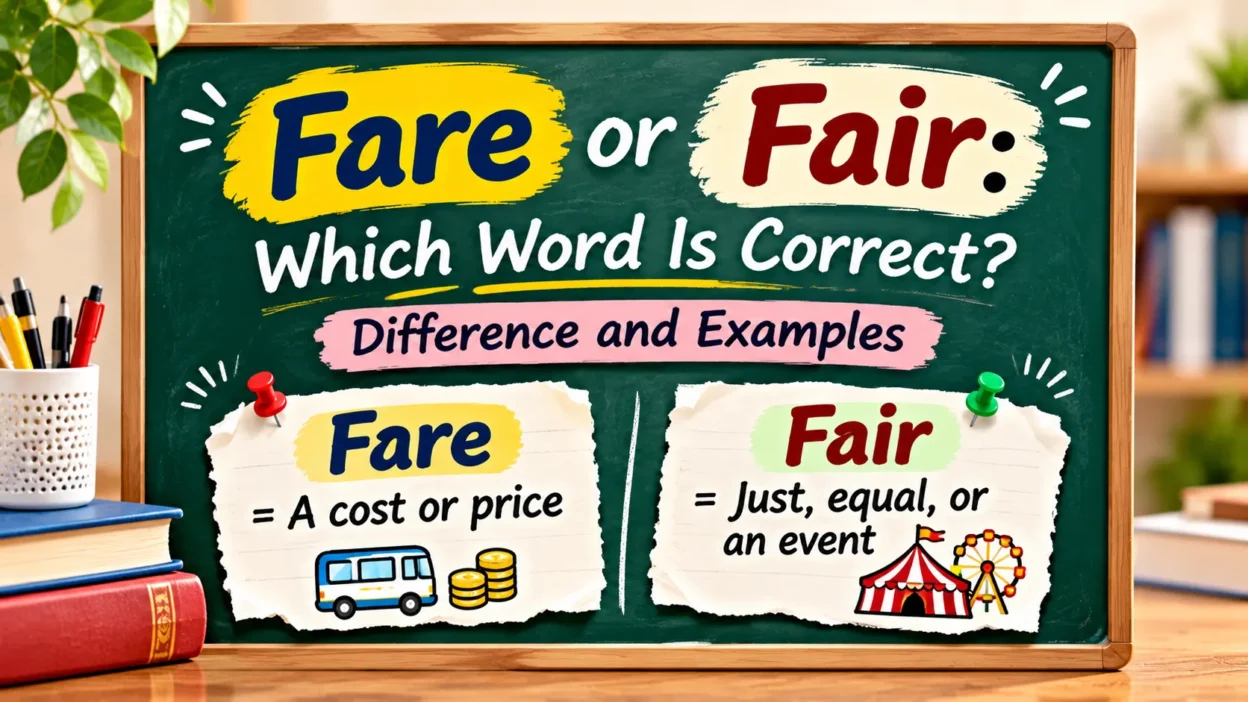
Have you ever wondered whether to write fare or fair? These two words sound exactly alike, but they have different meanings and uses. Choosing the correct spelling depends on what you want to communicate.
Fare is a noun that commonly refers to the price paid for transportation, such as a bus ticket, train journey, or taxi ride. It can also describe food provided or served, or function as a verb meaning to get along or perform in a particular situation.
Fair has several meanings. It can describe something just and reasonable, an event with rides and entertainment, or a light complexion or color. It can also refer to a public exhibition or marketplace.
For example, you might pay a bus fare to travel across town, while expecting a fair price for the journey. Both words are correct, but they cannot be used interchangeably.
In this guide, you will learn the difference between fare and fair, explore their meanings, understand common expressions, and discover practical examples that make choosing the correct spelling easy.
Fare vs. Fair: What Is the Difference?
The main difference between fare and fair is their meaning. Fare usually refers to a transportation price, food, or how someone performs in a situation. Fair generally describes something just, reasonable, or acceptable, but it also refers to an exhibition or public event.
| Word | Part of Speech | Meaning | Example |
|---|---|---|---|
| Fare | Noun | The price paid for transportation | The bus fare is $3. |
| Fare | Noun | Food or a type of cuisine | The restaurant serves traditional fare. |
| Fare | Verb | To perform or get along | How did you fare in the interview? |
| Fair | Adjective | Just, equal, or reasonable | Everyone deserves a fair opportunity. |
| Fair | Noun | A public event or exhibition | We visited the county fair. |
| Fair | Adjective | Light in color or complexion | She has fair hair. |
| Fair | Adverb | In a just or acceptable manner | The players competed fair and square. |
Quick examples
- Correct: The bus fare increased this year.
- Correct: Everyone deserves fair treatment.
- Correct: How did you fare in the competition?
- Correct: We visited the local fair.
- Incorrect: Everyone deserves fare treatment.
- Incorrect: The bus fair increased this year.
Quick answer: Use fare when discussing transportation costs, food, or performance. Use fair when describing justice, equality, reasonable treatment, or a public event.
What Does Fare Mean?
The word fare has several meanings, depending on the context. It is most commonly used as a noun referring to the money paid for transportation. It can also describe food or cuisine and function as a verb meaning to perform or experience a particular outcome.
1. Fare means transportation cost
When you pay money to travel by bus, train, taxi, airplane, or another form of transportation, that payment is called a fare.
Examples:
- The bus fare is $2.
- I paid the train fare online.
- The taxi fare was higher than expected.
- Children may receive discounted fares on public transportation.
- The airline increased its ticket fares.
- She checked the subway fare before leaving home.
- The passenger paid the correct fare.
- We need to calculate the total fare for the trip.
2. Fare means food or cuisine
Fare can also refer to the food served at a restaurant, event, or particular location. This usage often appears in descriptions of traditional, local, or seasonal food.
Examples:
- The restaurant serves traditional Italian fare.
- The festival offered delicious local fare.
- Guests enjoyed a variety of vegetarian fare.
- The hotel provides simple but satisfying breakfast fare.
- The market features fresh regional fare.
3. Fare means to perform or get along
As a verb, fare means to perform, succeed, or experience a particular situation.
Examples:
- How did you fare in your examination?
- She fared well during the interview.
- The team did not fare as expected in the tournament.
- Small businesses may struggle to fare well during difficult economic conditions.
- He wondered how his friends were faring after the move.
- The company fared better than its competitors.
This meaning is especially common in expressions such as fare well and fare poorly.
What Does Fair Mean?
The word fair has several common meanings. It can describe something just, equal, reasonable, or unbiased. It can also refer to a public event or exhibition and describe light-colored hair or skin.
1. Fair means just or reasonable
When something is fair, it treats people appropriately without unnecessary favoritism or discrimination.
Examples:
- Everyone deserves a fair chance.
- The teacher made a fair decision.
- We should offer fair wages to employees.
- The company follows a fair hiring process.
- Both teams received fair treatment.
- She believes the competition was fair.
- The judge listened to both sides before reaching a fair decision.
2. Fair means a public event or exhibition
A fair can be an event where people gather to enjoy entertainment, explore products, participate in activities, or display goods and services.
Examples:
- We attended the county fair last weekend.
- The school organized a science fair.
- The annual book fair attracted many visitors.
- Local businesses displayed their products at the trade fair.
- The children enjoyed the rides at the summer fair.
- The community hosted a craft fair.
3. Fair means light in color or complexion
The word fair can describe light-colored hair, skin, or other physical features.
Examples:
- She has fair hair and green eyes.
- The character was described as having a fair complexion.
- The painting showed a person with fair skin.
- He has fair-colored hair.
This meaning is more descriptive and may appear in literature or traditional descriptions.
4. Fair means reasonably good or acceptable
In some contexts, fair describes something that is neither excellent nor terrible but is reasonably satisfactory.
Examples:
- The weather was fair during our trip.
- She received a fair score on the examination.
- The restaurant received fair reviews.
- His performance was fair but could improve.
Fare or Fair: Example Sentences
The following examples show how the two words work in everyday English.
| Sentence | Correct Word | Explanation |
|---|---|---|
| The bus fare increased last month. | Fare | Refers to transportation cost. |
| Everyone deserves a fair chance. | Fair | Describes equal treatment. |
| How did you fare in the interview? | Fare | Means how someone performed. |
| We visited the county fair. | Fair | Refers to a public event. |
| The restaurant serves traditional fare. | Fare | Refers to food. |
| The teacher gave everyone a fair opportunity. | Fair | Means just and reasonable. |
| The taxi fare was expensive. | Fare | Refers to the cost of travel. |
| The team did not fare well. | Fare | Describes performance. |
| She has fair hair. | Fair | Describes a light color. |
| The school organized a science fair. | Fair | Refers to an exhibition. |
Fare vs. Fair: Pronunciation Difference
Although fare and fair have different spellings and meanings, they are pronounced exactly alike in standard English.
Both words are generally pronounced /fer/ in American English.
- Fare: /fer/
- Fair: /fer/
These words are examples of homophones. Homophones are words that sound the same but have different spellings and meanings.
Because pronunciation does not help you distinguish these words, the context of your sentence is the best way to choose the correct spelling.
Fare vs. Fair: Common Expressions
Both words appear in several common English expressions. Learning these phrases can make the difference easier to remember.
Common expressions with fare
| Expression | Meaning | Example |
|---|---|---|
| Bus fare | Money paid for a bus journey | The bus fare is affordable. |
| Train fare | Money paid for train transportation | I checked the train fare online. |
| Airfare | The cost of an airplane ticket | Airfare increased during the holiday season. |
| Taxi fare | Money paid for a taxi ride | The taxi fare was reasonable. |
| Fare well | Perform or get along successfully | I hope you fare well in your new job. |
| Fare poorly | Perform unsuccessfully | The company fared poorly last year. |
| Traditional fare | Traditional food | The restaurant serves traditional fare. |
| Local fare | Food associated with a particular region | Visitors enjoyed the local fare. |
Common expressions with fair
| Expression | Meaning | Example |
|---|---|---|
| Fair play | Honest and respectful behavior | Fair play matters in every competition. |
| Fair chance | An equal opportunity | Everyone deserves a fair chance. |
| Fair treatment | Just and unbiased treatment | Employees expect fair treatment. |
| Fair enough | Reasonable or acceptable | Fair enough, I understand your point. |
| Fair and square | Honestly and according to the rules | She won the competition fair and square. |
| County fair | A public community event | We attended the county fair. |
| Trade fair | An event where businesses display products | The company exhibited its products at a trade fair. |
| Science fair | An event showcasing science projects | Students presented their projects at the science fair. |
| Fair weather | Pleasant or relatively clear weather | We enjoyed fair weather during the picnic. |
| Fair share | A reasonable or appropriate portion | Everyone should contribute their fair share. |
Fare or Fair: Common Spelling Mistakes
Because these words are homophones, writers sometimes mix them up. Here are some common mistakes and their corrections.
Mistake 1: Writing fair instead of fare for transportation
Incorrect: The bus fair is $2.
Correct: The bus fare is $2.
Why? The sentence refers to the amount of money paid for transportation, so fare is correct.
Mistake 2: Writing fare instead of fair for equal treatment
Incorrect: Everyone deserves a fare opportunity.
Correct: Everyone deserves a fair opportunity.
Why? The sentence describes equality and reasonable treatment, so fair is the correct word.
Mistake 3: Confusing fair and fare in performance
Incorrect: How did you fair in the examination?
Correct: How did you fare in the examination?
Why? The verb fare means to perform or get along.
Mistake 4: Confusing fair with fare when discussing food
Incorrect: The restaurant offers traditional fair.
Correct: The restaurant offers traditional fare.
Why? In this context, fare refers to food or cuisine.
Mistake 5: Using fare instead of fair for an exhibition
Incorrect: We visited the school science fare.
Correct: We visited the school science fair.
Why? A science fair is an exhibition where students present their projects.
Fare or Fair: Easy Ways to Remember
If you regularly confuse these words, the following memory tricks can help.
Fare = Travel, Food, or Performance.
Think about bus fares, restaurant fare, and how someone fares in a competition.
Fair = Justice, Equality, or Events.
Think about fair treatment, a fair chance, and a county fair.
A simple memory trick
- You pay a fare to travel.
- You deserve a fair opportunity.
Another helpful trick is to remember the phrase fare well. If you are asking how someone performed or succeeded, use fare.
For example:
- I hope you fare well in your new position.
- Everyone deserves a fair opportunity in the workplace.
Fare vs. Fair in Everyday Conversation
You will encounter both words in conversations, emails, travel arrangements, shopping, and professional writing.
Everyday examples
- How much is the bus fare?
- That’s not a fair decision.
- I hope you fare well in your new job.
- We are going to the county fair.
- The restaurant serves delicious local fare.
- Everyone should receive fair treatment.
- The taxi fare was too expensive.
- She won the competition fair and square.
- How did your team fare in the tournament?
- The school is hosting a book fair next month.
These examples show that the correct spelling depends on the meaning of the sentence, not how the word sounds.
Fare vs. Fair in Business and Professional Writing
Both words are useful in professional communication, but they appear in different contexts.
In transportation and travel businesses, fare refers to the amount customers pay for a journey. In food and hospitality, it can describe meals or cuisine.
So In business communication, fair often describes reasonable pricing, equal opportunities, ethical treatment, and unbiased decisions.
Professional examples
- The airline announced changes to its ticket fares.
- The company follows a fair recruitment policy.
- The restaurant offers traditional regional fare.
- Employees should receive fair compensation.
- The travel agency compared different airfare options.
- The organization aims to provide fair opportunities to all applicants.
- The business performed well despite difficult market conditions.
- The company attended an international trade fair.
Frequently Asked Questions
1. Is it fare or fair?
Both words are correct, but they have different meanings. Fare refers to transportation costs, food, or how someone performs. Fair describes something just or reasonable, a public event, or a light color.
2. What does fare mean?
Fare is a noun referring to transportation costs or food. It can also be a verb meaning to perform or get along in a particular situation.
3. What does fair mean?
Fair can mean just, reasonable, unbiased, or acceptable. It can also refer to a public exhibition or event and describe light-colored hair or complexion.
4. Are fare and fair pronounced the same?
Yes. In standard American English, both words are pronounced /fer/. They are homophones because they sound alike but have different meanings and spellings.
5. Is it bus fare or bus fair?
The correct expression is bus fare because it refers to the money paid for a bus journey.
6. Is it fair chance or fare chance?
The correct phrase is fair chance. It means an equal or reasonable opportunity.
7. Is it county fare or county fair?
The correct phrase is county fair when referring to a public event featuring entertainment, exhibitions, food, and activities.
8. What does fare well mean?
Fare well means to perform or get along successfully in a particular situation. For example, “She hopes to fare well in her new job.”
9. What does fair and square mean?
Fair and square means doing something honestly, properly, and according to the rules. For example, “Our team won the match fair and square.”
10. What is the plural of fare?
The plural is fares. For example, “The airline changed its ticket fares.”
11. Can fair be used as a noun?
Yes. Fair can be a noun referring to a public event or exhibition. For example, “The annual book fair attracted many visitors.”
12. What is the difference between fare and airfare?
Fare is a general term for the price paid for transportation. Airfare specifically refers to the cost of traveling by airplane.
13. How do you use fair in a sentence?
Example: “The teacher made a fair decision after listening to both students.” Here, fair means just and reasonable.
Conclusion
The difference between fare and fair becomes easy once you understand their meanings. Fare refers to transportation costs, food, or how someone performs in a particular situation. Fair describes something just, equal, or reasonable, and it can also refer to a public event or exhibition.
Use fare when discussing a bus ticket, airline price, restaurant cuisine, or someone’s performance. Choose fair when talking about equal treatment, reasonable decisions, or community events.
Remember this simple rule: You pay a fare to travel, but you deserve fair treatment. Keeping this distinction in mind will help you use both words correctly in everyday and professional writing.

Miles Ellington enjoys exploring the subtle differences that can completely change how a word or phrase is understood. At Differology, he turns confusing language questions into straightforward explanations, covering word comparisons, vocabulary, grammar, usage, and everyday English.
With a practical and reader-focused approach, Miles uses real-world examples and clear comparisons to help readers choose the right word, understand its meaning, and communicate more precisely.