English contains many words that sound identical but have completely different meanings. These words can create confusion even for experienced writers, especially when their spellings differ by only one letter. Pail and pale are two such words. Although they are pronounced the same way, one refers to a container, while the other describes color, appearance, or a change in intensity.
Understanding the difference between pail and pale is useful for students, bloggers, content writers, and anyone who wants to communicate clearly in English. Choosing the wrong spelling can change the meaning of a sentence, making an otherwise well-written piece appear careless.
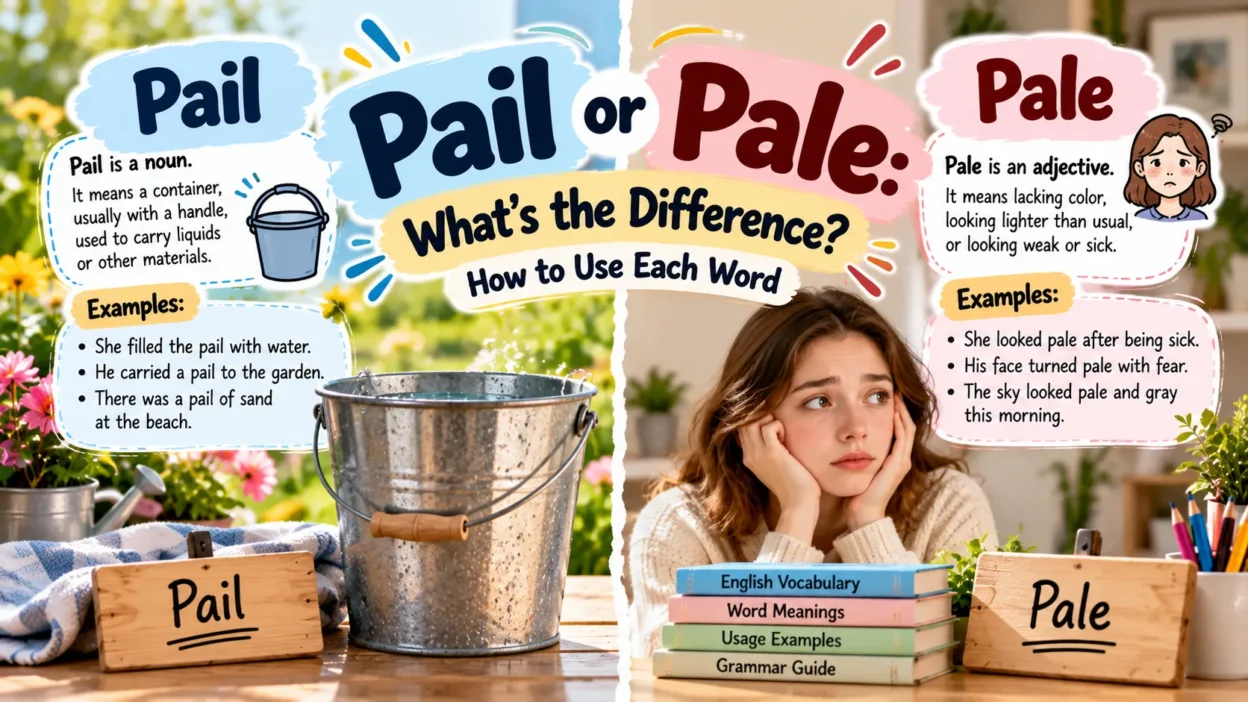
The distinction is straightforward once you understand the purpose of each word. A pail is a bucket used for carrying or holding something, whereas pale describes something that has a light color or appears less vivid than usual. The two words are not interchangeable, and the correct choice depends entirely on the context.
🪣 What Does Pail Mean in English?
A pail is a container, usually similar to a bucket, that people use to carry, collect, or store liquids and other materials. It commonly has an open top and a handle that makes lifting and transportation easier. Pails may be made from plastic, metal, or other durable materials, depending on their intended purpose.
The word is frequently used in everyday situations involving household chores, gardening, farming, construction, and outdoor activities. For example, someone might carry a pail of water to clean a floor, use one to collect vegetables from a garden, or fill one with sand at the beach.
Although pail and bucket are often used interchangeably, pail can sometimes refer to a particular kind of container. Its meaning remains connected to a physical object rather than a color, appearance, or quality.
Everyday Situations Where Pail Is Used
A pail is a practical object found in many environments. Its exact purpose depends on what it is designed to hold.
Household cleaning: People frequently use pails to carry water, cleaning solutions, and other supplies. A cleaning pail may be used when washing floors, cleaning outdoor surfaces, or performing other household tasks.
Example: “Mom filled a pail with warm water before cleaning the kitchen floor.”
Gardening and landscaping: Gardeners use pails to transport water, collect weeds, carry harvested vegetables, or gather small quantities of soil and compost.
Example: “The gardener carried a pail of fresh tomatoes into the house.”
Construction and maintenance: Pails can hold paint, plaster, sand, and other materials needed for building and repair work.
Example: “The painter placed the brush inside a pail after finishing the wall.”
Outdoor activities: Children and adults may use pails at beaches, parks, and campsites. A beach pail, for instance, is commonly used to collect shells or carry sand for building sandcastles.
Example: “The children filled their pails with wet sand near the water.”
Farming and animal care: On farms, pails can be used to carry animal feed, water, or collected milk, depending on the material and design of the container.
Example: “The farmer carried a pail of fresh milk to the storage area.”
These situations share one important feature: pail refers to a container used for holding or transporting something.
📝 Pail Examples in Different Sentences
Recognizing a word in context is one of the most effective ways to understand its meaning. The following examples show how pail works in everyday English.
- She carried a pail of water from the well.
- The gardener filled the pail with fresh soil.
- The children brought a pail and shovel to the beach.
- Please leave the empty pail beside the garden shed.
- He used a metal pail to collect rainwater.
- The farmer placed the pail beneath the equipment.
- We bought a new pail for washing the car.
- The painter kept the remaining paint in a sealed pail.
- The little boy dropped his pail while playing in the sand.
- She collected fallen apples in a large pail.
- The worker carried a pail of cement across the site.
- A pail of warm water stood beside the mop.
- The children took turns filling the pail at the tap.
- He washed the tools and returned them to the storage area beside the pail.
- The gardener used a small pail to gather weeds.
In every sentence, pail functions as a noun. It identifies a tangible object that can be filled, emptied, carried, or stored.
Useful Expressions With Pail
The word pail also appears in a few familiar expressions.
A pail of water: This expression refers to a container filled with water.
Example: “She brought a pail of water to the thirsty animals.”
A beach pail: This is a bucket used for playing in sand or collecting small objects at the beach.
Example: “The toddler carried a colorful beach pail along the shore.”
Kick the bucket: This is an informal idiom meaning to die. Although the expression contains the word bucket rather than pail, it is sometimes discussed alongside bucket-related vocabulary because of its literal image.
Example: “In the old comedy, the character joked that he would kick the bucket someday.”
The last expression should not be confused with the ordinary meaning of pail. Idioms often have meanings that cannot be understood by interpreting each word literally.
🎨 What Does Pale Mean in English?
The word pale has several related meanings. Most commonly, it describes a color that is light, soft, or lacking intensity. It can also describe someone’s complexion when their skin appears lighter than usual. In addition, pale can function as a verb meaning to become less vivid or less impressive.
Unlike pail, which identifies a physical object, pale usually describes a quality or condition.
For example, pale blue refers to a light shade of blue, while pale skin describes a complexion that appears light or less colorful than usual. The word can also describe weak light, faded colors, or something that seems less significant when compared with something else.
The exact meaning depends on how the word is used in a sentence.
Pale as a Description of Color
One of the most common uses of pale is to describe light colors. Pale colors generally have a soft or washed-out appearance rather than a deep, saturated one.
Examples include pale pink, pale yellow, pale green, and pale blue. These shades are common in interior design, fashion, painting, photography, and graphic design.
Consider the following sentences:
- The bedroom walls were painted a pale shade of blue.
- She wore a pale pink dress to the afternoon event.
- Pale green curtains complemented the wooden furniture.
- The artist mixed white paint with blue to create a pale color.
- A pale yellow glow spread across the evening sky.
In these examples, pale helps readers visualize the appearance of an object or scene.
Pale as a Description of Someone’s Appearance
The word can also describe a person’s complexion when it appears unusually light. This may happen because of fear, fatigue, illness, cold temperatures, or other circumstances.
Examples:
- His face looked pale after the long journey.
- She became pale when she heard the unexpected news.
- The child appeared pale and tired after playing outside.
- He noticed that his hands looked pale in the cold weather.
- Her pale complexion contrasted with her dark hair.
In these sentences, pale describes appearance. It does not name an object or a container.
The word should be used thoughtfully when describing people, since a pale appearance can have many causes and does not, by itself, establish anything about a person’s health.
Pale as a Verb
Although pale is often used as an adjective, it can also function as a verb. As a verb, it may mean to become less bright, less vivid, or less impressive.
For example, the sentence “The colors paled in the afternoon sunlight” means that the colors became less vivid.
Another common expression is pale in comparison. This phrase means that something appears less important, impressive, or significant when compared with something else.
Examples:
- His earlier achievements paled in comparison with his latest success.
- The excitement paled after the disappointing announcement.
- The beauty of the smaller garden paled beside the grand estate.
- The initial problem paled in comparison with the challenges that followed.
Here, pale does not describe a bucket or a person’s skin. It expresses a reduction in strength, impact, or significance.
🔍 Pail vs. Pale: A Detailed Comparison
Although the words share the same pronunciation, their grammatical roles and meanings are distinct. Comparing them side by side makes the difference easier to remember.
| Feature | Pail | Pale |
|---|---|---|
| Meaning | A bucket or similar container | Light in color, less vivid, or less intense |
| Part of speech | Noun | Usually an adjective; also a verb |
| Refers to | A physical object | Color, appearance, or degree |
| Typical context | Cleaning, gardening, farming, construction | Fashion, art, appearance, descriptions, comparisons |
| Example | He carried a pail of water. | The walls were pale yellow. |
| Related word | Bucket | Paleness |
| Common expression | A pail of water | Pale in comparison |
The simplest way to distinguish the words is to ask whether the sentence names an object or describes a quality.
If the sentence refers to something that can hold water, sand, or paint, pail is likely correct. If it describes a color, complexion, light, or degree of importance, pale is usually the right choice.
💡 How to Remember the Difference Between Pail and Pale
A simple memory trick can help you avoid confusing these words when writing quickly.
Pail = a container. Imagine a bucket filled with water. Whenever you need a word for that object, remember the spelling pail.
Pale = a light color. Imagine pale blue paint or a pale pink flower. Whenever you are describing something light or faded in appearance, remember the spelling pale.
You can also use a substitution test. Replace the word with a clearer alternative and see whether the sentence still makes sense.
For example:
“The gardener filled the pail with water.”
Replace pail with bucket: “The gardener filled the bucket with water.” The meaning remains the same, so pail is appropriate.
Now consider:
“The walls were painted pale green.”
Replace pale with light: “The walls were painted light green.” The basic meaning remains intact, confirming that pale is correct.
This method is especially useful when proofreading articles, school assignments, business documents, and website content.
⚠️ Common Mistakes People Make With Pail and Pale
Even though the distinction is simple, these words can be confused because their pronunciation does not reveal their spelling. Since both words are legitimate English vocabulary, an automatic spelling checker may not identify an incorrect choice.
Using Pale When You Mean a Bucket
Incorrect: “She carried a pale of water into the garden.”
Correct: “She carried a pail of water into the garden.”
The sentence refers to a container, so pail is required.
Using Pail to Describe a Color
Incorrect: “The designer selected pail blue curtains.”
Correct: “The designer selected pale blue curtains.”
The sentence describes a light shade of blue, making pale the correct choice.
Confusing Pale With Paleness
Pale is commonly used as an adjective, while paleness is the noun describing the condition or quality of being pale.
Example: “The paleness of the paint made the room appear brighter.”
Both words are related, but they serve different grammatical purposes.
Assuming Spell-Checkers Will Catch Every Error
A spelling checker may accept pail in a sentence where pale is intended because pail is not misspelled. The problem is contextual rather than mechanical.
For accurate proofreading, check both spelling and meaning. Read the entire sentence and ask whether the word fits the situation being described.
📚 Pail and Pale in Everyday Writing
Understanding these words is particularly useful when writing descriptions, instructions, stories, and informational articles.
In household instructions, pail may appear when describing how to carry water, mix cleaning solutions, or transport supplies.
Example: “Fill a pail with warm water before beginning the cleaning process.”
In descriptive writing, pale can help establish a visual image or mood.
Example: “Pale sunlight streamed through the curtains, illuminating the quiet room.”
In creative writing, the words can even appear in the same passage while performing completely different roles.
Example: “She carried a pail of water into the garden, where pale flowers swayed in the morning breeze.”
Here, pail identifies the container, while pale describes the flowers. Their meanings remain distinct even though they appear in the same sentence.
Writers who understand this difference can create clearer descriptions and avoid unnecessary spelling errors.
📝 Practice: Choose the Correct Word
Test your understanding by choosing either pail or pale for each blank.
- The gardener filled the _____ with fresh soil.
- She wore a _____ blue scarf to the party.
- The child carried a _____ of water to the chickens.
- His face became _____ when he heard the frightening news.
- The artist used _____ pink paint for the background.
- Please leave the empty _____ near the garden shed.
- The flowers had _____ yellow petals.
- The worker carried a _____ filled with paint.
- The evening sky turned a _____ shade of orange.
- Her earlier performance paled in comparison with her final performance.
Answers and explanations
- Pail — It refers to a container holding soil.
- Pale — It describes a light shade of blue.
- Pail — It is a bucket used to carry water.
- Pale — It describes the person’s appearance.
- Pale — It describes the color of the paint.
- Pail — It refers to an empty container.
- Pale — It describes the flowers’ light color.
- Pail — It identifies the container used for paint.
- Pale — It describes the light shade of orange.
- Paled — This is the past-tense form of the verb pale, meaning the earlier performance seemed less impressive by comparison.
The exercise demonstrates that the right spelling depends on the meaning and grammatical role of the word.
❓ Frequently Asked Questions
What is the difference between pail and pale?
A pail is a bucket used for holding or carrying liquids and other materials. Pale describes a light color, a person’s unusually light appearance, or something that becomes less vivid or impressive.
Are pail and pale homophones?
Yes. Pail and pale are homophones because they have the same pronunciation but different spellings and meanings.
Is a pail the same as a bucket?
In everyday English, pail and bucket often refer to the same type of container. Both can be used to carry water, paint, sand, or other materials.
What does pale mean in simple words?
Pale means light in color or less vivid than usual. For example, pale pink is a soft, light shade of pink.
Can pale be used as a verb?
Yes. Pale can mean to become less vivid, intense, or impressive. For example, “The earlier achievement paled in comparison with the new discovery.”
What is the noun form of pale?
The noun form is paleness, which describes the quality or condition of being pale.
Example: “The paleness of the walls gave the room a calm appearance.”
Which word should I use when talking about water?
Use pail when you mean a container holding water.
Example: “He carried a pail of water to the garden.”
Why do people confuse pail and pale?
They are pronounced identically in many English accents. Because the words sound the same, writers must rely on their meanings and context to choose the correct spelling.
Can pail and pale appear in the same sentence?
Yes. They can be used together when a sentence describes both a container and a color.
Example: “She placed the pail beside the pale yellow wall.”
Is pale always related to color?
No. Although pale commonly describes color or complexion, it can also function as a verb and appear in the expression pale in comparison, meaning that something seems less significant beside something else.
Conclusion
The difference between pail and pale is simple once you understand how each word is used. Pail is a noun that refers to a bucket or similar container, while pale usually describes a light color, a person’s appearance, or something that seems less vivid or impressive.
Although their identical pronunciation makes them easy to confuse, their meanings are clearly different. A pail can hold water, sand, or paint, whereas pale can describe a blue sky, a pink flower, or a person’s complexion.
Whenever you are unsure which spelling to choose, consider the sentence’s meaning. If you are naming a container, use pail. If you are describing color, appearance, or intensity, use pale. This simple distinction will help you write more accurately and confidently.

Miles Ellington enjoys exploring the subtle differences that can completely change how a word or phrase is understood. At Differology, he turns confusing language questions into straightforward explanations, covering word comparisons, vocabulary, grammar, usage, and everyday English.
With a practical and reader-focused approach, Miles uses real-world examples and clear comparisons to help readers choose the right word, understand its meaning, and communicate more precisely.