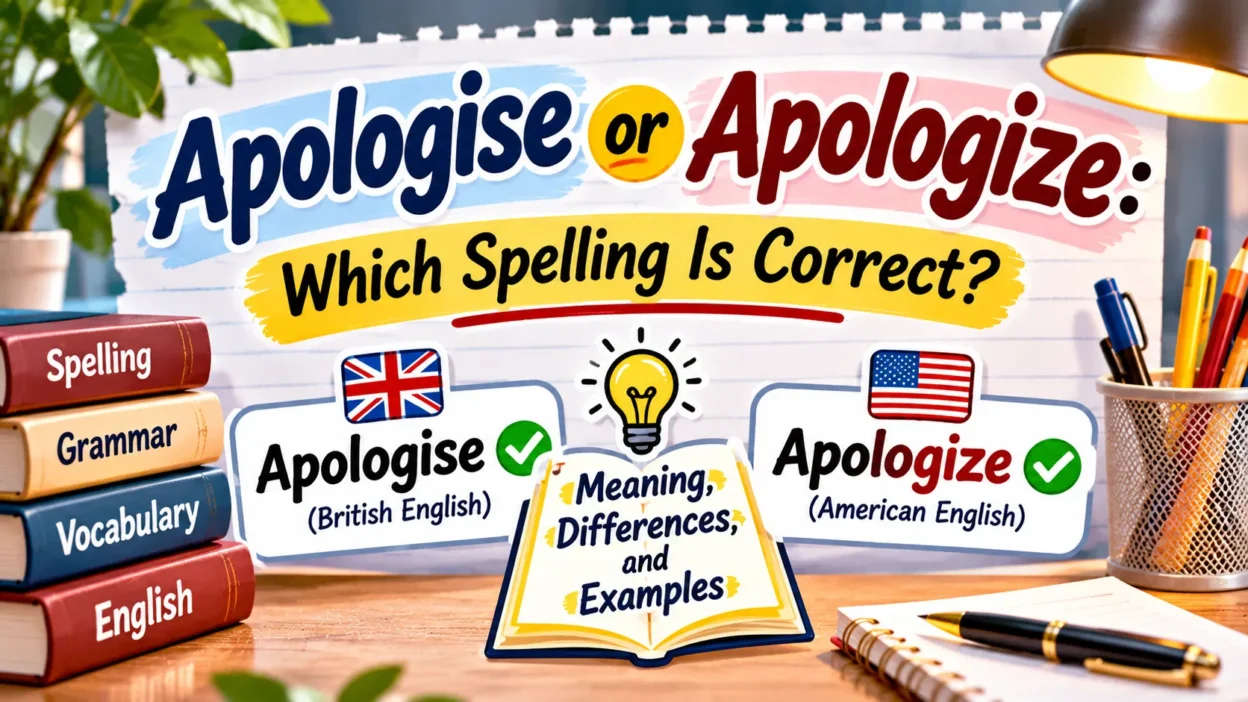
Apologise or apologize—which spelling should you use when writing an apology? Both words are correct, and they have exactly the same meaning. The difference comes down to regional spelling preferences. Apologize is the standard spelling in American English, while apologise is commonly used in British English and other varieties of English. If you write for an American audience, choose apologize to match US spelling conventions.
Although these two spellings look different, they share the same pronunciation, meaning, and grammatical function. Both are verbs that describe admitting a mistake, expressing regret, or saying sorry for something you have done. You might apologize to a friend for arriving late, apologize to a customer for a problem, or apologize to a coworker for a misunderstanding. Understanding the difference helps you choose the right spelling for your readers. In this guide, we’ll explain the meanings, spelling rules, examples, and related word forms so you can use apologise and apologize confidently.
📖 Apologise or Apologize: Which Spelling Is Correct?
Both apologise and apologize are correct English spellings. The main difference is the variety of English in which writers commonly use them.
- Apologize: American English spelling.
- Apologise: British English spelling.
If your readers are primarily in the United States, use apologize. American dictionaries and style guides generally prefer the spelling with a z.
British English commonly uses apologise, although the spelling apologize is also accepted in some British dictionaries and publications. The choice depends on the preferred spelling style.
| Spelling | English Variety | Example |
|---|---|---|
| Apologize | American English | I apologize for the mistake. |
| Apologise | British English | I apologise for the mistake. |
Both sentences communicate the same message. Neither spelling is universally wrong.
🇺🇸 What Does Apologize Mean in American English?
Apologize is a verb that means to express regret or say sorry for something you have done or something that has caused inconvenience or hurt.
In American English, apologize is the preferred spelling. People use it in everyday conversations, professional emails, customer service messages, and formal writing.
For example, you might apologize when you arrive late, make a mistake, forget an important appointment, or hurt someone’s feelings.
Examples of apologize in sentences:
- I apologize for being late to the meeting.
- She decided to apologize for her rude comment.
- You should apologize if your words hurt someone.
- The company issued a statement to apologize for the inconvenience.
- He called his friend to apologize for the misunderstanding.
- I sincerely apologize for the confusion.
- We apologize for the delay in responding.
- The teacher asked the student to apologize.
- I want to apologize for my behavior yesterday.
- They publicly apologized for the mistake.
In the United States, apologize is the spelling you should use when following standard American English conventions.
🇬🇧 What Does Apologise Mean in British English?
Apologise is the British English spelling of the same verb. It means to express regret, admit a mistake, or say sorry.
The meaning and pronunciation do not change when you replace the z with an s. Only the spelling preference differs.
British writers commonly use apologise in personal messages, business communication, school assignments, and formal documents.
Examples of apologise in sentences:
- I apologise for arriving late.
- She wanted to apologise to her neighbor.
- We apologise for any inconvenience caused.
- He decided to apologise for his behavior.
- They should apologise for the misunderstanding.
- I sincerely apologise for the mistake.
- The manager asked the employee to apologise.
- Please accept my apology, and I apologise for the delay.
- She called to apologise for forgetting the appointment.
- The company issued a statement to apologise to its customers.
These sentences have the same meanings as their American English versions. The spelling simply follows British conventions.
🔍 Why Do Apologize and Apologise Have Different Spellings?
The difference between apologize and apologise comes from regional spelling conventions that developed over time.
American English generally favors -ize endings in words such as organize, recognize, and realize. British English commonly uses -ise in those same words, although both forms may be accepted depending on the dictionary and publication style.
The verb apologize comes from the Greek word apologizesthai, meaning to speak in defense. Its spelling developed through Latin and French influences before entering English.
Over time, different English-speaking regions developed their own preferences. American dictionaries commonly standardized the -ize spelling, while many British publications adopted the -ise form.
Here are some other examples of the same spelling difference:
| American English | British English |
|---|---|
| Apologize | Apologise |
| Organize | Organise |
| Recognize | Recognise |
| Realize | Realise |
| Analyze | Analyse |
| Criticize | Criticise |
| Specialize | Specialise |
| Memorize | Memorise |
| Customize | Customise |
| Categorize | Categorise |
Remember that British English does not reject every -ize spelling. Some British dictionaries accept both forms, so consistency with your chosen style guide matters.
✍️ Apologize vs. Apologise: Meaning and Pronunciation
The words apologize and apologise have identical meanings and pronunciations. You say them the same way, regardless of which spelling you choose.
Pronunciation: uh-POL-uh-jize
Both spellings function as verbs. They describe expressing regret or admitting that an action was wrong.
Consider these examples:
- American English: I apologize for the inconvenience.
- British English: I apologise for the inconvenience.
- American English: They apologized for the delay.
- British English: They apologised for the delay.
The only difference appears in the written form. You do not need to change your pronunciation when switching between American and British spelling.
📝 Apologize or Apologise in Different Tenses
Both spellings follow the same grammatical patterns. The only difference is the use of z or s in the verb.
Here are the common forms:
| Verb Form | American English | British English |
|---|---|---|
| Base form | Apologize | Apologise |
| Third-person singular | Apologizes | Apologises |
| Past tense | Apologized | Apologised |
| Present participle | Apologizing | Apologising |
| Past participle | Apologized | Apologised |
Examples in different tenses:
- Present: I apologize for the mistake.
- Present: She apologizes whenever she is wrong.
- Past: He apologized to his teacher.
- Future: I will apologize tomorrow.
- Present continuous: They are apologizing for the delay.
- Present perfect: She has apologized several times.
- Past perfect: He had apologized before the meeting began.
These grammatical forms work in both varieties of English. Simply maintain the spelling style you have selected.
💬 When Should You Use Apologize?
Use apologize when writing in American English. It is the preferred spelling for US readers and follows common American spelling conventions.
You should choose this form for:
- American blog articles
- US school assignments
- Professional emails in the United States
- Business reports
- Customer service messages
- American social media posts
- Website content targeting US readers
- American English grammar exercises
Examples:
- I apologize for the late response.
- We apologize for any inconvenience.
- She wants to apologize to her parents.
- The company apologized to its customers.
- Please accept my apology for the confusion.
If you are creating content for an American audience, use apologize, apologizes, apologized, and apologizing consistently.
🌍 When Should You Use Apologise?
Use apologise when following a British English spelling style that prefers -ise endings.
This spelling is common in British publications and is also used in several other English-speaking regions that follow British spelling conventions.
You may use apologise in:
- British English articles
- UK school assignments
- British business communication
- Publications following an -ise spelling style
- Personal letters written in British English
- Websites targeting readers who prefer British spelling
Examples:
- I apologise for the misunderstanding.
- She apologised to her colleague.
- We apologise for the inconvenience.
- He is apologising for his behavior.
- They will apologise after the meeting.
The word is not less correct than apologize. It simply follows a different regional spelling preference.
⚠️ Common Mistakes to Avoid When Using Apologize or Apologise
Although both spellings are correct, writers sometimes make mistakes when choosing between them or using their different grammatical forms.
Here are some common errors to avoid:
- Mixing spelling styles: Avoid using apologize in one paragraph and apologise in another unless you are discussing the spelling difference.
- Using the wrong tense: Use apologized for the American past tense and apologised for the British past tense.
- Confusing the verb and noun: Apologize is a verb, while apology is a noun.
- Forgetting the -ing form: Use apologizing in American English and apologising in British English.
- Assuming one spelling is incorrect: Both forms are accepted English spellings.
- Using British spelling for a US-focused article: Choose apologize when writing for an American audience.
Consistency is especially important in professional writing. Pick one English variety and follow its spelling conventions throughout your article.
📚 Apologize, Apology, and Apologetic: What’s the Difference?
These words belong to the same word family, but they serve different grammatical purposes.
| Word | Part of Speech | Meaning |
|---|---|---|
| Apologize | Verb | To express regret or say sorry |
| Apology | Noun | An expression of regret |
| Apologetic | Adjective | Feeling or showing regret |
| Apologetically | Adverb | In a way that shows regret |
Examples:
- Apologize: I need to apologize for my mistake.
- Apology: She offered a sincere apology.
- Apologetic: He looked apologetic after the argument.
- Apologetically: She smiled apologetically.
These words are useful in everyday conversations and formal writing. Understanding their differences helps you communicate more clearly.
🗣️ How to Use Apologize in Everyday Conversations
People use apologize in many situations, from casual conversations to professional communication. A sincere apology can help acknowledge mistakes, show respect, and improve relationships.
Here are some natural ways to use the word:
For being late:
- I apologize for being late.
- Sorry I’m late. I should have called ahead.
For making a mistake:
- I apologize for the error in my report.
- I made a mistake, and I want to apologize.
hurting someone’s feelings:
- I apologize if my words upset you.
- I didn’t mean to hurt you, and I’m sorry.
For professional communication:
- We apologize for the inconvenience.
- I sincerely apologize for the delayed response.
For misunderstandings:
- I apologize for the confusion.
- Let me apologize for the misunderstanding.
A good apology should be sincere and specific. Simply saying the word does not always resolve a problem; acknowledging what happened and taking responsibility can make the message more meaningful.
🇺🇸 American English vs. British English: More Examples
The difference between apologize and apologise is part of a wider pattern in English spelling. Many words have different regional forms, even though their meanings remain the same.
Here are some useful examples:
| American English | British English |
|---|---|
| Apologize | Apologise |
| Color | Colour |
| Favorite | Favourite |
| Center | Centre |
| Theater | Theatre |
| Traveling | Travelling |
| Gray | Grey |
| Organize | Organise |
| Realize | Realise |
| Defense | Defence |
| License (noun) | Licence (noun) |
| Check | Cheque (banking context) |
If you write for American readers, use the American forms consistently. This creates a natural reading experience and keeps your content aligned with US spelling conventions.
❓ Frequently Asked Questions About Apologise or Apologize
These frequently asked questions explain the spelling, meaning, pronunciation, and correct usage of apologize and apologise.
Is it apologize or apologise in American English?
Apologize is the standard American English spelling. If you are writing for readers in the United States, use apologize rather than apologise.
Is apologise wrong?
No. Apologise is a correct spelling commonly used in British English. It has the same meaning and pronunciation as apologize.
Is apologize British or American?
Apologize is standard in American English. However, some British dictionaries and publications also accept it as an alternative spelling.
Do apologize and apologise mean the same thing?
Yes. Both words mean to express regret, admit a mistake, or say sorry. Their only difference is regional spelling preference.
How do you spell apologize in the USA?
In the United States, the correct standard spelling is apologize, with a z.
How do you spell apologize in the UK?
In British English, apologise, with an s, is commonly preferred. However, apologize is also accepted by some British dictionaries and style guides.
Is it apologized or apologised?
Both spellings are correct. Use apologized in American English and apologised in British English.
Is it apologizing or apologising?
Apologizing is the American English form, while apologising is the common British English form.
What is the noun form of apologize?
The noun form is apology. For example: “She offered a sincere apology for her mistake.”
What is the past tense of apologize?
The American English past tense is apologized. In British English, writers commonly use apologised.
How do you pronounce apologize?
Both apologize and apologise are pronounced the same way: uh-POL-uh-jize.
Which spelling should I use for a US-based website?
Use apologize if your website targets an American audience. Keep related forms such as apologizes, apologized, and apologizing consistent with American English.
✅ Conclusion: Apologise or Apologize?
Both apologise and apologize are correct spellings, and they carry exactly the same meaning. The difference comes from regional English conventions. British English commonly favors apologise, while American English prefers apologize. Neither spelling is universally wrong.
If you are writing for readers in the United States, choose apologize and use its related forms consistently. Remember the simple rule: Apologize is American English; apologise is commonly British English. Once you understand this regional difference, choosing the correct spelling becomes easy.

Miles Ellington enjoys exploring the subtle differences that can completely change how a word or phrase is understood. At Differology, he turns confusing language questions into straightforward explanations, covering word comparisons, vocabulary, grammar, usage, and everyday English.
With a practical and reader-focused approach, Miles uses real-world examples and clear comparisons to help readers choose the right word, understand its meaning, and communicate more precisely.