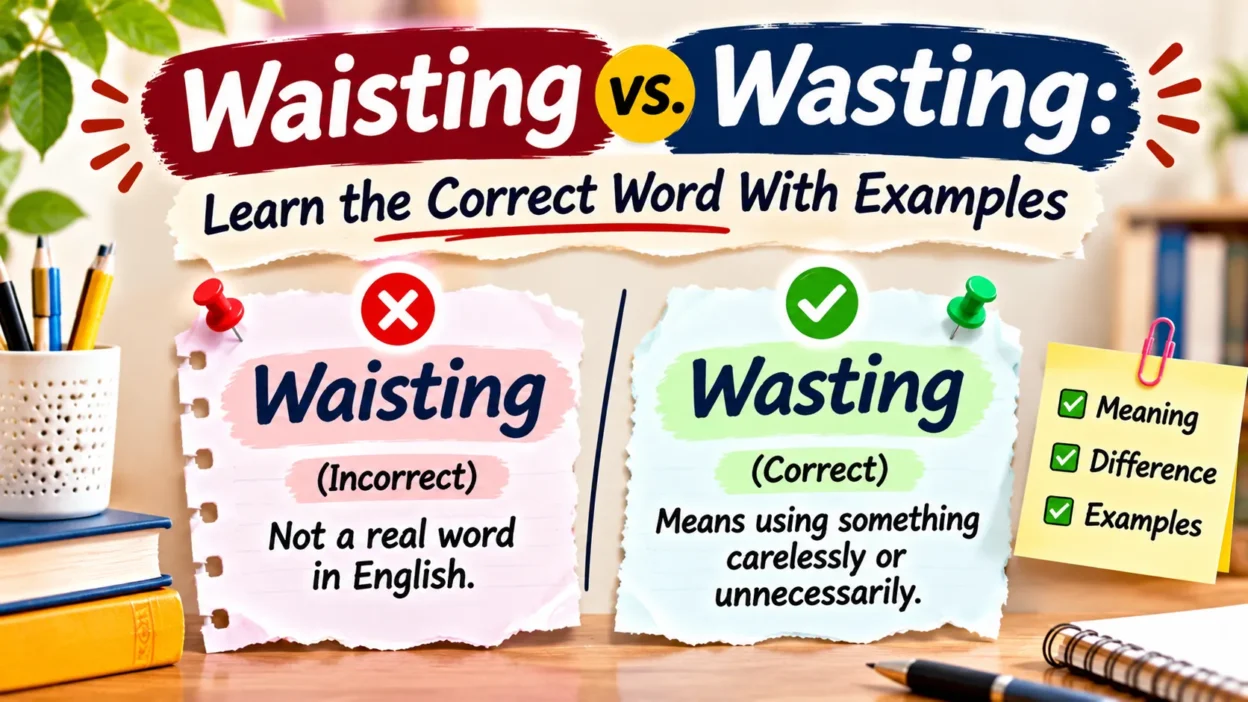
Have you ever wondered whether to write waisting or wasting? These two words look almost identical, but they have different meanings and grammatical uses. Choosing the correct spelling depends on whether you are talking about a person’s waist or the act of using something carelessly or unnecessarily.
Wasting is the correct and commonly used word when referring to spending time, money, energy, or resources without good results. It comes from the verb waste. For example, “Stop wasting your time on unimportant things.”
Waisting is a much less common word derived from waist. It can describe shaping or making something narrower around the waist, particularly in clothing or tailoring contexts.
Although both spellings are possible, wasting is the word you will need in most everyday sentences. In this guide, you will learn their meanings, grammatical differences, examples, common mistakes, and an easy way to remember which spelling to use.
Waisting vs. Wasting: What Is the Difference?
The main difference between waisting and wasting is their root word and meaning. Wasting comes from waste and means using something unnecessarily or allowing it to be lost. Waisting comes from waist and relates to the waist area of the body or the shaping of clothing around it.
| Word | Root Word | Meaning | Example |
|---|---|---|---|
| Wasting | Waste | Using something carelessly or unnecessarily | He is wasting his money. |
| Waisting | Waist | Shaping or narrowing something around the waist | The tailor is waisting the garment. |
Quick examples
- Correct: You are wasting your valuable time.
- Correct in a tailoring context: The designer is waisting the dress.
- Incorrect: Stop waisting your time.
- Incorrect for the intended meaning: She is wasting the dress around the waist.
Quick answer: Use wasting when talking about losing or misusing time, money, energy, or resources. Use waisting only when referring to a specific action involving the waist, usually in clothing or tailoring.
What Does Wasting Mean?
Wasting is the present participle and gerund form of the verb waste. It means using something carelessly, unnecessarily, or inefficiently, often without receiving any useful benefit.
The word is commonly used when talking about time, money, food, energy, opportunities, and natural resources.
1. Wasting means using time unnecessarily
When someone spends time on activities that do not provide value or achieve a useful purpose, the word wasting is appropriate.
Examples:
- Stop wasting your time on unnecessary arguments.
- She is wasting valuable hours watching random videos.
- We should avoid wasting time during important meetings.
- He regrets wasting so many years on an unproductive routine.
- They are wasting time instead of completing the assignment.
2. Wasting means spending money carelessly
The word can also describe spending money without careful thought or a worthwhile purpose.
Examples:
- He is wasting money on things he does not need.
- Stop wasting your savings on unnecessary purchases.
- The company is wasting money on ineffective advertising.
- She dislikes wasting money on expensive products.
- We should avoid wasting our budget on unnecessary expenses.
3. Wasting means using resources inefficiently
Wasting can describe the unnecessary use of food, water, electricity, fuel, and other resources.
Examples:
- Leaving the lights on is wasting electricity.
- We should stop wasting clean drinking water.
- Throwing away edible food means wasting valuable resources.
- The factory is wasting too much raw material.
- Avoid wasting fuel by planning your journey.
4. Wasting means losing an opportunity
The word can also describe failing to use an opportunity effectively.
Examples:
- He is wasting a great opportunity.
- Do not keep wasting your potential.
- She felt that she was wasting her talent.
- The team wasted several chances to score.
- They regretted wasting an excellent business opportunity.
What Does Waisting Mean?
Waisting is a less common word formed from the noun waist. It relates to shaping, narrowing, or giving something a particular waist shape.
It is most likely to appear in clothing design, tailoring, garment construction, or specialized descriptions of body shape and structure.
1. Waisting in clothing and tailoring
In clothing construction, waisting can refer to shaping a garment around the waist to create a narrower or more fitted appearance.
Examples:
- The designer is waisting the dress to create a fitted silhouette.
- The tailor adjusted the waisting of the jacket.
- The garment requires additional waisting for a closer fit.
- The designer considered the waisting before completing the dress.
The exact wording may vary in professional tailoring. Expressions such as shaping the waist, taking in the waist, or waist shaping are often clearer in everyday writing.
2. Waisting as a description of shape
The word may also appear in specialized descriptions of structures or garments that become narrower around a central waist-like area.
Examples:
- The design features a narrow waisting section.
- The structure has a noticeable waist-like shape.
- The garment’s waisting creates a more defined silhouette.
Important: Waisting is not the standard spelling for wasting time, money, food, or energy. If that is your intended meaning, always use wasting.
Waisting or Wasting: Example Sentences
The following examples show how both words can be used correctly.
| Sentence | Correct Word | Explanation |
|---|---|---|
| She is wasting her time. | Wasting | Means using time unnecessarily. |
| Stop wasting your money. | Wasting | Refers to careless spending. |
| The company is wasting resources. | Wasting | Describes inefficient resource use. |
| He is wasting a valuable opportunity. | Wasting | Means failing to use an opportunity effectively. |
| The tailor is waisting the garment. | Waisting | Refers to shaping around the waist. |
| The dress needs additional waist shaping. | Waisting-related concept | Describes garment construction. |
| We are wasting too much food. | Wasting | Means using or discarding food unnecessarily. |
| The designer adjusted the waisting of the dress. | Waisting | Refers to a garment’s waist shape. |
Waisting vs. Wasting: Pronunciation Difference
The words waisting and wasting are pronounced differently in standard English.
- Wasting: /ˈweɪstɪŋ/ — sounds like “WAY-sting.”
- Waisting: /ˈweɪstɪŋ/ — also commonly pronounced “WAY-sting.”
Although their spellings and meanings differ, these words are generally homophones because they have the same pronunciation.
This makes context especially important when deciding which spelling to use.
Waisting vs. Wasting: Grammar and Word Forms
Understanding the root words can help you recognize their related forms.
| Word | Related Form | Meaning | Example |
|---|---|---|---|
| Waste | Base verb or noun | To use carelessly; unwanted material | Do not waste food. |
| Wastes | Present-tense verb or plural noun | Uses unnecessarily; unwanted materials | He wastes money. |
| Wasted | Past-tense verb or adjective | Used unnecessarily or lost | She wasted an opportunity. |
| Wasting | Present participle or gerund | The act of using something unnecessarily | They are wasting time. |
| Waist | Noun | The middle part of the body | The dress fits around the waist. |
| Waists | Plural noun | More than one waist | The garments have fitted waists. |
| Waistband | Noun | A band around the waist of clothing | The waistband feels tight. |
| Waisting | Specialized derived form | Shaping around the waist | The designer adjusted the waisting. |
Notice that wasting comes from waste, while waisting comes from waist. Remembering the root word is one of the easiest ways to avoid confusion.
Common Expressions With Wasting
The word wasting appears in many everyday expressions.
| Expression | Meaning | Example |
|---|---|---|
| Wasting time | Spending time without useful results | Stop wasting time. |
| Wasting money | Spending money unnecessarily | He is wasting money on unused subscriptions. |
| Wasting energy | Using energy without a worthwhile result | Do not waste energy on unnecessary arguments. |
| Wasting food | Using or throwing away food unnecessarily | Avoid wasting food at home. |
| Wasting resources | Using resources inefficiently | The company is wasting resources. |
| Wasting an opportunity | Failing to benefit from a chance | She regrets wasting the opportunity. |
| Wasting potential | Not making good use of abilities | He is wasting his potential. |
| Wasting effort | Putting effort into something without useful results | They are wasting effort on an ineffective strategy. |
Waisting or Wasting: Common Spelling Mistakes
Because the words look similar and sound alike, writers sometimes confuse them. Here are some common mistakes and their corrections.
Mistake 1: Writing waisting instead of wasting time
Incorrect: You are waisting your time.
Correct: You are wasting your time.
Why? The sentence describes using time unnecessarily. The correct word comes from waste.
Mistake 2: Writing waisting instead of wasting money
Incorrect: She is waisting money on unnecessary purchases.
Correct: She is wasting money on unnecessary purchases.
Why? The sentence refers to careless spending, not shaping something around the waist.
Mistake 3: Writing waisting instead of wasting food
Incorrect: We should avoid waisting food.
Correct: We should avoid wasting food.
Why? The sentence describes the unnecessary use or disposal of food.
Mistake 4: Confusing waist with waste
Incorrect: The dress fits tightly around the waste.
Correct: The dress fits tightly around the waist.
Why? Waist refers to the middle part of the body, while waste refers to unwanted material or unnecessary use of something.
Waisting or Wasting: Easy Ways to Remember
A simple memory trick can help you choose the correct spelling.
Wasting = Waste.
Think about time, money, food, energy, and resources. If something is being used unnecessarily, choose wasting.
Waisting = Waist.
Think about clothing, body shape, tailoring, and the middle part of the body. If the sentence relates to shaping around the waist, waisting may be appropriate.
A simple memory trick
- You are wasting your time.
- Your waist is part of your body.
Remember that the letter combination waste is associated with unnecessary use, while waist refers to body shape.
Frequently Asked Questions
1. Is it waisting or wasting?
Both spellings exist, but they have different meanings. Wasting means using something unnecessarily, while waisting is a rare term related to shaping or narrowing something around the waist.
2. What does wasting mean?
Wasting means using time, money, energy, food, or resources carelessly or without a useful result. For example, “He is wasting his money.”
3. What does waisting mean?
Waisting is a specialized word derived from waist. It can refer to shaping a garment around the waist, especially in tailoring or clothing design.
4. Is waisting a real word?
Yes. Waisting can be used as a specialized form related to the waist. However, it is uncommon in everyday English and should not replace wasting.
5. Is it wasting time or waisting time?
The correct expression is wasting time. It means spending time on something unnecessary or unproductive.
6. Is it wasting money or waisting money?
The correct expression is wasting money. It describes spending money carelessly or unnecessarily.
7. What is the difference between waist and waste?
Waist is the middle part of the human body, while waste refers to unwanted material or the careless use of something valuable.
8. Are waisting and wasting pronounced the same?
Yes. They are generally pronounced /ˈweɪstɪŋ/ in standard English, even though their meanings and spellings are different.
9. What is the root word of wasting?
The root word is waste. Its related forms include wastes, wasted, and wasting.
10. What is the root word of waisting?
The root word is waist. The word relates to the waist area and specialized descriptions of waist shaping.
Conclusion
The difference between waisting and wasting depends on the root word and the meaning of your sentence. Wasting comes from waste and describes using time, money, energy, or resources unnecessarily. Waisting comes from waist and is a much less common term associated with shaping garments around the waist.
Use wasting in everyday expressions such as “wasting time,” “wasting money,” and “wasting food.” Reserve waisting for specialized clothing or tailoring contexts.
Easy rule to remember: You are wasting your time, but a tailor may adjust the waisting of a garment.

Miles Ellington enjoys exploring the subtle differences that can completely change how a word or phrase is understood. At Differology, he turns confusing language questions into straightforward explanations, covering word comparisons, vocabulary, grammar, usage, and everyday English.
With a practical and reader-focused approach, Miles uses real-world examples and clear comparisons to help readers choose the right word, understand its meaning, and communicate more precisely.