
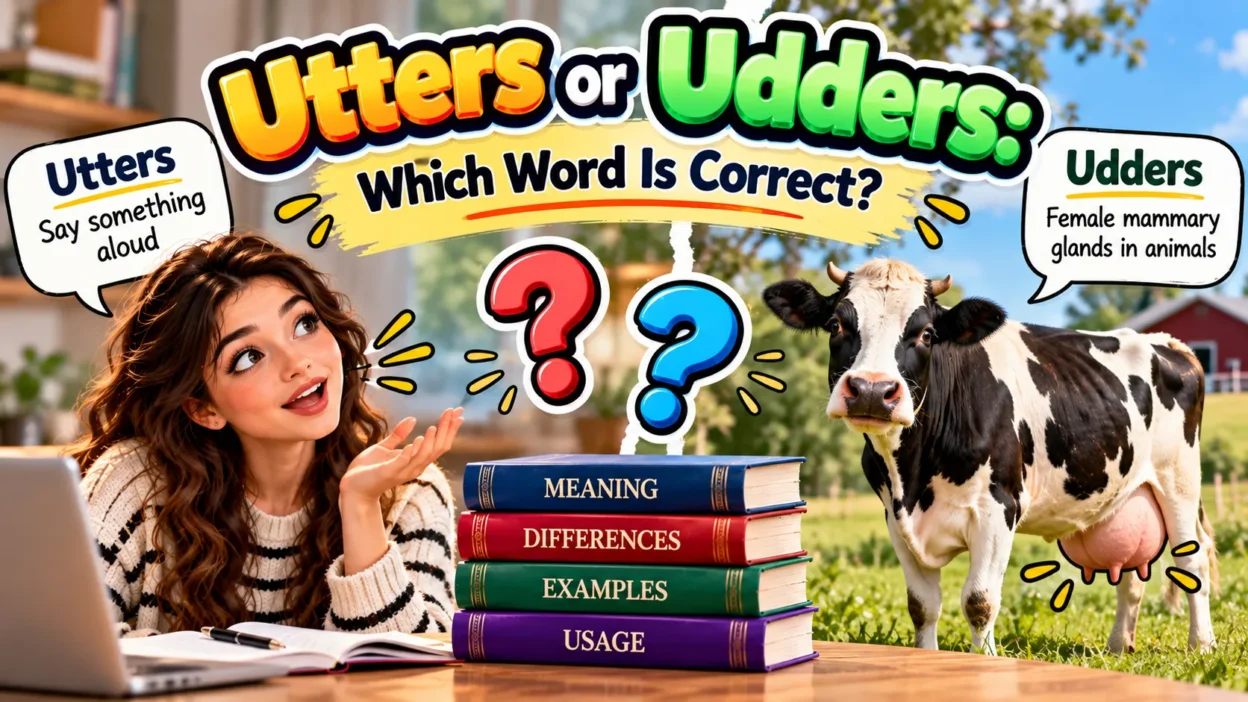
Have you ever wondered whether to write utters or udders? These words sound similar, but they have completely different meanings. Choosing the correct word depends on whether you are describing speech or referring to an animal’s milk-producing organ.
Utters is a verb that means to say, speak, or express something aloud. Udders is a plural noun referring to the milk-producing organs of certain mammals, such as cows and goats.
For example, you might write, “She utters a quiet apology,” or “The farmer checks the cow’s udders.” Both words are correct, but they cannot be used interchangeably.
In this guide, you will learn the difference between utters and udders, explore their definitions and pronunciation, see example sentences, and discover an easy trick to remember which word to use.
Utters vs. Udders: What Is the Difference?
The main difference between utters and udders is their meaning and grammatical function.
| Word | Part of Speech | Meaning | Example |
|---|---|---|---|
| Utters | Verb | Says or expresses something aloud | He utters a few words. |
| Udders | Plural noun | Milk-producing organs of certain mammals | The cows have healthy udders. |
Use utters when describing someone speaking or expressing a sound, word, or statement. Use udders when talking about the anatomical structures that produce and store milk in animals.
Quick examples
- Correct: The child utters a strange sound.
- Correct: The farmer examines the cow’s udders.
- Incorrect: The child udders a strange sound.
- Incorrect: The farmer examines the cow’s utters.
The words may sound alike, but their meanings make the correct choice clear.
What Does Utters Mean?
Utters is the third-person singular form of the verb utter. It means to say, speak, pronounce, or express something aloud.
Writers often use utters when describing spoken words, short statements, sounds, or emotional reactions. The word can sound more formal or dramatic than the everyday verb says.
Examples of utters in sentences
- She utters a quiet prayer before leaving home.
- He utters a few words of encouragement.
- The frightened child utters a small cry.
- The witness utters a warning during the emergency.
- The character utters a mysterious phrase.
- She rarely utters a complaint.
- He utters an apology after realizing his mistake.
- The speaker utters the final sentence with confidence.
In each example, utters refers to something spoken or expressed aloud.
Synonyms for utters
Depending on the context, possible synonyms include:
- Says
- Speaks
- Expresses
- Voices
- Pronounces
- States
- Declares
- Announces
- Exclaims
- Mumbles
- Whispers
- Shouts
These alternatives are not identical in every situation. For example, whispers describes speaking quietly, while announces suggests making information known.
What Does Udders Mean?
Udders is the plural form of udder. An udder is the milk-producing organ found in certain mammals, including cows and goats. It contains mammary glands that produce milk for their young and, in dairy farming, for collection.
An udder is made up of mammary tissue and associated structures. In cows, it has four quarters, each with its own teat.
Examples of udders in sentences
- The farmer checks the cows’ udders during routine care.
- The veterinarian examines the goat’s udders.
- Healthy udders are important for dairy production.
- The calves drink milk from their mothers’ udders.
- The farmer cleans the equipment used during milking.
- The veterinarian checks for signs of swelling or discomfort in the udder.
In these examples, udders refers to animal anatomy, not speech.
Animals that have udders
Udders are associated with several types of mammals, especially domesticated dairy animals.
- Cows
- Goats
- Sheep
- Buffaloes
The precise anatomy varies by species. For example, a cow’s udder has four quarters, while goats typically have two halves.
Utters or Udders: Pronunciation Difference
The words utters and udders are pronounced very similarly in many English accents. This similarity can make them confusing in conversation and spelling.
- Utters: Commonly pronounced “UT-erz.”
- Udders: Commonly pronounced “UD-erz.”
The first vowel and the middle consonant sound may differ slightly depending on the speaker’s accent. In many accents, the difference between the t in utters and the d in udders is subtle.
Because the words sound similar, focus on the meaning of the sentence rather than relying only on pronunciation.
Utters vs. Udders: Grammar and Word Forms
Understanding the grammatical role of each word makes it easier to use it correctly.
| Word Form | Meaning | Example |
|---|---|---|
| Utter | To say or express aloud | Please do not utter a threat. |
| Utters | Says or expresses aloud | She utters a short reply. |
| Uttered | Said or expressed aloud | He uttered a warning. |
| Uttering | Saying or expressing aloud | She is uttering a prayer. |
| Udder | The milk-producing organ of an animal | The cow’s udder is healthy. |
| Udders | More than one udder | The farmer examines several udders. |
Notice that utter can also function as an adjective meaning complete or absolute, as in “utter confusion.” However, utters in the comparison above is the verb form.
Common Mistakes When Using Utters and Udders
Because these words sound alike, writers sometimes mix them up. Here are a few mistakes to avoid.
Mistake 1: Using udders when you mean speaking
Incorrect: She udders a few words.
Correct: She utters a few words.
Why? The sentence describes speech, so the verb utters is required.
Mistake 2: Using utters when you mean animal anatomy
Incorrect: The farmer checks the cow’s utters.
Correct: The farmer checks the cow’s udder.
Why? The sentence refers to an animal’s milk-producing organ. Use udder for one and udders for more than one.
Mistake 3: Confusing singular and plural
Incorrect: The farmer examines several udder.
Correct: The farmer examines several udders.
Why? The word several requires a plural noun in this sentence.
Mistake 4: Choosing a word based only on sound
If you hear a sentence without seeing it written, the context can help you identify the correct word.
- “He utters a warning” refers to speech.
- “The cow’s udders are healthy” refers to animal anatomy.
Always consider what the sentence is describing.
Utters or Udders: More Example Sentences
The following examples show how to use both words naturally.
Sentences with utters
- The poet utters a line that inspires the audience.
- He utters a nervous laugh before the interview.
- She utters a few words of gratitude.
- The child utters a surprised gasp.
- The character utters a mysterious warning.
- The speaker utters the phrase slowly.
- He rarely utters an unkind word.
- She utters a heartfelt apology.
- The witness utters a statement in court.
- The singer utters the opening words softly.
Sentences with udders
- The farmer inspects the cow’s udders.
- The veterinarian examines the goat’s udder.
- The calves feed from their mothers’ udders.
- Proper milking practices help protect udder health.
- The dairy worker checks the animal for signs of discomfort.
- The sheep’s udder is examined during routine care.
- The veterinarian discusses udder health with the farmer.
- The farmer follows hygienic milking procedures.
- The cows are checked regularly for signs of illness.
- The dairy team monitors the animals’ health.
Easy Trick to Remember Utters vs. Udders
Use this simple memory trick:
Utters = words. Both utter and words relate to speaking or expressing something.
Udders = milk. An udder is a milk-producing organ found in certain mammals.
You can also remember the difference by asking yourself one question: Is the sentence about someone saying something, or is it about an animal?
- If it is about speaking, choose utters.
- If it is about animal anatomy, choose udders.
This quick check will help you avoid the most common spelling mistake.
Frequently Asked Questions
1. Is it utters or udders?
Both words are correct, but they have different meanings. Utters means says or expresses something aloud. Udders refers to the milk-producing organs of certain mammals.
2. What does utters mean?
Utters is the third-person singular form of utter, meaning to say, speak, or express something aloud. For example, “She utters a quiet prayer.”
3. What does udders mean?
Udders is the plural of udder, the milk-producing organ found in animals such as cows, goats, and sheep.
4. Are utters and udders pronounced the same?
They sound very similar in many English accents, but the first vowel and middle consonant can differ. Pronunciation varies by region, so sentence context is often the easiest way to distinguish them.
5. What is the singular form of udders?
The singular form is udder. For example, “The cow’s udder is healthy.”
6. What is the past tense of utter?
The past tense is uttered. For example, “He uttered a warning before leaving.”
7. Can utter be an adjective?
Yes. Utter can be an adjective meaning complete or absolute, as in “utter silence” or “utter confusion.” In the phrase “she utters a sentence,” however, it is a verb.
8. Which word should I use when describing a cow?
Use udder for one milk-producing organ and udders when referring to multiple animals’ udders. For example, “The farmer checks the cows’ udders.”
Conclusion
The difference between utters and udders comes down to meaning. Utters is a verb that describes saying or expressing something aloud, while udders is the plural noun for the milk-producing organs of certain mammals.
Remember the simple rule: utters means speaking, while udders means milk-producing organs. Once you understand this distinction, choosing the correct word becomes easy.

Miles Ellington enjoys exploring the subtle differences that can completely change how a word or phrase is understood. At Differology, he turns confusing language questions into straightforward explanations, covering word comparisons, vocabulary, grammar, usage, and everyday English.
With a practical and reader-focused approach, Miles uses real-world examples and clear comparisons to help readers choose the right word, understand its meaning, and communicate more precisely.